Reviving the BBC Domesday Project
Matt Holder discovers how the BBC’s Domesday Project was nearly lost to recent history and how a group of volunteers are bringing it back to life.
DOMESDAY86
Credit: www.domesday86.com
OUR EXPERT
Matt Holder has worked in IT support for over a decade and always tries to utilise Linux alongside the other installed systems.
The Domesday Book is an incredible piece of British history, compiled between 1085 and T 1086 as a record of the Great Survey ordered by King William I. It covered land usage and money owed to the king. Much of England and parts of Wales were surveyed. The book survives today and is stored at the National Archives at Kew Gardens.
What does this have to do with us computer lovers? Well, during the ’80s, the BBC launched a project to mark the 900th anniversary of the book, because part of the BBC’s remit is not only to broadcast TV programmes, but also to educate viewers. The project aimed to be a survey of sorts about the whole of the United Kingdom, with much of the information produced by school children.
The BBC, Acorn, Phillips and Logica worked together on the project because some serious (for the time) hardware and data storage was needed.
Dredging his memory, this writer still remembers a day in year five of primary school when a trolley was wheeled into the classroom. On this trolley was a BBC Master AIV, a monitor, which was pretty much the shape of a perfect cube, a LaserDisc player and a trackerball. The trackerball was used to navigate around the software’s interface, which seemed positively space-age at the time. From the front of the classroom, Mr L announced that the day’s lesson would encompass a demonstration of the Domesday software, presumably loaned by the local council. A giant silver-coloured disc was then taken from its protective case and loaded into the player.
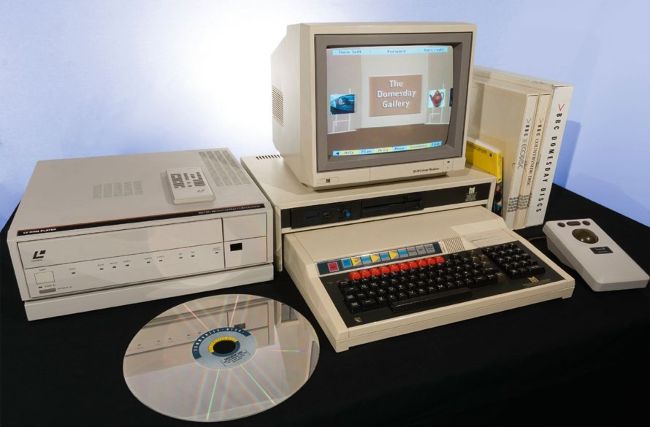
The complete Domesday system setup.
CREDIT: Domesday86 Project
Laser trailblazer
LaserDiscs were 12 inches in diameter and stored analogue video and digital or analogue sound. Depending on the method used, disks could hold between 30 and 36 minutes, or between 60 and 64 minutes of video per side, in a quality higher than that offered by VHS or Betamax. The discs were read by a laser (much like a CD or DVD) and the information was encoded using frequency modulation – think of FM radio as a comparison. Using various techniques, features such as slow motion and freeze frame were made available to the user. LaserDisc was more popular in Japan than Europe and the US. Lessons were learned and CD, DVD and Blu-ray all built upon what was used for LaserDisc.
The BBC Micro and Master computers were a collaboration between Acorn and the BBC, and worked alongside a set of TV programmes and resources, set around educating the public about computing. For the time, these devices were incredibly customisable, with expansion slots being available for usage. For the Domesday Project, the BBC Master was fitted with a SCSI interface and a second processor, which was primarily used to control the LaserDisc player. The software was written in BCPL, which was a precursor language to C. The choice seems to have been to enable the software to run on multiple architectures. Sadly the lack of popularity meant that ports were not readily made, but there was a version that ran on the RM Nimbus x86 computer.