GB
  
You are currently viewing the United Kingdom version of the site.
Would you like to switch to your local site?
16 MIN READ TIME

Reviving the BBC Domesday Project

Matt Holder discovers how the BBC’s Domesday Project was nearly lost to recent history and how a group of volunteers are bringing it back to life.

DOMESDAY86

Credit: www.domesday86.com

OUR EXPERT

Matt Holder has worked in IT support for over a decade and always tries to utilise Linux alongside the other installed systems.

The Domesday Book is an incredible piece of British history, compiled between 1085 and T 1086 as a record of the Great Survey ordered by King William I. It covered land usage and money owed to the king. Much of England and parts of Wales were surveyed. The book survives today and is stored at the National Archives at Kew Gardens.

What does this have to do with us computer lovers? Well, during the ’80s, the BBC launched a project to mark the 900th anniversary of the book, because part of the BBC’s remit is not only to broadcast TV programmes, but also to educate viewers. The project aimed to be a survey of sorts about the whole of the United Kingdom, with much of the information produced by school children.

The BBC, Acorn, Phillips and Logica worked together on the project because some serious (for the time) hardware and data storage was needed.

Dredging his memory, this writer still remembers a day in year five of primary school when a trolley was wheeled into the classroom. On this trolley was a BBC Master AIV, a monitor, which was pretty much the shape of a perfect cube, a LaserDisc player and a trackerball. The trackerball was used to navigate around the software’s interface, which seemed positively space-age at the time. From the front of the classroom, Mr L announced that the day’s lesson would encompass a demonstration of the Domesday software, presumably loaned by the local council. A giant silver-coloured disc was then taken from its protective case and loaded into the player.
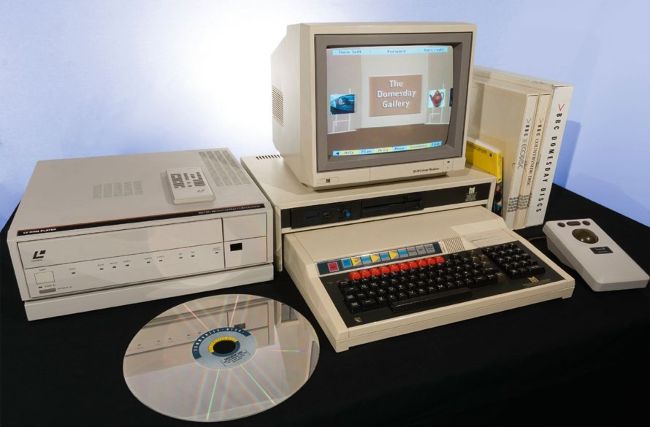
The complete Domesday system setup.
CREDIT: Domesday86 Project

Laser trailblazer

LaserDiscs were 12 inches in diameter and stored analogue video and digital or analogue sound. Depending on the method used, disks could hold between 30 and 36 minutes, or between 60 and 64 minutes of video per side, in a quality higher than that offered by VHS or Betamax. The discs were read by a laser (much like a CD or DVD) and the information was encoded using frequency modulation – think of FM radio as a comparison. Using various techniques, features such as slow motion and freeze frame were made available to the user. LaserDisc was more popular in Japan than Europe and the US. Lessons were learned and CD, DVD and Blu-ray all built upon what was used for LaserDisc.

The BBC Micro and Master computers were a collaboration between Acorn and the BBC, and worked alongside a set of TV programmes and resources, set around educating the public about computing. For the time, these devices were incredibly customisable, with expansion slots being available for usage. For the Domesday Project, the BBC Master was fitted with a SCSI interface and a second processor, which was primarily used to control the LaserDisc player. The software was written in BCPL, which was a precursor language to C. The choice seems to have been to enable the software to run on multiple architectures. Sadly the lack of popularity meant that ports were not readily made, but there was a version that ran on the RM Nimbus x86 computer.

Unlock this article and much more with
You can enjoy:
Enjoy this edition in full
Instant access to 600+ titles
Thousands of back issues
No contract or commitment
Try for 99p
SUBSCRIBE NOW
30 day trial, then just £9.99 / month. Cancel anytime. New subscribers only.


Learn more
Pocketmags Plus
Pocketmags Plus

This article is from...


View Issues
Linux Format
November 2023
VIEW IN STORE

Other Articles in this Issue


LINUX FORMAT
LINUX FORMAT
The #1 open source mag
WELCOME
MEET THE TEAM
This issue, we’re setting up a Jellyfin media server – that was Neil’s first ever Linux-based project. What first got you installing Linux back in the day?
At your service
I recently expanded my home server’s RAID to
REGULARS AT A GLANCE
Free Software Foundation celebrates GNU at 40
Since 1983, GNU has formed the backbone of key computer systems. The FSF reflects on all that’s great about copyleft and free software.
Gnome 45 is coming
Gnome 45 ‘Rīga’ focuses on improved performance plus overhauling windows and file management.
From Terraform to OpenTofu
OpenTofu is now overseen by the Linux Foundation.
TOFU FOR ALL!
Joe Brockmeier is head of community, Percona. “
CODEC COUP
Benjamin Gaignard is a senior software engineer at
Download manager was trojaned
Team issues script to check if Linux systems have been compromised.
Millions of LibreOffice!
The LibreOffice suite soars in popularity.
AV1 decoder
Kernel support for AV1 uAPI and stateless video decoders.
Distro watch
What’s behind the free software sofa?
SECURITY FIRST
Italo Vignoli is one of the LibreOffice and
MAC MAGIC
Jon Masters is a kernel hacker who’s been
Kernel Watch
Jon Masters keeps up with all the latest happenings in the Linux kernel, so you don’t have to.
ONGOING DEVELOPMENT
RISC-V patches include an updated (version 9) series
Answers
Got a burning question about open source or the kernel? Whatever your level, email it to answers@linuxformat.com
Mailserver
WRITE TO US Do you have a burning
LETTER OF THE MONTH
FOCAL point
Xournal++
HANDWRITTEN NOTES
Parallel Disk Usage
Version: 0.9.0 Web: https://crates.io/crates/parallel-disk-usage Linux has
Mission Center
Version: 0.3.1 Web: https://missioncenter.io System admins go
Floorp
Version: 11.1.2 Web: https://floorp.app F irefox
Ferdium
Version: 6.4.1 Web: https://ferdium.org The idea
HopToDesk
Version: 1.40.5 Web: www.hoptodesk.com There are
Touché
Version: 2.0.9 Web: https://github . com/JoseExposito/touche If
Sonic Robo Blast 2
SRB2 lets you relive the original, and playing
Fheroes2
Version: 1.0.7 Web: https://ihhub.github.io/fheroes2 Another classic
Ulauncher
Version: 5.15.3 Web: https://ulauncher.io The search
AlbumEasy
Version: 4.5.0 Web: www.thestampweb.com/albumeasy If you
REVIEWS
Seagate FireCuda 540
Chris Szewczyk finds high performance and peace of mind. At a price.
AMD Radeon RX 7800 XT
Introducing a multi-chip RX 6800 XT for less – and Dave James thinks that it’s actually the best £500 GPU around.
Qubes 4.1.2
Nate Drake explores the apex of Linux security: an OS that divides all your apps into colour-coded, isolated virtual machines.
Mageia 9
Nate Drake visits the spiritual successor to Mandriva Linux and comes away enchanted.
Ubuntu 23.10
Nate Drake dives into the labyrinth and finds Canonical has released another solid offering with its Mantic Minotaur iteration of Ubuntu.
Old World
A 4X (Explore, Expand, Exploit and Exterminate) game? Management is all ears and demands Fraser Brown plays it.
Fediverse servers
Looking to create your own online community? The fediverse is for you. David Rutland tests the best self-hosted fediverse servers available.
Ease of deployment
How quickly can you set up a server?
Hardware requirements
Will it run on your old box?
Customising and special features
What is it that makes these fediverse server types stand out above the rest?
Customisation options
Make your instance truly unique.
Fediverse to go
Social media lives in the palm of your hand.
Moderation and safety
No one wants a server full of filth.
Holding a conversation
Talking is the best way to be social.
The Verdict
Fediverse servers
STREAMING MADE EASY!
Bring together all your film, TV, music, audiobook and photo streaming needs under one roof. Nick Peers shows you how.
Install Jellyfin
Get set up and ensure your media files are organised correctly.
Stream films, TV and music
Jellyfin can cover almost all of your media streaming needs…
Back up and view photos and videos
Ditch the expensive subscription and back up (and stream) photos locally.
Stream audiobooks from your server
Why pay for Audible when you can host your own collection?
Pi USER
Astro Pi Mission Zero blasts off into 2024!
Go out of this world and enter the new competition for young coders that’s now on!
Pi-almOS PDA
Alive once more!
The Pi Beret!
Adafruit EYESPI Pi.
RASPBERRY PI STILL RULES
Les Pounder works with groups such as the
Raspberry Pi 5
The first new flagship in four years has Les Pounder and Avram Piltch fighting over who gets first dibs on the latest SBC.
Play Steam games on your Raspberry Pi
Les Pounder has just had his living room redecorated after a nasty flood – what better way to celebrate than by shooting aliens?
IN DEPTH
A BIG BANG!
Matt Holder discovers what System76’s Cosmic desktop and Pop!_OS distribution have to offer.
TUTORIALS
Fast file management
Shashank Sharma may be a gamophobe but he has no fear in admitting his commitment to the CLI thanks to the many wonderful tools on offer.
Take command of your photo collection
Nick Peers reveals how to organise your photos, plus improve, repair and enhance them – all with a single tool.
Twenty years of WordPress websites!
In the first part of this new series, Michael Reed takes a look at what the content management system WordPress can serve up.
How to enjoy free streaming TV
Perfect your media server install by adding your own bespoke collection of streaming TV channels. Neil Mohr is your channel-hopping guide.
COBOL: still going after all these years
It might have appeared back in 1959 and look odd compared to today’s languages, but COBOL is still fuelling business, Mike Bedford reports.
ADMINISTERIA
ORANGE VS RED
Stuart Burns is a Linux administrator for a
Red Hat says no more Screen time for you!
With the end of Screen in sight, it’s time to use Tmux. Our man in the bowels of the server room explains.
Beware of geeks bearing gifts
We’re still trying to work out why you need a download manager anyway…
Seek and ye shall locate
How to find files in Linux using Find, Locate and Grep…
NordVPN
Mike Williams puts one of the big-name VPNs under his microscope.
Cargo
A website builder with a user-friendly interface and customisable features – Ruby P Jane is suitably impressed.
Seventh level of networking
Understanding networking needn’t be hell. Darien Graham-Smith takes us through the ISO OSI model that runs it all!
CODING ACADEMY
Visualise smart- home sensor data
Matt Holder investigates how to take data from an API and display it in a home-built interface.
Write GUI apps in Pascal with Lazarus
David Bolton explains how to get started with Lazarus and Free Pascal to develop GUI applications running on Linux.
Chat
X
Pocketmags Support