Fabric Focus
Narrative thread
TEXTILE TALES
With their scenic vignettes, the fabric designs widely referred to as toile de Jouy are filled with hidden stories and offer a print style that continues to be reimagined for interiors today
FEATURE KERRYN HARPER-CUSS
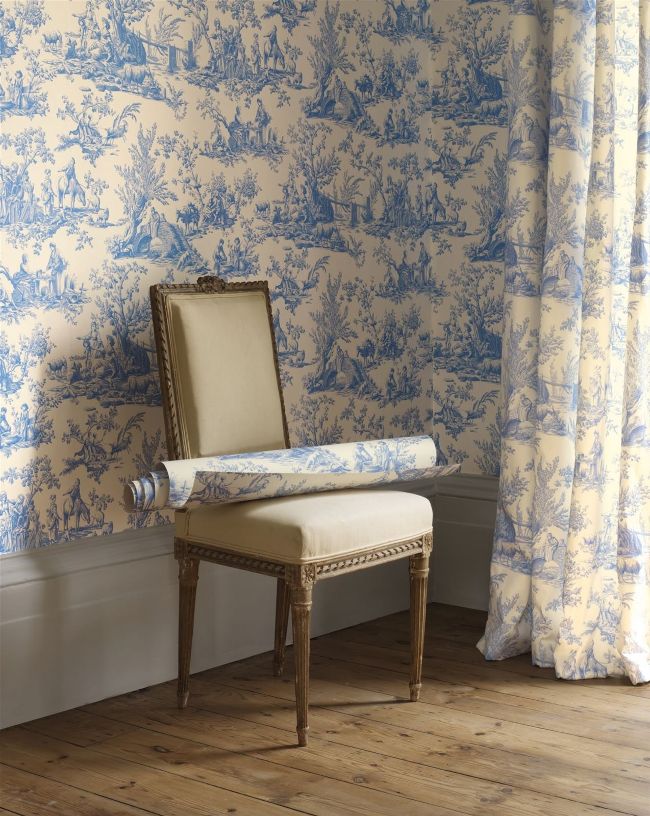
Depicting villagers enjoying rural pursuits, Bellegarde, shown in bleu, is designed in the style of an 18th-century pastoral toile. Curtain £112 per metre; wallpaper £94 per roll, Manuel Canovas
The practice of ‘setting the scene’ is common in interior design. We all understand that thoughtful use of colour and pattern helps build a subtle narrative; this is not a modern phenomenon – in 18th- and 19th-century Europe, a vogue for textiles printed with scenic vignettes became popular as a way to capture stories and add decorative intrigue to homes as well as clothing.
The most recognised modern reproductions tend to focus on monotone prints featuring pastoral motifs, often on a plain – usually white or off-white – cloth or toile. Original designs, however, were as likely to depict political or social events, mythological fables, popular literature and even war scenes alongside representations of idealised rural life. The earliest designs were relief printed with handheld wooden blocks; by the 1750s, innovations in copperplate printing had advanced so that fabric and paper could be printed by being pressed onto inked, flat panels of embellished copper. The fineness of detail that could be etched and engraved into copper plates elevated the sophistication of the images and the crispness of design, and also the demand from those in the upper classes who could afford them.