GB
  
You are currently viewing the United Kingdom version of the site.
Would you like to switch to your local site?
13 MIN READ TIME

GUILT

Michael Breslin considers the place of guilt in a healthy personality.
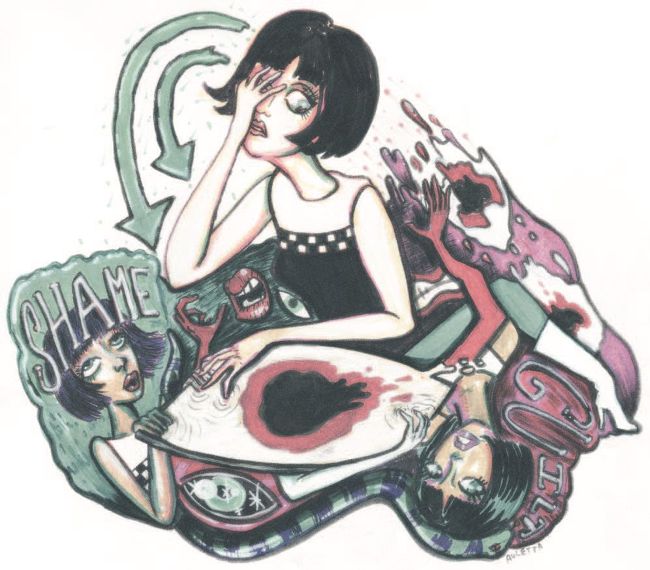
The Many Faces of Guilt by Susan Auletta
© SUSAN AULETTA 2025 PLEASE VISIT INSTAGRAM.COM/SM_AULETTA/

The goal of this article is to demonstrate the place of guilt in a healthy personality. First what do we mean by a ‘healthy personality’ and ‘guilt’. According to Sydney M. Jourard and Ted Landsman inHealthy Personality(1980), “the term healthy personality is used to describe those ways of being that surpass the average in actualization of self and in compassionate relationships with others.” I would add that a healthy personality requires being responsible enough to make decisions about the direction of one’s life, and having the courage to live with the consequences of one’s choices and actions. Guilt, meanwhile, is “the experience of self-loathing that arises when a person transgresses [their] own moral principles” (Ibid, p.130).

By this definition, the feeling of guilt is unique to human beings, as animals do not have moral principles that they might loath themselves for transgressing. It is an important, if not vital, emotion, and is essential in the formation of ourselves. Willard Gaylin, MD, expresses the importance of guilt in his book, Feelings: Our Vital Signs (1979): He says that guilt “is the emotion that shapes so much of our goodness and generosity. It signals us when we have transgressed from codes of behavior which we personally want to sustain. Feeling guilty informs us that we have failed our own ideals… Guilt is a form of self-disappointment. It is the sense of anguish that we did not achieve our standards of what we could be ” (p.52).

So one experiences the feeling of guilt when one fails to live up to one’s own ideal expectations. In this sense, guilt serves as an indicator of how someone can become more: it helps determine what needs to be corrected in the self so that the person might continue in the process of attaining a healthy personality.

Guilt & Shame

It is important to distinguish guilt from another emotion often confused with it: shame. The feelings are similar in that they serve as guides for acceptable and non-acceptable behavior for the individual. However, they differ in an important aspect. Whereas guilt is an internalized and personal feeling, shame occurs when one’s wrongdoing becomes publicly known. Gaylin explains the distinction between guilt and shame in this way:

“Both facilitate the socially acceptable behavior required for group living, both deal with transgression and wrongdoing against codes of conduct and are supporting pillars of the social structure. But whereas guilt is the most inner-directed of emotions, shame incorporates the community, the group, the other, directly into the feelings” (p.56).

Unlock this article and much more with
You can enjoy:
Enjoy this edition in full
Instant access to 600+ titles
Thousands of back issues
No contract or commitment
Try for 99p
SUBSCRIBE NOW
30 day trial, then just £9.99 / month. Cancel anytime. New subscribers only.


Learn more
Pocketmags Plus
Pocketmags Plus

This article is from...


View Issues
Philosophy Now
April/May 2025
VIEW IN STORE

Other Articles in this Issue


Editorial
Being Human
“Unhand me, grey-beard loon.” I n a clearing
Philosophy Now
Contributors
Vikky Leaney Vikky Leaney is currently writing up
Editorial & News
News
Sandra G. Harding has died Prominent feminist and
Philosophy Shorts
‘More songs about Buildings and Food’ was the
The Human Experience
What Does it Mean to be Human?
Vikas Beniwal considers some philosophers’ core understandings.
Empathy & Sympathy
James R. Robinson asks, how do they relate, and how do they differ?
EXISTENTIAL COMICS
A comic by Corey Mohler about the inevitable anguish of living a brief life in an absurd world.
Philosophical Haiku
Pyotr Kropotkin (1842–1921)
Love Letter
Nigel Rapport steps towards a cosmopolitan love.
Hope: Blessing or Curse?
John Creigan considers whether hope helps us thrive or holds us back.
General Articles
The Philosophy of Pain
Vikky Leaney says pain is a problem even (or especially) when we can’t see it.
Restoring Our Humanity with John Macmurray
Colin Stott contemplates Macmurray’s reunifying thinking.
The Importance of Nature for Thought
Gerardo Posada considers some of the philosophical benefits of green spaces.
Fun, Poetry & Fiction
Mostafa Mohaghegh Damad
Mostafa Mohaghegh Damad PHOTO © SHIASUN 2017
Kant Have Cake and Eat It Too! Ethics Hotline
ETHICS HOTLINE © JUNIO BROWNING 2025
One More
There is a moral dilemma in store for J.C. Michaels
Non-Western Philosophy
Karma & Human Freedom
Utkarsh Chawla tells us why we’re in the moral Goldilocks zone.
Indigenous Australian Philosophy
Ross Naidoo looks at Indigenous thinking through a philosophical lens.
Australian Indigenous Philosophy
As the traditions of Australia’s Indigenous peoples developed
Regulars
Paulo Freire (1921–1997)
Bruno de Oliveira follows a philosopher of liberation through education.
Letters
When inspiration strikes, don’t bottle it up. Email me at rick.lewis@philosophynow.org Keep them short and keep them coming!
The Goal of Life is Happiness
Massimo Pigliucci surveys the views of ancient schools.
A Lifelong Preoccupation
Raymond Tallis recalls a life trying to fathom the chasm between mind and brain.
Question of the Month
Is Morality Objective Or Subjective?
Reviews
Books
Rick Lewis reviews Raymond Tallis’s latest book, Artur Szutta explores inner space with James Tartaglia , and Lucy Weir thinks about climate ethics with Robin Attfield.
Books
My Mind & My Thoughts (detail) by
Books
ROBIN ATTFIELD, AN Emeritus Professor of Philosophy at
God’s Silence on TV
Hugh Hamilton looks at how God is presented. Spoilers for the shows Lucifer , Preacher and Supernatural ahead.
Chat
X
Pocketmags Support