Interview
Steven Pinker
is the Johnstone Family Professor of Psychology at Harvard University, and a popular writer on linguistics and evolutionary psychology. Angela Tan interviews him about politics, language, death, and reasons to be optimistic.
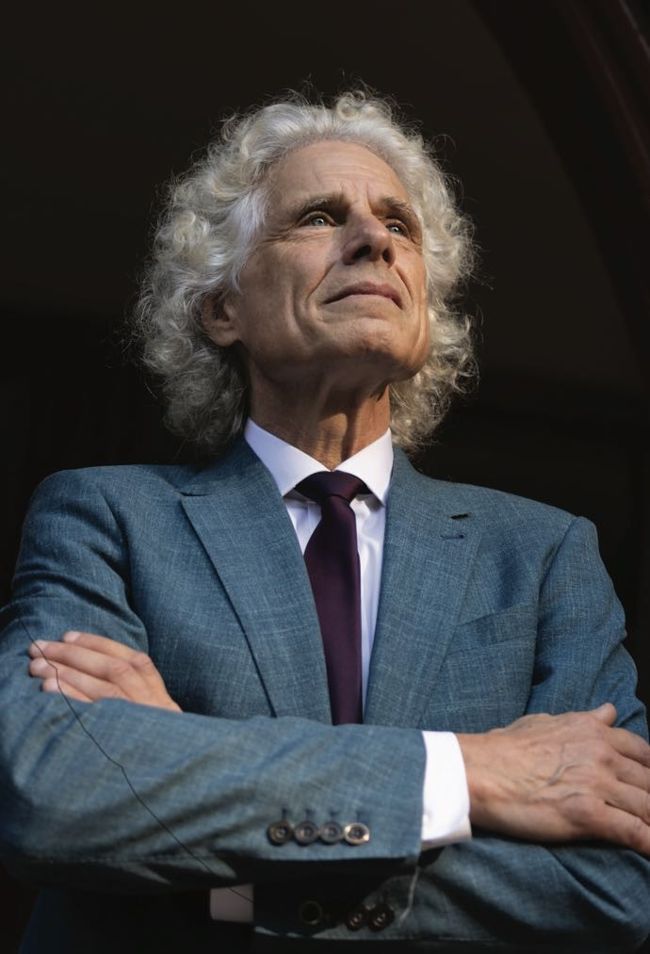
PHOTO © CHRISTOPHER MICHEL CMICHEL67 CREATIVE COMMONS LICENCE 4.0
Hello Professor Pinker. In your book, The Better Angels of Our Nature (2011), you discuss the decline of violence and how, despite appearances otherwise, our own era is by far the most peaceful in human existence. Are there unconscious biases we hold as a society that prevent our seeing a decline in violence? It’s hard to make a generalization about a whole society. But you certainly can talk about the beliefs of an individual, and there are a number of cognitive biases that get in the way of our individually appreciating the ways in which violence has declined. In particular, there’s an interaction between a cognitive bias which Amos Tversky and Daniel Kahneman dubbed the availability bias, where we use images, narratives, and stereotypes from memory as a guide to estimating the probability and frequency of risk. Are you in danger of getting eaten by a shark if you go into the ocean? Well, if you can remember a shark attack from last year at that beach, you’re gonna stay out of the water, even if statistically you’re in greater danger of dying in a car accident when driving to the beach. There are a lot of distortions of risk that come from reliance on anecdotes. Then, when you think that the news is a nonrandom sample of the most dramatic, usually the worst things, happening on Earth at any given moment, there’s going to naturally be a tendency, given the availability bias, to think that the state of the world is described by the worst things happening at any given time. So while there certainly are disasters – and at this moment you and I are living through one in Ukraine, and one in Israel and Gaza, together with civil war in Ethiopia and Sudan – we tend not to think about the parts of the world that are at peace that used to be at war, such as Latin America. And there are no wars between countries in Southeast Asia. But we tend to overestimate the prevalence of war and violence based on a combination of what the news gives us and what the human mind latches onto. It’s only when you see the data and plot the number of deaths from war, from homicide, the amount of racism, and the amount of domestic violence, over time, that you can see whether violence really has increased or not. I argue in The Better Angels of Our Nature that when you look at those data, it is often surprising how many of them have decreased, despite the impressions we get from the media.