News & Views
A unique survivor
► Featuring stories this month about the lifestyle of the most menacing of all reptiles, how scientists are seeking to gain a better insight into the remarkable journey of the monarch butterfly, the work of the egg detectives, critically endangered species in the Pacific region and more, including how it now appears that the immune system of amphibians is contributing to their demise, and starting here with new insights into the tuatara and its origins. Compiled by G. Valentine.
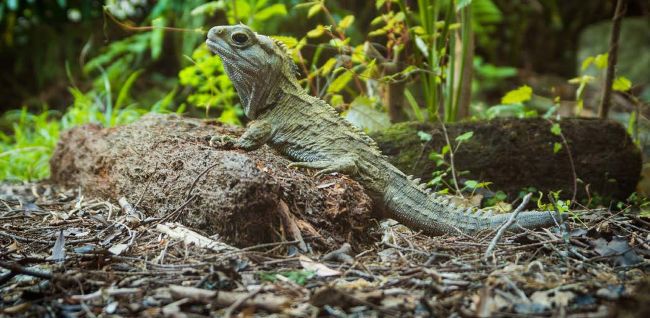
Today’s tuataras have existed unchanged since the age of the dinosaurs. Photo courtesy Ross Gordon Henry/
www.shutterstock.com The tuatara (Sphenodon punctatus) may look rather like a lizard, but in fact, it is the sole survivor of a totally separate ancient reptilian order, whose distribution today is confined to New Zealand. It hasn’t changed much since it first lived alongside the dinosaurs between 150-250 million years ago.
One of its most remarkable features is the fact that individuals can live for over a century. An international team of researchers in partnership with Māori tribe Ngātiwai have now sequenced, assembled and analysed the tuatara’s complete genetic body plan or genome for the first time.