GB
  
You are currently viewing the United Kingdom version of the site.
Would you like to switch to your local site?
6 MIN READ TIME

Starting out with STICK INSECTS

Ranking as experts in animal camouflage, stick insects are pets which will not disturb anyone, but that doesn’t mean they’re boring, as David Alderton explains.
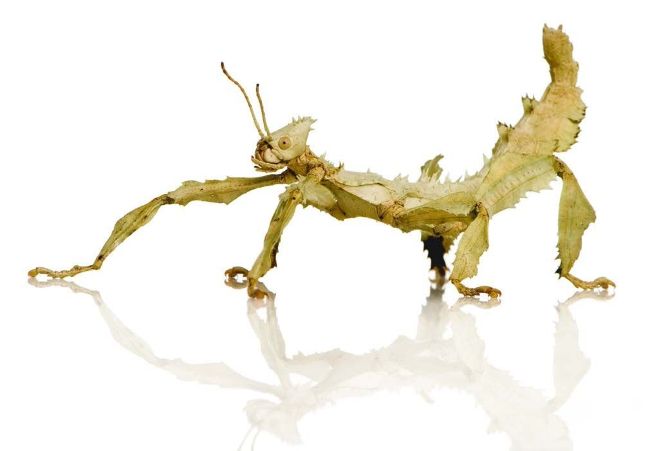
Even the head of these stick insects is well-camouflaged.

Saving time and trouble

Rather than having to cut fresh brambles every day, which can become hard to find during the winter months in any case, the simplest solution is to stand stems in a container of water, stuffing the neck here with tinfoil to stop any young stick insects falling in and drowning. The bramble can then be changed when it starts to shrivel up or once its leaves have been chewed away by the stick insects.

If you’re looking for a pet for children, which can be maintained easily and cheaply, then consider stick insects, particularly the Indian or laboratory stick insect (Carausius morosus). This is the most commonlykept species and is very easy to cater for, although it is important to bear in mind that these stick insects can reach a length of 15cm (6in) when adult, and so they need reasonably spacious surroundings as they grow larger.

Young hatchlings, however, can be kept in smaller sizes of plastic containers with ventilated hoods, provided that they cannot slip out through gaps in the roof of the vivarium, as they are very agile at this stage. Even a converted sweet jar can be used for this purpose. Wrapping a layer of fine black cloth over the top will serve to keep the stick insects adequately confined within.

Read the complete article and many more in this issue of Practical Reptile Keeping
Purchase options below
If you own the issue, Login to read the full article now.
Single Digital Issue Issue 131
 
£3.99 / issue
This issue and other back issues are not included in a new subscription. Subscriptions include the latest regular issue and new issues released during your subscription. Practical Reptile Keeping
Annual Digital Subscription £32.99 billed annually
Save
31%
£2.75 / issue
6 Month Digital Subscription £17.99 billed twice a year
Save
25%
£3.00 / issue
PRINT SUBSCRIPTION? Available at magazine.co.uk, the best magazine subscription offers online.
 

This article is from...


View Issues
Practical Reptile Keeping
Issue 131
VIEW IN STORE

Other Articles in this Issue


Practical Reptile Keeping
Welcome
As the challenge of coronavirus continues to play out
Regulars
Rediscovery of a lost chameleon
Featuring stories about the rare hatching of twin snakes by a UK breeder, unexpected sea turtle breeding patterns this year, new insights into the development of the crocodile lineage, beetles that cultivate fungus as food, an overlooked pterodactyl, a South America frog which may have been successfully rescued from the brink of extinction and more, starting here with the remarkable rediscovery of a chameleon that hadn’t been sighted officially for over a century.
STRANGE SEA TURTLE NUMBERS
Florida’s sea turtle nesting survey came to a close
Tadpoles offer hope for a critically endangered species
Nearly 200 Loa water frog (Telmatobius dankoi) tadpoles
New insights into crocodile evolution
Scientists probing a prehistoric crocodile group’s
Slingshot amphibians
Fossils of bizarre, armoured amphibians known as albanerpetontids
Unexpected twins
Snake-breeder Dean Reddy got more than he bargained
REPTILE FOCUS
Four-toed worm lizard - Bipes canaliculatus
FLIGHTS OF FANCY?
Could pterosaurs (also known as pterodactyls) - flying reptiles that lived at the time of the dinosaurs - still exist? Dr Karl Shuker focuses on some interesting reports from the Americas and Australasia.
YOU & YOUR Reptiles
If you have a favourite photograph of one of your reptiles
.Next issue.
John Courteney-Smith MRSB looks at recent advances
News & Views
Amazing beetles
Ambrosia beetles belong to the bark beetle family
NEW PTEROSAUR FOUND
Palaeontologists have made an amazing discovery while
How amphibians breathe
There’s a key thing that links virtually all living organisms on Earth, and that is the need for oxygen. However, while in many animals, absorbing it into their bodies is a simple process, the same cannot be said for the amphibians, which have therefore evolved some rather intriguing ways of breathing. Paul Donovan reports.
Lighting concerns
Email your queries to practicalreptilekeeping@gmail.com.
Features
Insights into the leopard gecko
John Courteney-Smith MRSB of Arcadia Reptile continues his in-depth series examining what we know about the universally popular leopard gecko from the wild, and how this information can be best utilised to care for these lizards in vivarium surroundings.
Ten benefits of keeping reptiles, in terms of our wellbeing
In these difficult times, people are focusing more on their pets than ever before, as we almost subconsciously identify the benefits that pets bring to our daily lives. Here Dr Margit Gabriele Muller, Dr Med Vet, MRCVS, MBA examines ten of the specific benefits that keeping reptiles offer to us, when it comes to assisting our wellbeing.
Reptile skin and its care
Considerable research has been carried out into maintaining the health of various reptilian body systems, including the respiratory, digestive, metabolic and reproductive systems. Yet the body’s largest and most vitally important organ - providing the front-line in the battle against infection - is often surprisingly overlooked. This is the skin, as Hannah Salisbury MSc BSc (Hons) AnSci explains.
Chat
X
Pocketmags Support