In Ascendia
When Porcupine Tree released In Absentia in 2002, it represented not only a dramatic shift in the band’s sound but it also marked the start of a new era in modern progressive music and inspired a generation of heavy artists. Following on from Kscope’s deluxe reissue, Prog takes a more detailed look at the album that Steven Wilson describes as “the beginning of the end”.
Words: Dave Everley Images: Lasse Hoile
As Steven Wilson looks out over the floor of the Middle East Club in Cambridge, Massachusetts from the stage, he can’t help feeling a little depressed. Thirty pairs of eyes stare back at him. This the sum total of people who’ve turned up to see him and his band Porcupine Tree play this hip East Coast club… It’s Monday, July 22, 2002, and this is supposed to be a tipping point for Porcupine Tree. Over the last decade, these British oddballs have existed on the fringes, becoming a rallying point for anyone with an interest in shape-shifting, vaguely psychedelic sounds without ever quite extending beyond cultdom.
But recently, things have changed. In a fairly astonishing turn of events, Porcupine Tree have been signed by Lava Records, a subsidiary of music industry powerhouse Atlantic. They have suddenly found themselves on the same label as rap-metal superstar Kid Rock and platinum-dusted MORgrungers Matchbox Twenty.
“It opened up a whole new audience for them, and it helped open up a whole new audience for progressive rock. You suddenly heard a lot of bands who sounded like them.”
Mikael Akerfeldt
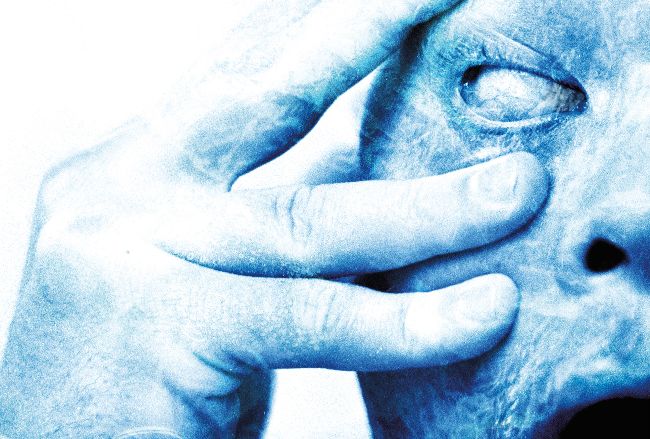
Lasse Hoile’s In Absentia cover.
The dream Porcupine Tree have been sold is that their new album, In Absentia, will push them to the next level. If it succeeds, Wilson and his bandmates will be sipping cocktails around guitar-shaped swimming pools in newly purchased Beverley Hills homes. But all that looks to be a long way away on this Monday night at the Middle East Club in Cambridge, Massachusetts.
“You suddenly realise that you’re facing an uphill battle trying to convince a lot of people who don’t know you to start caring about you,” says Wilson today. “That’s not just the fans but it’s partly the industry too.”
In Absentia would be released two months later, the first of two albums Porcupine Tree made during their dalliance with the majors. In music industry terms it was a flop, even though it outsold all of the band’s previous releases by a wide margin. It certainly never bagged them any guitar-shaped swimming pools. Yet at the same time it reshaped the band entirely, opening them up to a new audience, and by extension ushering in a brand new era for progressive music.
Almost 20 years on, In Absentia stands as a landmark. It was the first great progressive rock album of the 21st century, one whose marriage of musicianship, melody and heaviness shaped so much that followed. But it would also set its creators on a path that would see their leader dissolving them less than a decade later. In Absentia was a game-changer for Porcupine Tree, but it would ultimately herald the beginning of the end for modern prog’s greatest band.
Eighteen months before he began working with them, Gavin Harrison saw Porcupine Tree at Shepherd’s Bush Empire in west London. Harrison had carved out a career as an in-demand session drummer, playing with everyone from Level 42 to Iggy Pop. In 1995, he had appeared on a solo album by former Japan and current Porcupine Tree keyboard player Richard Barbieri, and it was Barbieri who invited Harrison along to the Empire half a decade later to see his current band.
“I was impressed that they could get so many people in the room playing very uncommercial music,” says Harrison, though he was less impressed with what he saw. “After about an hour, I thought, [noncommittally] ‘That’s it, I’ve heard enough.’ I sent Richard a message saying I wasn’t feeling well.”
Steven Wilson was experiencing a different set of emotions, chiefly frustration. Porcupine Tree were essentially a one-man bedroom project that had grown massively out of hand. By the mid-90s they had turned into a proper band; by the end of the decade Wilson had reined in his more amorphous tendencies in favour of a concise approach that veered towards the pop. The albums Stupid Dream and Lightbulb Sun, released in 1999 and 2000 respectively, were packed with hooks and choruses and conventional song structures. This was as radio-ready as Porcupine Tree had ever got.