Aphrodite’s Child 666
What began as the band’s enjoyment of late-60s freedom ended in an apocalyptic musical maelstrom that fired the imagination of Salvador Dalí. In an article that originally appeared in Prog 10, we explore the story behind Aphrodite’s Child’s 666.
Words: Rob Hughes
Salvador Dalí was no stranger to the bizarre. The Spanish painter and self-appointed genius once appeared on the Tonight Show carrying a leather rhinoceros. Grasshoppers terrified the hell out of him. He routinely lugged around a piece of ‘lucky driftwood’ to ward off evil spirits. At a party in New York, he offered to pleasure Cher with an oddly shaped dildo. Yet all of this seems like Surrealist foreplay compared to his grand scheme to accompany the release of 666, the 1972 album from Greek quartet, Aphrodite’s Child.
Dalí’s plan was to stage a ‘happening’ in Barcelona, witnessed only by a couple of local shepherds, who would later relay the wonder of it all to the people. There were to be loudspeakers in the streets, blaring out 666 for 24 hours, accompanied by marching soldiers in Nazi uniforms. Hundreds of live swans were to flock before Gaudi’s famous Sagrada Familia, sticks of dynamite sewn into their bellies, set to explode in ‘slow motion by special effects’. Navy planes were to roar overhead, their pilots instructed to dump their munitions on the great cathedral. No bombs, though. Instead they were to bombard the building with elephants, hippos, whales and, yes, archbishops carrying umbrellas. “It’s about time to finish with the church!” declared Dalí.
“It was prophetic. People thought we believed in the Apocalypse. We thought the opposite…”
Lucas Sideras
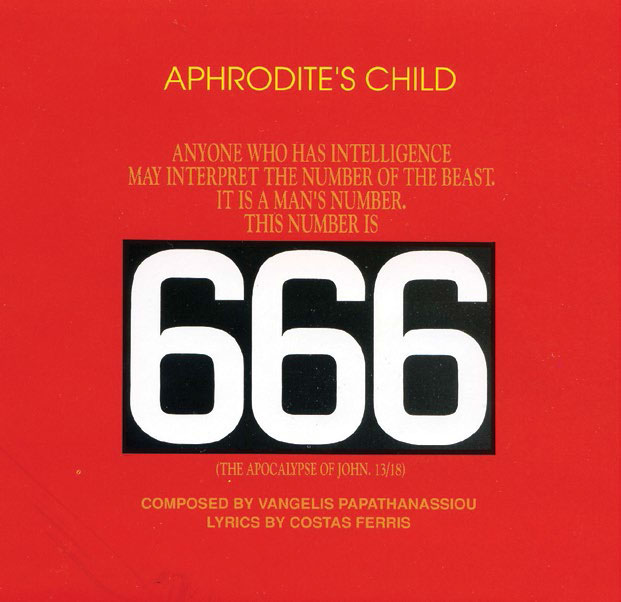
Apocalyptic! Aphrodite’s Child’s 666.
GAB ARCHIVE/REDFERNS/GETTY IMAGES
Needless to say, and much to the undoubted relief of said groups of wildlife and clergy, all this never happened. But it was a measure of the extreme response that 666 could elicit. This was, after all, no regular rock opus. The album was an archly ambitious concept piece based on the New Testament, whereby good and evil do battle as the Book Of Revelations is played out through the prism of the 60s. Or something like that. The brainchild of composer Vangelis Papathanassiou and lyricist Costas Ferris, it was a startling mix of proto-metal, Aquarian freakout and the avant-garde. Progressive rock as Marcel Duchamp might have imagined it. Dalí. himself called it “a music of stone”, stating that, had he himself been a musician and lyricist, it would have qualified as one of his greatest works.