The Musical Box
IT BITES
Francis who? It Bites’ triumphant second act finally gets its time in the spotlight with the reissue of two 21st century prog classics.
Words: Dom Lawson
New spins…
Illustration: Kevin February
Edited by Dave Everley prog.reviews@futurenet.com
The return of It Bites in 2006 was greeted with widespread joy and only a tiny bit of affectionate concern. The latter was caused entirely by the absence of original frontman and co-founder Francis Dunnery. The maverick Dunnery had splashed his avowedly singular personality all over the three much-loved albums that the Brits had released during their first hurrah in the 80s. It would be reductive to say that It Bites had ever been a one-man band, and both drummer Bob Dalton and keyboardist John Beck were present and correct in the reborn line-up. But such was Dunnery’s lyrical wit and musical ingenuity that an It Bites without him wasn’t something that anyone had seriously considered.
As it turns out, the recruitment of John Mitchell as their new frontman was Beck and Dalton’s shrewdest move. Now wholly familiar to readers of this magazine as one of modern prog’s most prolific contributors, not least with his current project Lonely Robot, Mitchell’s work with the likes of Arena, Kino and his own group The Urbane ensured that he had the necessary prog credentials to prevent delicate diehards from completely freaking out.
More importantly, he had been a huge fan of It Bites since adolescence, and was more than happy to cite the band’s original trio of albums as a colossal influence on his own music. Throw in the fact that Mitchell was (and is) a skilled studio engineer and experienced producer in his own right, and It Bites had clearly found the right man for the job.
Fifteen years on, It Bites have never officially split up but seem to be on an indefinite hiatus. As a result, these lavish, remastered reissues of the band’s two 21st century studio albums represent the entirety of the Mitchell era, albeit given the now expected sonic upgrade and, made widely available on vinyl again.
The Tall Ships/Map Of The Past
INSIDEOUT
“The world needs more albums as life-affirming as these.„
Originally released in the autumn of 2008, The Tall Ships was an It Bites album from tip to toe; from the flurry of harmonised vocals that kicked off opener Oh My God to the adventurous sprawl of centrepiece The Wind That Shakes The Barley, Mitchell’s selfproclaimed adoration of the band he had just joined had simply enabled them to write more of the sparkling and ingenious material that had made the likes of Once Around The World such unassailable touchstones for 80s prog.
It certainly helped that the new frontman’s voice sounded similar enough to his predecessor’s to slot neatly and immediately into It Bites’ unique sound world, but the best of the new songs were plainly the equal of their esteemed forebears. Notably, Mitchell’s melancholy rasp and somewhat gentler lyrical tone brought new warmth to the band’s sound, something he would explore to the fullest on The Tall Ships’ eventual follow-up. With his new bandmates’ immaculate arrangements sparkling around him, he reached a first peak of bruised poetry on closing epic This Is England. Although not quite up there with Once Around The World’s expansive title track, it was a rather audacious statement that yes, It Bites could do the really mad, proggy stuff without Dunnery, too.
Having reassured and delighted the vast majority of It Bites fans old and new with The Tall Ships, It Bites returned in 2012 with a stone-cold masterpiece. Map Of The Past was the moment when John Mitchell’s personality convincingly drowned out the lingering influence of his predecessor. A beautifully poignant exploration of the frontman’s own ancestry, both real and imagined, it featured some of the most absurdly memorable songs the band had ever released.
Wallflower, Flag and Cartoon Graveyard were high-energy prog anthems, fizzing with the same, bright-eyed brio that had powered Calling All The Heroes three decades earlier; Meadow And The Stream was a joyous eruption of slickness, complexity and melodic cunning; The Big Machine and the title track were soaring, Billy-big-bollocks prog with deliciously crestfallen undercurrents; the quirky Send No Flowers was as gently acerbic and loaded with meaning as a raised eyebrow. It all sounded immaculate, too, with plenty of the high-quality sonic values that typified the band’s 80s output, but with a depth and power that, arguably for the first time, accurately reflected the muscular majesty of an It Bites live show.
Until recently, the prospect of any more It Bites live shows seemed slender at best. In May 2019, Dalton announced on Facebook that the band “won’t be touring or gigging again”; and yet, in late 2020, Mitchell revealed online that the band were “doing an It Bites album (communication permitting). We may be some time.” Let’s hope that they don’t take too long, because the world needs more albums as life-affirming and substantial as these.

MATT BERRY
Blue Elephant ACID JAZZ
The actor-musician creates a multipart monster.
Among us freaks, weirdos and misfits there’s a tremendous affection for Matt Berry. He’s our ambassador of odd in mainstream entertainment, bringing us characters such as ageing, idiosyncratic actor Stephen Toast, providing silly voice-overs for mega corporations, and sneaking progressive ideas past the guards with his surrealist humour, sartorial style and over two decades of writing and producing music.
Following his last release, 2020’s stripped-back and countryfied Phantom Birds, ninth album Blue Elephant goes back to Berry’s signature styles; 60s-influenced pop, folkflecked jazz and psychedelia. Berry plays 18 instruments (!), sings and self-produces; percussion comes from prog maestro Craig Blundell, who contributed to Phantom Birds and is neighbours with the polymath. Fuelled by “lots of cups of tea, lots of laughs” Blue Elephant is one of the strongest things Berry’s released to date, best consumed on vinyl with a continuous, multipart track per side.
Reflecting on the cover art – also painted by Berry – it’s Joseph Merrick, aka The Elephant Man, in a blue tonic suit, lurking in a nightclub. This character might be a Berry favourite; he cropped up in Berry’s 2019 Victorian detective sitcom Year Of The Rabbit, too. So Blue Elephant heads for somewhere – Swinging London? – in Aboard, all Mellotron, piano, groovy bass, funky drum breaks and ghostly background washes. It’s Walk On The Wild Side meets Histoire De Melody Nelson that soon gives way to the upbeat Summer Sun, and Berry’s first sung parts.
Berry has said that he wanted to retreat from song-based composition and his 15 ‘movements’ deliver ideas descended from Hot Rats, Odgens’ Nut Gone Flake and Lonerism with a home production style would suit Aphrodite’s Child, Pentangle, or Jacco Gardner. Nuanced and shot through with disquiet, nostalgia and poignancy, Blue Elephant veers from Doors to The Moody Blues via some pleasingly over-the-top flanging. There’s backwards word salad on side two, spirited away by fluttering electronics, and in Safer Passage something gorgeously otherworldly, with vocoder, Farfisa and manipulated vocals. By Story Told this could easily tip over into a musical… which Berry’s done before with 2004’s AD/BC, influenced by his love of Jesus Christ Superstar.
Ending in a funky epilogue for Now Disappear (Again) Blundell and Berry’s collaboration works well. The humour of previous releases skulks in the background, but is outweighed by experimental and imaginative arrangements. Like his 2010 folk opus Badger’s Wake, it’s suite salvation.
JO KENDALL
AMORPHIS
Live At Helsinki Ice Hall NUCLEAR BLAST
Impressive unadulterated live thrills from Finnish prog metallers.
Recorded in December 2019, just months before touring ground to a halt, this double live album from Amorphis captures the band in front of a notably responsive hometown crowd. Where2017’s An Evening With Friends At Huvila featured an intimate acoustic performance, this is the full-blown prog metal experience.
The setlist isn’t quite a career retrospective; while they go as far back as 1994’s Tales From The Thousand Lakes, nearly half the tracks come from 2018’s Queen Of Time. Older tracks like Against Widows and Black Winter Day highlight their folk metal influences, while the newer material steers more towards melodic death and symphonic prog metal.
Although Amorphis aren’t a band for extended instrumental workouts, keyboardist Santeri Kallio impresses throughout, with spirited solos in Heart Of The Giant and My Kantele, and an excellent organ outro for Into Hiding. Frontman Tomi Joutsen tends to growl more than he sings, but he’s got a strong voice able to deliver power and emotion in abundance. Sure to leave listeners hankering for the return of live gigs, this is a terrific outing from the Finns. DW
ASPIC BOULEVARD
Memory Recall Of A Replicant Dream BLOW UP RECORDS
Sicilian brothers’ spacey soundtrack to sci-fi favourites.
Alessandro and Marco Barrano obviously spent their formative years devouring science fiction of all stripes, judging by this debut LP that’s based on weighty tomes by everyone from John Wyndham to Dean Koontz to Valerio Evangelisti. So far so prog, but the Barrano brothers also took a keen interest in vintage electronic technology, resulting not only in a collection of analogue keyboards, drum machines and tape recorders, but also an array of sound devices they made themselves at home.
It’s the latter factor that makes their debut album sound like little else out there. The anthemic synth washes of Electromagnetic Playground jackknife into avant-garde ambient space noise. Swirls of something resembling a fairground steam organ punctuate Aerial Steam Horse before macabre-sounding synth grunts and ghoulish theremin continue the nightmare ride. Elsewhere, there’s an Eastern flavour to Kubernetikos’ percussion accompaniment, as flourishes of Asian mantras and Bhangra melodies lace its techno pulses, along with strobe flashes of electronic melodrama. Old gear meets dystopian futures. The result is a truly unique record. JS
ARCHANGEL
Third Warning AMS RECORDS
Ubi Maior man’s piano-led, symphonically inclined solo project returns.
Eight years since his gothic-themed second solo set, Gabriele Manzini has taken time out from his day job with Italian prog stalwarts Ubi Maior to create a more conventional symphonic prog set, albeit still centred around his florid way with the ivories.
Technological Anguish offers a misleading opening as dark techno textures introduce a protagonist darkly intoning man vs machine anxieties. But as Manzini’s keyboards edge towards the foreground, they’re joined by gutsy guitar motifs that veer into more familiar AOR-prog territory. Frustratingly, the apocalyptic lyrical themes are hard to pick up on in detail, as the cloudy production tends to submerge Giancarlo Padula’s vocals. There’s more to be had on the many instrumental passages, when Manzini tantalises us with evocative synth figures or indulges his Rick Wakeman fantasies on the organ.
The Last Days Of Beauty is a captivating piano-led reverie, while 10-minute closer When The Eagle Hung His Head finds mesmerising cascades of keys lifted up by muscular rock backing, background chants and crescendous percussion. The end of the world doesn’t sound too bad, all told. JS
THE ARISTOCRATS
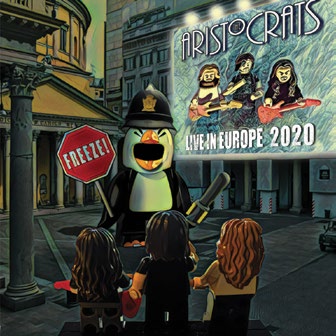
FREEZE! Live In Europe 2020 BOING!
Rip-snorting, genre-mangling set from the prodigious power trio.
As The Aristocrats turn 10, FREEZE! finds the trio of Guthrie Govan, Bryan Beller and Marco Minnemann as exuberant as ever, captured live in Spain near the end of the tour for 2019’s You KnowWhat…? They kick off with the freaked-out funk of D Grade F*ck Movie Jam as Beller lays down a bassline too dirty to ever come out in the wash. Spanish Eddie is a mutant hybrid between flamenco and Frank Zappa, and When We All Come Together is a twisted hoedown with Govan blending chicken-pickin’ country guitar with fusion. The Ballad Of Bonnie And Clyde is a punchy rocker, followed by Get It Like That, the only selection from their selftitled 2011 debut, which features Minnemann’s drum solo. Dedicated to Neil Peart, it sees the polyrhythmic monster throw in licks from YYZ and Tom Sawyer as he introduces a series of themes as springboards for improvisation. “We have an alien onstage with us tonight,” declares Beller, before they conclude with the smoky moods of Last Orders. The musicianship is dauntingly good but it’s the energy and excitement behind the outrageous chops that makes The Aristocrats so gleefully enjoyable. DW
RICK ARMSTRONG
Infinite Corridors RANDOM DISTURBANCE
Spacey solo debut from Edison’s Children man.
Aside from being astronaut Neil Armstrong’s son, Rick Armstrong is known chiefly as the guitarist in Edison’s Children. His fine solo debut is rooted in the style of Tangerine Dream, and even Ozric Tentacles at their mellowest, possessing an epic soundtrack feel that conjures memories of the rippling musical backdrop to Blade Runner.
Armstrong’s keyboard prowess is showcased on atmospheric opener Hypernova and pulsating Chaos Theory, which have an airy swagger rare in the electronic genre. The doom-laden keys on Timespiral provide a sense of imminent foreboding, with the mechanical Sunstorm being similarly engaging.
Armstrong shows restraint in unleashing his guest musicians, with contributions from Marillion guitarist Steve Rothery, John Mitchell and King Crimson bassist Tony Levin only appearing on the final two tracks. Of these, the Floydian Shifting Sands evokes flickers of Shine On You Crazy Diamond. That’s not to imply the track isn’t highly original. It just contains similarly spacious, mournful music that is performed with rare care and precision. It all adds up to an impressive statement of intent. RW