POLICE REFORM
Spent FORCE?
Institutionally corrupt? Racist? Complacent? The police are coming under increasing attack from left, right and centre. Duncan Campbell investigates why
In court six of the Royal Courts of Justice last November, a 67-year-old man called Texo Johnson had his conviction for assault with intent to rob quashed. The chancellor of the High Court, Julian Flaux, told the handful of masked souls assembled that it was “most unfortunate that it has taken nearly 50 years to rectify the injustice suffered.”
It was 1972 when Johnson and five young friends, all black, who became known as the “Stockwell Six,” were arrested by police on the London underground, beaten up, framed and sent to jail or Borstal after an Old Bailey trial. Two of Johnson’s co-defendants, Cleveland Davidson and Paul Green, had also been cleared at the Court of Appeal in July 2021.
“My parents, who were Christian and who are dead now, never believed me,” Davidson told me. “My father, who didn’t believe the police would lie, said he would send me home to Jamaica. It ruined my life.”
They and many others were the victims of a corrupt detective sergeant in the British Transport Police (BTP) called Derek Ridgewell, who specialised in fitting up young black men at a time when there was a public panic about “mugging” on the underground. Ridgewell would soon follow his victims to jail after his own conviction for mailbag theft. He died in 1982, shortly after explaining candidly to the governor of Ford prison: “I just went bent.” Only now, half a century after the convictions, are those wrongs being righted.
Earlier last year, in a three-part BBC television documentary series called Bent Coppers, retired detectives recalled the widespread corruption of the 1960s and 1970s, when officers routinely got a “drink” (a bribe) to look the other way in cases where robbery and even murder was involved. One former City of London detective, Lew Tassell, described how senior officers were at it too: “the higher you went, the bigger the drink you got.”
Another three-part BBC series shown last year, A Killing in Tiger Bay, told the story of the murder of Lynette White in Cardiff in 1988. Despite the chief suspect being a lone white man, five black men were charged and three jailed for life for the killing, after a shameful investigation carried out by South Wales detectives. The three were eventually cleared on appeal and the real murderer, Jeffrey Gafoor, was finally jailed in 2003. Eight officers were charged with conspiracy to pervert the course of justice in connection with the case, but their trial collapsed in 2011 and they were acquitted.
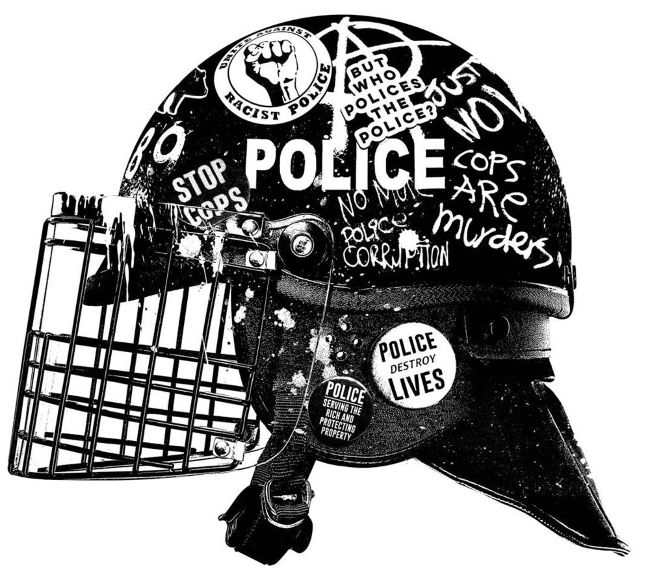
ILLUSTRATION BY GREGORI SAAVEDRA
A third television series, Stephen, told the story of the murder of Stephen Lawrence in 1993 and how the case was grimly bungled. The previous year Murder in the Car Park explained how no one had been convicted of the 1987 south London axe murder of private investigator Daniel Morgan, when allegations of police malpractice were rife. It has just led to Morgan’s family bringing an action for damages against the Metropolitan Police.
But these are historical errors, are they not? Ghosts of the past from the sixties, seventies, eighties? Different eras?
We fast-forward to the conviction of a serving Metropolitan Police officer, Wayne Couzens, for the rape and murder of Sarah Everard in 2021. Swiftly, Maggie Blyth, deputy chief constable of Hampshire, acknowledged at a police gathering that trust between women and the police had been “broken through some of the tragic events of the last few weeks and months.” At the same event, the victims’ commissioner and former Northumbria Police and crime commissioner, Vera Baird, addressed the police: “ask yourselves, after 30 reports and 30 years of women’s voices raised against violence against women and girls: why are you still not policing it properly?”
Then came the jailing in December of PCs Deniz Jaffer and Jamie Lewis for passing on photos of the murdered sisters Nicole Smallman and Bibaa Henry. That same month, the inquest into the death of one of the victims of serial killer Stephen Port was told by a witness that the Met was guilty of “institutional homophobia” because it had been so slow to link the deaths of four young gay men in east London, a story retold in the recent television series, Four Lives. Meanwhile the aftermath of Operation Midland—the protracted investigation into the fantastical, invented allegations about a VIP sexual abuse ring—still reverberates.