Crumbling monument
Thomas Jefferson was a slave-holder who urged permanent revolution. He doesn’t deserve to be called an American hero, argues Ferdinand Mount
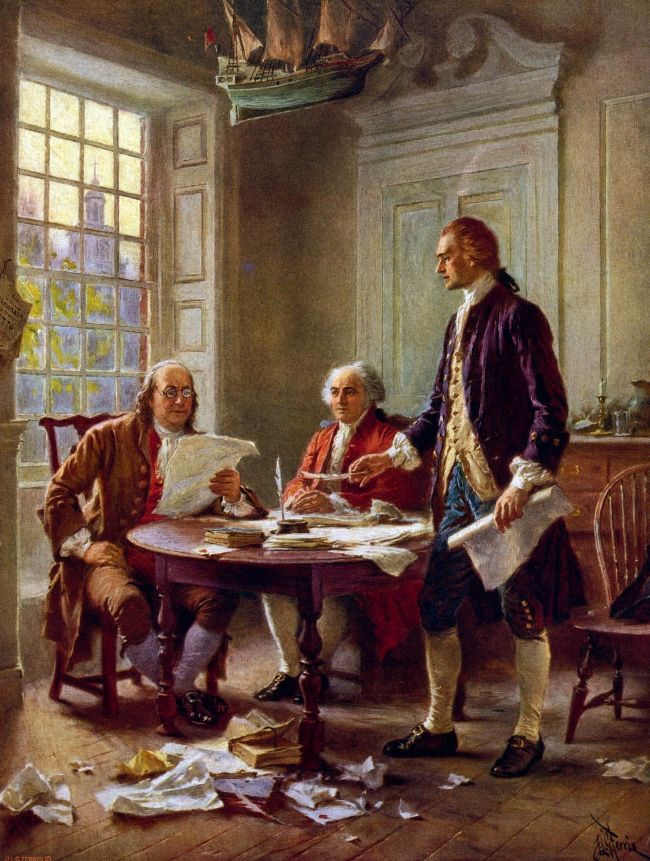
“A mere draughtsman”: Thomas Jefferson (standing) works on the Declaration of Independence with John Adams and Benjamin Franklin, by Jean Leon Gerome (1932)
© UNIVERSAL HISTORY ARCHIVE/UIG / BRIDGEMAN IMAGES
There are two stories about how Thomas Jefferson came to write the United States Declaration of Independence. The most famous is Jefferson’s own account: “The committee of five met; no such thing as a sub-committee was proposed, but they unanimously pressed on myself alone to undertake the draught.”
The other comes from John Adams, Jefferson’s grumpy, brilliant predecessor both as vice-president and as president of the US. Both men were writing nearly 50 years after the event, but I prefer Adams’s version, which brings back the anxious, chaotic days of July 1776. “We were all in haste, Congress was impatient,” Adams recalled, “and the instrument was reported, as I believe, in Jefferson’s handwriting as he first drew it”—no time for a fair copy.
Adams thought the Declaration, for all its subsequent fame, “contained no new ideas, that it is a commonplace compilation, its sentiments hacknied in Congress for two years before.” Jefferson retorted that “I did not consider it as any part of my charge to invent new ideas altogether.” In fact, several weeks earlier, while Jefferson was away in Philadelphia, George Mason had composed Virginia’s own Declaration of Rights in very similar language, down to life, liberty and the pursuit of happiness.
“It has been a struggle to fit Jefferson into the national pantheon and keep him there”
When the Second Continental Congress went through Jefferson’s draft, they struck out quite a bit of the highflown, near-hysterical language about blood and tyranny, though leaving in a long enough catalogue of George III’s crimes against the colonies. What they most conspicuously took out was Jefferson’s fierce denunciation of the King for having “waged cruel war against human nature itself, violating its most sacred rights of life and liberty in the persons of a distant people who never offended him, captivating & carrying them into slavery in another hemisphere, or to incur miserable death in their transportation thither.”
It was outrageous humbug, especially for a Virginian planter, to blame George III for the slave trade, since it was the colonists who had so enthusiastically imported the slaves. Lord Dunmore, the last British Governor of Virginia, had freed any slave who was willing to fight for the British, and it was the first business of the victorious American rebels to recapture and re-enslave as many as they could. The same issue of the Virginia Gazette (20th July 1776) that printed Jefferson’s Declaration also carried ads offering rewards for the recapture of runaway slaves.