PRESERVATION FOCUS
DEVELOPING DAY-TO-DAY
This Derbyshire-based line runs from the Midland Main Line at Duffield, through a number of small villages, up to Wirksworth, and has become a firm favourite of enthusiasts and tourists in recent years. Oliver Edwards finds out more.
The Ecclesbourne Valley Railway
A NINE-mile branch line from Duffield, only a dozen miles from Derby, to serve the industries around Wirksworth was originally opened in the 1860s.
It was part of the second 'boom' in railway building, built by the pre-Grouping heavyweight and a dominant regional player, the Midland Railway.
During construction, the railway was forced to build a huge viaduct over the line to accommodate the needs of a local farmer; it was the most substantial bridge along the route, though it never carried trains!
This 'white elephant' was blown up, as part of military training, in the early-1930s. Being of some interest, the event was recorded by British Pathe films, and can still be viewed online.
Agricultural produce was an important source of income for the line, providing the railway with its 'milk and honey line' slogan today. Locally mined stone was also exported by rail, meaning the line avoided the fate of many other branch lines of the period, namely total reliance on one traffic. Passenger services on the line were offered until the 1940s.
The railway survived the culling of secondary routes and branches in the 1950s and 1960s thanks to its stone traffic, a bulky material which can be less easily transferred to road transport than other products. Class 25 and 47 diesels were used on the line through the 1970s and 1980s, along with visiting 'Sprinter' units on occasional special train workings.
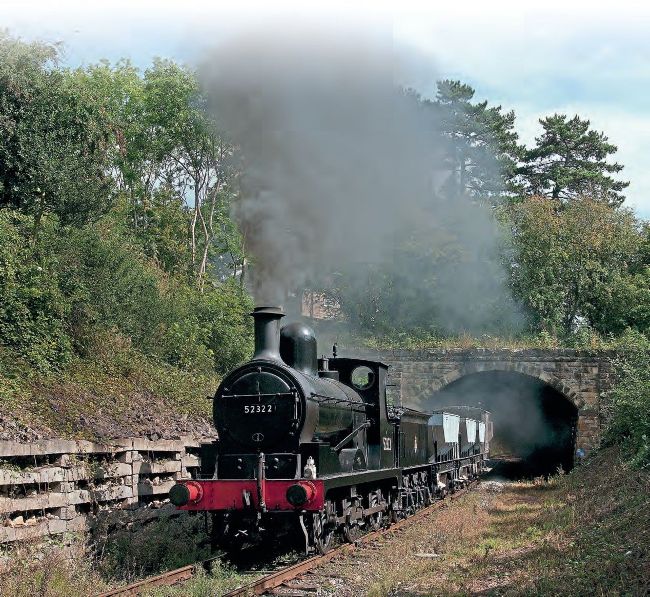
Former L&Y class 0-6-0 No. 52322 works a ballast train away from Duffield towards Wirksworth on September 4, 2013.
ROBIN STEWART-SMITH
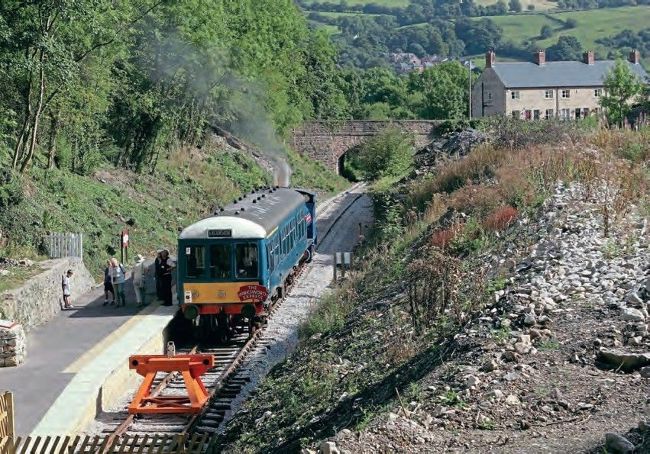
Opening a short, independent extension from Wirksworth station to Ravenstor up a 1-in-27 incline has added another dimension to the Ecclesbourne Valley Railway. RSH 0-4-0ST Castle Donington No. 1 pauses in Ravenstor station on September 2, 2005, after pushing a DMU car up the incline.
CHRIS MILNER
■ Nine miles of line
■ Five stations
■ 10 resident diesels
■ Four resident steam locomotives
■ 13 diesel multiple units, trailer cars or 'Bubble' cars
■ 19 carriages
Many will recall the branch was used by British Rail to take press images of trains for its PR department.
Eventually, the line's downfall came in the late- l 980s as a result of aggregate traffic, finally transferring to road casing completely in 1991. However, interest in preserving the railway grew and the millennium saw an increased pace of developments.
Vegetation
WyvernRail was formed in 1992 to save the line, and in 1996 a Light Railway Order was granted. The following year came the formation of the Derby and Wirksworth Railway Association (later to become the Ecclesbourne Valley Railway) to push reopening plans forward.
There was a lot of vegetation to clear, which began in 2000, and this led to reopening trains on October 1, 2002, between Wirksworth and Gorsey Bank, a half-mile away.
Negotiations began in 2003 with Network Rail to secure a 15-year purchase deal, and once that was successfully resolved the railway has expanded rapidly, with services extending along the 'mainline' until Duffield was reached in 2011.