PRACTICE & PERFORMANCE
ACHIEVING ‘PENDOLINO’ PERFECTION
After last month’s attempt at setting a new record time between Euston and Glasgow missed out by seconds after a near four-hour run, John Heaton FCILT examines some of the subtleties involved in getting maximum performance from a Class 390 ‘Pendolino’.
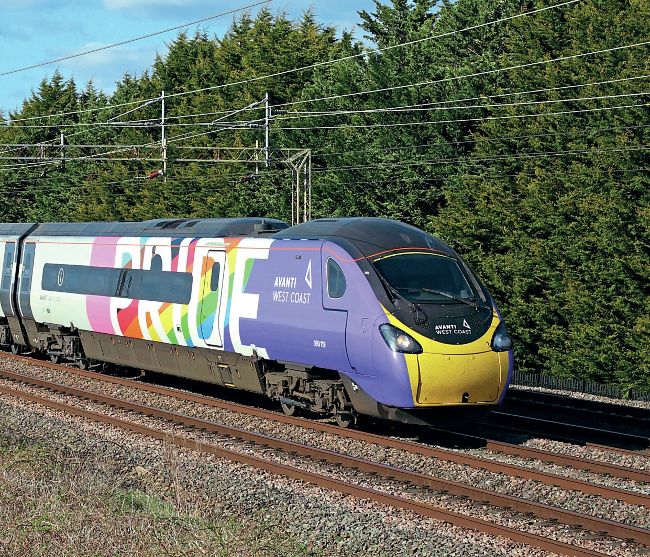
Pride-liveried No. 390119 heads south at Horton, north of Cheddington, on April 5 while working the 1M12/11.33 Glasgow Central to Euston.
JAMIE SQUIBBS
THE margin between ‘normal’, ‘good’ and ‘exceptional’ runs is narrowing. In the past, the difference could be magnified by excessive speed or, in the days of steam, brief and exceptional power outputs beyond the ambit of technical specifications.
Since around 2009, British train performance has been moderated by the use of On-Train Monitoring Recorders (OTMR), ‘black boxes’ that can highlight every driving transgression. I would also add it could equally support the driver in a case of conflicting evidence from technical or signalling staff.
Driver recruitment and training over the last 20 years has been based on compliance – enforced by random reviews, uploading of data, and now the availability of ‘auto analysis’ reviews of performance. Drivers must obey every nuance of every rule all the time,
conserve energy, provide a smooth ride and, oh, yes – nearly forgot this one – keep time. Farepaying passengers are justified in asking: “And why shouldn’t they?”
Top train drivers have always been well paid in comparison to similar occupations, but since (not necessarily because of) Privatisation, this has been extended to all train drivers with their (sometimes liberal and often arcane) bonuses, such as ‘mileage’ payments, now consolidated into pensionable pay.
Driver reaction to close monitoring, often by those with little and even no practical driving experience, can be characterised by the phrase: “If that’s what they want, then that’s what I’ll do.”
A new breed
The increasing majority of drivers joined after the abolition of British Rail. In marked contrast to the 15-year-old engine cleaners of the 1950s, the new breed of drivers is often drawn from other professions – not least from the armed forces, where their training has been the unquestioning obedience of orders, regardless of sense or sensitivity.
Trains have a top speed; the infrastructure has a top speed. Compliance is measured by the OTMR, by the on-train speed supervision system, and at key locations by the Train Protection & Warning System (TP&WS) grids. The latter have been instrumental in reducing the most dangerous instances of ‘signals passed at danger’, so I would not dream of decrying it. Its contribution to preventing that once-in-alifetime error has been considerable.
On the other hand, TP&WS grids are part of a ‘catch-all’ system that applies to all trains using the network, so the siting of grids is based on the traction with the least effective brake force that uses the route. However, most
World Record Officially the world’s longest-running railway series, established in 1901