PRACTICE & PERFORMANCE
Devon’s ‘Thirty- Sevens’
World Record Officially the world’s longest-running railway series, established in 1901
Class 37s have always been rare on passenger duties in England’s third largest county, but John Heaton FCILT highlights some of the best from the last 60 years.
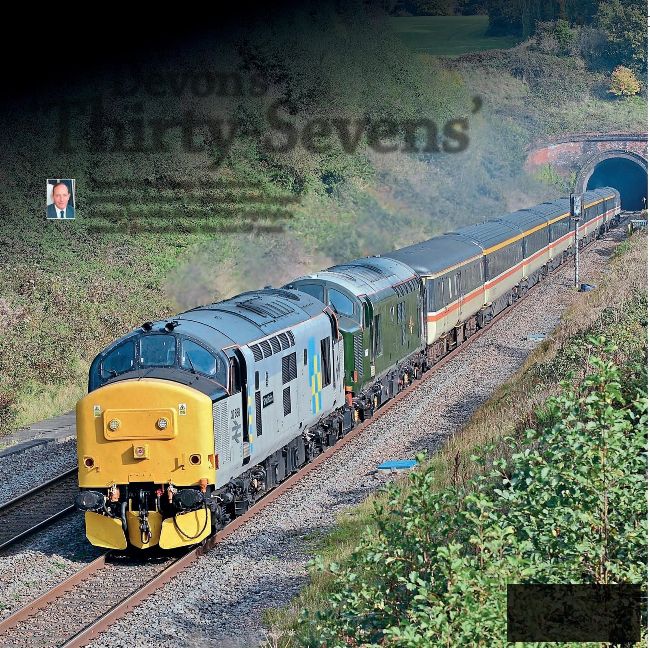
Replacing the originally advertised ‘Peak’ No. 45112, which was not ready in time to make its main line return on this tour, Class 37s Nos. 37688 Great Rocks and 37521 (as D6817) head the York-Paignton ‘Torbay Delight’ out of Whiteball Tunnel and into Devon on October 19, 2022. Class 47 No. 47828 was at the rear.
STEPHEN GINN
THE yodel alarm at Paignton South level crossing begins to sound and the ‘train crew operated’ barriers lower against road traffic. The signature grumble of an English Electric engine heralds the appearance of Class 37 No. 37275, edging round the foliage and sidling into Paignton Queen’s Park Dartmouth Steam Railway station.
This is Class 37 Day at Paignton, with a Locomotive Services special from York stabling for nearly three hours in Goodrington Yard and a programme of round trips from Paignton to Kingswear by No. 37275 supplementing the normal timetable for the benefit of enthusiasts. The last journey coincided with the timings of the York railtour, allowing its passengers further Class 37 haulage, this time behind a preserved example.
But some observers remembered the day No. 37275 itself had been the central attraction. It was June 23, 1984 and I was enjoying a summer Saturday family picnic on Dawlish beach when I became aware of the 08.20 Liverpool-Paignton nine-coach holiday extra rounding the curve at Dawlish Warren. I had been watching trains for barely half an hour and had already noted Nos. 45104 on the Nottingham-Paignton, 45033 on the Penzance-Leeds, and 47100 on the 10.14 Paddington-Paignton, in addition to three HSTs and a couple of Class 50s, but this was different – aClass 37, rare on Class 1 passenger trains in the South West. Here was Cardiff Canton’s No. 37275.
I knew it should return on the 16.08 Paignton-Liverpool, so I had another couple of hours of relaxation before heading home for my train timing kit, but not before observing 21 more Class 1s, of which only five were HSTs, producing eight further Class 45s, three of which were ‘45/0s’. Nevertheless, I would be regularly told back then that there was no longer any variety to be had.
My northbound Liverpool turned up 1min early on the D315 timings, which were calculated for a Type 4 Class 47 on nine Mk.2s, and so our Type 3 should have actually lost some time. Departing on time with 2min ‘recovery’ to Exeter, even our underpowered loco had no need of heroics. We passed Dawlish Warren in 2m52s, at least 20sec down on Class 47 expectations, and eased back at precisely 75mph. Arrival at Exeter was still 1min early, but doubts were creeping in – perhaps this was not going to be worth a trip to Bristol Temple Meads after all. I could always alight at Taunton if necessary, however staying on board turned out to be the right decision for once!
Unspectacular start
The start was steady if unspectacular, taking 5m19s and 3.7miles to reach Stoke Canon level crossing, then with a maximum of 72mph at Hele, sustained on the average 1-in-300 (effectively steeper with the compensating reverse curves) up to Cullompton. Our, not quite venerable, 19-year-old loco just failed to match even the few speed-compliant drivers on the adjacent M5 motorway as progress tailed off to 67mph on the following 1-in-155 to Tiverton Junction.