PRACTICE AND PERFORMANCE
Mainly ‘B1s’
John Heaton FCILT looks at some examples of everyday performance in the 1950s, away from the glamour of the era’s high-profile expresses.
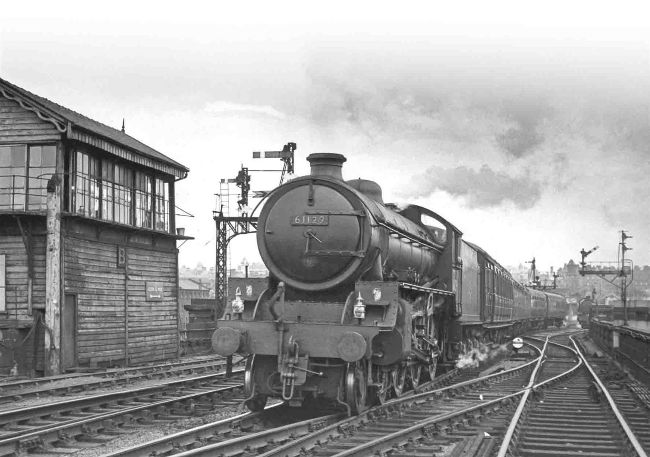
Left: ‘B1’ No. 61129 leaves Leeds Central on Sunday, July 1, 1962 with the 2.54pm to Doncaster.
J S WHITELEY
BURIED well below heroic tales of epic runs in the age of steam, lies a soft under-belly of sometimes indifferent workmanship and ineffective management. We looked closely at such an example in The RM’s September 2021 edition, with the 8.12am Leeds-York/Scarborough of 1958/59 showing its deplorable punctuality record; a situation that was allowed to exist despite it being the regular commuter train of many North Eastern Region HQ operating staff.
Noel Proudlock was the one who kept count of those events, but the train was by no means an isolated example. During the motive power section of his management training, Noel was assigned to the Wakefield District, based in an office at Westgate station. His main train to reach work was the 8.25am Leeds Central to Doncaster local, booked to call at Ardsley and Lofthouse; a train that promised a wealth of interest being a lightweight four-coach formation booked for Doncaster enginemen with a home-based Class 5 ‘B1’ but likely to produce a Class 7 ‘V2’ and even the odd Pacific.
From the vantage point of 2024, we can sit back and imagine the fireworks of flying up the three-mile, 1-in-100 climb from Beeston to Ardsley at speeds far exceeding those achieved by heavier London expresses, rousing acceleration from the intermediate station stops, and a final fling down the matching descent before masterly braking for entry to Wakefield Westgate.
This was far from being the case, however. There is certainly no merit in blasting away to arrive at every station before time, but the drivers rostered to this diagram seemed to vie for the least effort possible regardless of time loss. Is this too critical of people performing a hard, manual and responsible job? Judge for yourself.
Doncaster stopper
Noel used the 8.25am departure 26 times between October 27 and December 19, 1958, and arrived on time not even once. Admittedly, ‘B1’ No. 61121 (Table 2) was only 12 sec late on November 13, but this was one of only six that were fewer than 2 min late on a schedule that could not be termed taxing on any of its sections.
What were the excuses? The only significant acceptable cause of delay was fog, from which British industrial areas of the 1950s in general, and the West Riding in particular, suffered in the extreme. On the five foggy days, the 8.25am stopper arrived at Wakefield an average of 14 min late, but most of that time could be ascribed to adverse signals (usually from other trains affected by the conditions) and late starts ‘waiting loco’.
The loco for the 8.25am worked in from Doncaster, waited on the buffers for ‘engine release’ and repaired to Copley Hill for turning. Significantly, the only two occasions of late starts awaiting the return of the locomotive were on foggy days and averaged 12 min each to No. 61107 on October 28 and No. 61121 on November 27.
“No. 61035 Pronghorn is arguably one of the less attractive antelope names, but reputedly faster than a Thomson’s Gazelle, as opposed to Thompson’s gazelles”
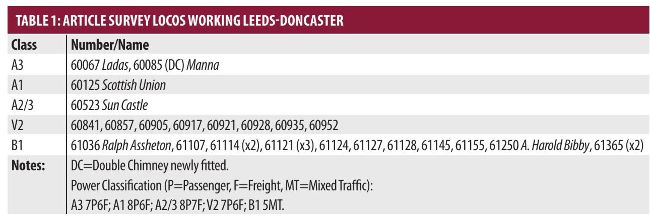
The stress of working late-running passenger trains with steam locos suffering a series of semaphore signal checks on foggy days must never be underestimated. One of the foggy day ‘B1’ runs has been included in Table 2. No. 61124 took 45 sec to ease up to the platform starting signal and waited for fellow fog-casualty, the 15min late inbound Castleford local DMU (Nos. 79004+79504), to cross its path. Modern operators would rightly blanche at this practice, but the driver was undeterred. He made a bolder climb to Ardsley than many of his counterparts before, inevitably succumbing to three signal checks approaching Westgate. The reasons for late running on days not afflicted with fog are harder to understand. In general, dispatch discipline was good, considering the accuracy of the timepieces in use. Only three of the 21 ‘clear days’ (‘non-foggy’ would be a better description of a 1950s Northern November) saw the train incur a late start of more than 30 sec, and all were fewer than 2 min late, but every single one lost time to Ardsley. Only one of the 21 ‘clear day’ trains suffered noticeable signal checks.