PRACTICE & PERFORMANCE
CROWNING GLORY
World Record Officially the world’s longest-running railway series, established in 1901
John Heaton FCILT delves into the archives to uncover workings from the previous two Coronation Days in 1953 and 1937, then takes look at the preview specials run by the LMS and LNER for their Coronation-themed titled trains.
CORONATIONS are unpredictable affairs. Since the inception of passenger railways in Britain, there have been two intervening gaps of 63 years and 70 years between such festivities, whereas the 50 years from 1902 saw three coronations and a non-event when King Edward VIII abdicated before his ceremony.
In the past, coronations have seemed to mark a moment of optimism and faith in the future, the death of the previous monarch being set officially on one side. You have to be over 70 to remember the last one on June 2, 1953 and nearer 90 to remember that of King George VI on May 12, 1937. The Railway Performance Society (RPS) electronic archives give an insight into those two historic days for those of us who were either too young or presumably had no stopwatch.
Royal resonances
On the day that Queen Elizabeth II was crowned in 1953, train running was recorded for posterity by just two individuals. The first was by that doyen of these columns in recent years, Noel Proudlock, who was undergoing his military national service. It is perhaps a sign of those times that the armed forces, in general, were given time off for the coronation rather than being squadroned into domestic security roles.
Listening to the radio recently, I heard it suggested as urban myth the idea that many people visited relatives who owned a television set simply to watch the pageantry. But I can assure that millennial commentator that it was neither a myth nor urban – although perhaps Noel took it a step further than most when he travelled from Winchester to Birmingham on one of his leave days to view the spectacle on his aunt’s television.
“After watching the spectacle on television, Noel made for Snow Hill for what was likely to be a ‘King’, thereby extending the day’s royal theme”
He chose to cross London twice rather than remain in the capital to watch proceedings live, setting off the day before behind ‘King Arthur’ No. 30784 Sir Nerovens on an extra train of 10 coaches weighing 330tons tare. This Class 5 took Roundwood at 46mph, the highest speed thereafter being 65mph. Less than a week later, Noel travelled to Leeds from Winchester on the 11.16am Bournemouth-York, a train of 300tons tare with ‘King Arthur’ No. 30736 Excalibur managing only 42mph at Roundwood.
Sir Nerovens suffered a signal stop at Woking Junction making the pre-coronation special six minutes late on what was obviously a busy day. Not to worry, there was a five minute box of recovery time, meaning the knight was just 25 seconds late into Waterloo.
A treat was awaiting Noel at Euston where he was to enjoy a splendid ‘Jubilee’ run with No. 45737 Atlas, which I first described for Railway World in May 1994. The train was made up to 13 vehicles with a tare weight of 400tons, but the Bushbury crew still managed to take the Tring summit at 52mph, with an equivalent drawbar horsepower (edhp) of approximately 1,040.
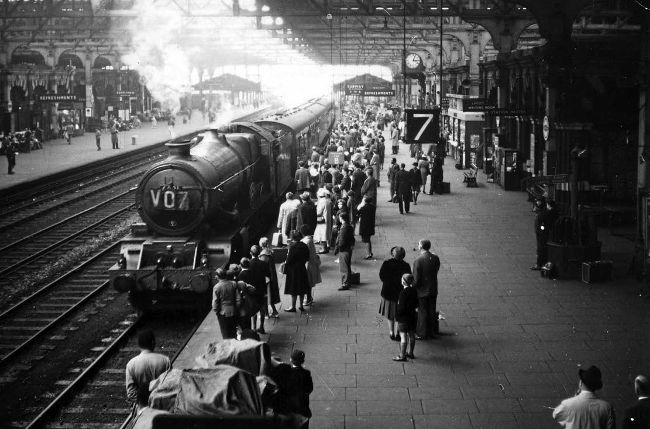
The sort of scene that would have greeted Noel Proudlock at Birmingham Snow Hill on Coronation Day 1953 as he returned home to Andover from the city. Rather than his ‘King’ Class No. 6013 King Henry VIII that day, this view on October 28, 1961 is of classmate No. 6021 King Richard II arriving with a Birkenhead to Paddington service.
R DORLASTON