ULTIMATE GUIDE TYPHOON
IF YOU WERE PITCHING KONAMI’S TYPHOON TO SOMEONE IN AN ELEVATOR YOU’D SAY IT WAS TWIN COBRA MEETS AFTER BURNER. READ ON TO DISCOVER HOW THIS ARCADE MASHUP WORKED AND WHY IT’S STILL A REAL BLAST TO PLAY 35 YEARS LATER
WORDS BY MARTYN CARROLL
» Ocean converted the game to the Commodore 64, Spectrum and Amstrad CPC. No 16-bit versions were considered.
Konami was the king of arcade shooters in the Eighties, with Scramble and Gradius (Nemesis) establishing the framework that other followers. Of course we’re talking about side-scrolling shooters here. When it came to vertical shooters Konami did dabble – see Mega Zone and Twinbee – but the vertical-scrolling shooter was the domain of developers like Capcom, Tecmo and Toaplan. Indeed, in 1987, when Konami was developing Typhoon, the arcades were already home to Flying Shark, 1943, Gemini Wing and Twin Cobra. Sega was also readying a new vertical shooter called Sonic Boom. For Typhoon to stand out from the crowd it would take something quite special.
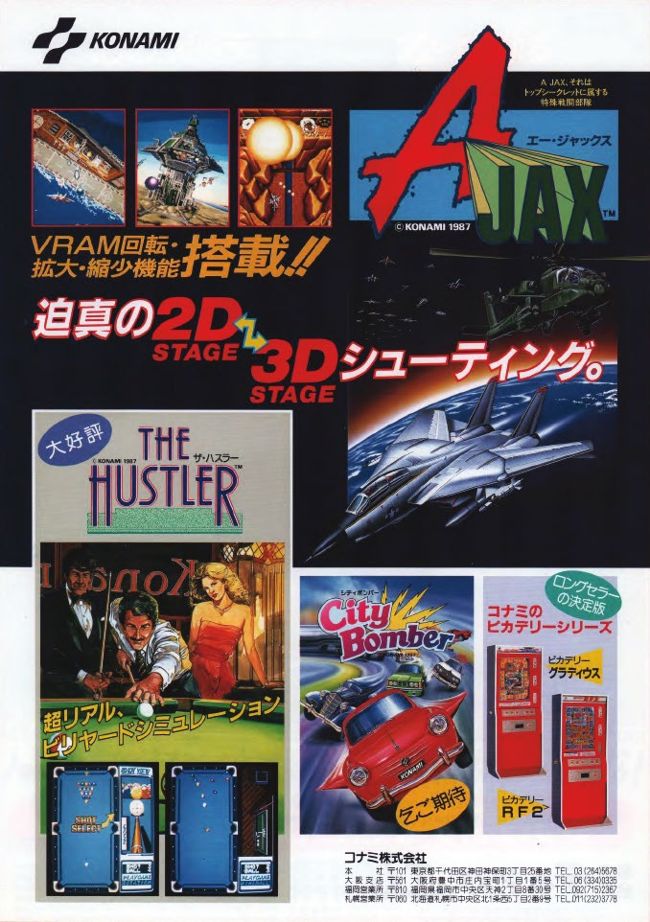
Konami’s answer was to marry 2D and 3D shooters. Typhoon featured traditional 2D stages in which you piloted a helicopter against waves of enemy forces, and these were interspersed with into-the-screen 3D stages where you took control of a fighter jet. It’s perhaps unsurprising that the game’s producer (Koji Hiroshita) and director (Satoru Okamoto) had both previously worked on Contra, another game that mixed playing perspectives.
Typhoon’s 2D style was dominant, occupying five of the game’s eight stages and containing the key gameplay elements. As was the norm, you started out with a feeble peashooter but by collecting power-ups you could switch to four more powerful weapons. Screen-clearing smart bombs were also featured and so were airto-ground missiles (think Xevious, only these missiles could be upgraded – twice). Konami also borrowed the Option weapon from its own Gradius. Collect one of these and a small helicopter would shadow your own and double your firepower. This upgraded weaponry was almost mandatory as the odds were overwhelmingly against you, with boats, tanks, planes and choppers all trying to take you down. Even the damn clouds fire at you!
“SCREEN-CL EARING SMART BOMBS WERE ALSO FEAT URED AND SO WERE AIR-TO-GROUND MISSILES”
The 3D stages were far easier and played like interstitial scenes designed to provide variation and visual flourish. Your jet’s loadout was limited to just guns and missiles, and it was more a case of avoiding enemies than actively trying to destroy them. The graphics weren’t up to After Burner standards, and the vertical alignment limited the impact to some extent, but it was still a fairly wild ride. In particular each 3D stage ended with a climactic battle against an enemy megastructure.