THE HISTORY OF WONDER BOY
WHETHER IT MAKES YOU THINK OF A LITTLE LAD ON A SKATEBOARD OR A BOY WHO TURNS INTO BEASTS, THE WONDER BOY SERIES HAS LONG BEEN ASSOCIATED WITH QUALITY. WE SPEAK TO RYUICHI NISHIZAWA TO FIND OUT THE SECRET OF ITS POWER
WORDS BY NICK THORPE

» Ryuichi Nishizawa is the cofounder of Westone and creator of the Wonder Boy franchise.
T here’sno question that the Eighties were the decade that videogame heroes were truly born. The games of the Seventies had scarcely had identifiable characters at all, and the most iconic ones were easily the villainous Space Invaders. The Eighties gave us Pac-Man, Q*bert, Frogger and Donkey Kong – no contest. But those early greats didn’t do away with legions of cars and spaceships overnight, and even by the middle of the decade, you were as likely to see anonymous sportsmen or vehicles in starring roles as any character you could identify. It was with that environment in mind that Escape – later known as Westone – began to develop a game about a little boy wearing some leaves to cover his modesty.
“I think it was the summer of 1985 when we started developing Wonder Boy. It was the time when Gradius was a big hit at the arcade.
At that time, shooting games were the star of arcade games, and I chose the side-scrolling action genre for our first game as an independent developer,” says Ryuichi Nishizawa, cofounder of Westone and creator of the Wonder Boy series. “Back then, there were not many games with strong characters, and I thought that a game with large characters jumping around the screen would stand out in the arcade. As expected, Wonder Boy stood out quite a bit.”
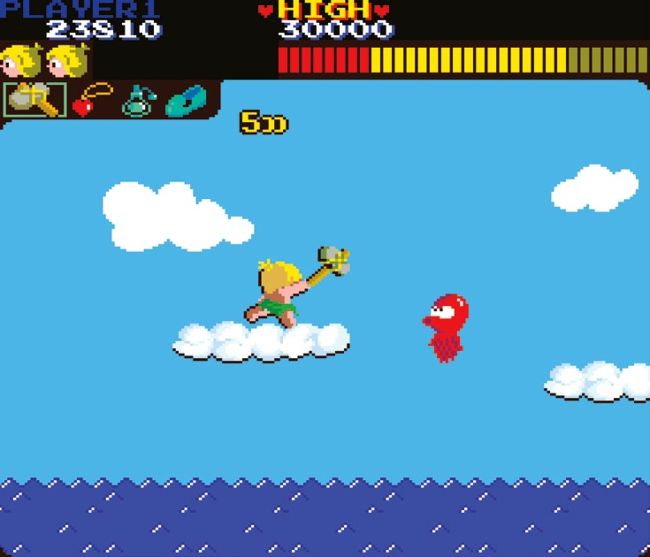
» [Arcade] Stone axes make light work of the various enemies, but you don’t have time to stand and aim.
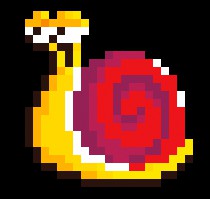
You played as Tom-Tom, as he was named in English releases, as he attempted to rescue his kidnapped girlfriend Tina. In gameplay terms, this meant venturing through platform obstacle courses and collecting fruit to keep your health up, while avoiding hazards like snakes, snails and fires, as well as battling bosses.
One of the more memorable features of the game was the power-ups you’d get from breaking eggs, including stone axes and a skateboard. “The initial game concept for Wonder Boy was designed to have the main character keep running and not be able to stop. This was because I wanted the player to enjoy the jumping action in a continuous state of tension,” says Nishizawa, explaining the inspiration for the latter. “However, when I implemented this specification, I found that the game was more difficult than I had imagined and was not for everyone. So I changed the specifications to allow players to run and stop at their own choice. This made it an action game for everyone, but I also wanted to keep that tension of not being able to stop, so I wondered if there was any way we could still keep this feature. As a result, I came up with the idea of riding a skateboard with a power-up.” It’s a decision that makes a lot of sense, but one detail makes it rather odd. “The reason why I suddenly turned my attention to skateboards is because I happened to find one on the rooftop of the building where the development office was located. I don’t know who left it there, but without this encounter, Boy might never have ridden a skateboard.”
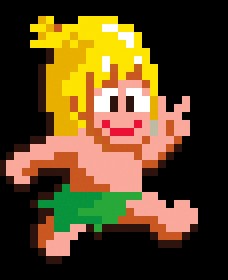
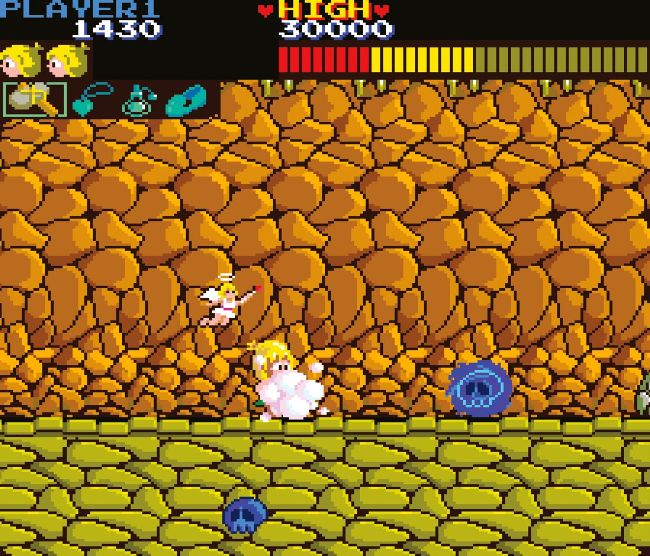
» [Arcade] If you find a fairy, you’ll gain temporary invincibility that lets you bash through baddies.
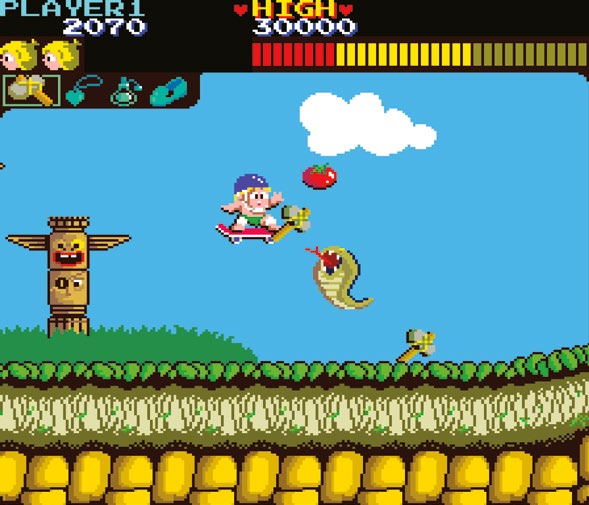
» [Arcade] We’d like to extend our thanks to whoever left their skateboard on Westone’s roof.
WHAT ’S IN A NAME?
WHEN IS A WONDER BOY GAME NOT A WONDER BOY GAME?
The history of the Wonder Boy series is rather convoluted, and it’s all for one simple reason – Westone owned the game designs and code, but Sega owns the Wonder Boy trademark. That meant that anyone could license the games from Westone for conversions, they just couldn’t be called Wonder Boy. The company that most frequently did so was Hudson Soft, which first licensed the original game for the NES and MSX and called it Adventure Island. That’s worth a whole boxout on its own though, so we’ll cover that elsewhere.
Hudson Soft went on to license four more Wonder Boy games, all for the PC Engine and all treated as completely unrelated properties. Wonder Boy In Monster Land became Bikkuriman World, featuring characters that were introduced on stickers in Bikkuriman chocolate wafer packets. Wonder Boy III: Monster Lair came over fully intact, but lost the Wonder Boy branding in North America. Wonder Boy III: The Dragon’s Trap became Dragon’s Curse in the US and, very confusingly, Adventure Island in Japan. Wonder Boya In Monster World was rebranded as The Dynastic Hero.
Elsewhere, Jaleco published Wonder Boy In Monster Land for the Famicom as Saiyuuki World, with a total thematic alteration. That got a sequel of its own, published internationally as Whomp’em, which wasn’t developed by Westone. In Brazil, Tectoy rebranded the Master System versions of Wonder Boy In Monster Land and Wonder Boy III: The Dragon’s Trap as Monica’s Gang games, with new graphics based on the popular comics.
And just to really make sure everyone understands the situation, Monster Boy And The Cursed Kingdom is a Wonder Boy game – there’s a Sega copyright on the title screen and it displays the Wonder Boy 30th Anniversary logo on the box. But it’s called Monster Boy, not Wonder Boy. Confused yet?
A NEW ADVENTURE
WHAT’S THE DEAL WITH THE ADVENTURE ISLAND SERIES?
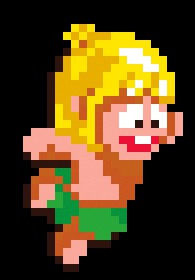
As we mentioned in the What’s In A Name? boxout, Hudson Soft licensed the Wonder Boy game design and released Adventure Island for the NES and MSX. Despite the fact that the company didn’t need to change the character, it decided to put its famed personality Takahashi Meijin front and centre. Given his notable ability to fire 16 shots per second in shoot-’em-ups, the choice to put him in a platform game was a surprising one, but it didn’t matter to international players who were introduced to the character as Master Higgins.
Adventure Island did quite well for Hudson, so a NES sequel arrived in 1990, developing on the original with new dinosaur mounts and the ability to backtrack. A version of this game came to the Game Boy, as did a version of Adventure Island 3, which was released in 1992. The same year also saw the release of Super Adventure Island for the SNES and New Adventure Island for the PC Engine, both of which stuck closely to the original formula too. The final major entries in the series appeared in 1994, the Japanese Famicom exclusive Adventure Island IV and the SNES game Super Adventure Island II. These games were both departures from the original Wonder Boy formula, with their focus on exploration bringing them closer to the later Wonder Boy games instead.
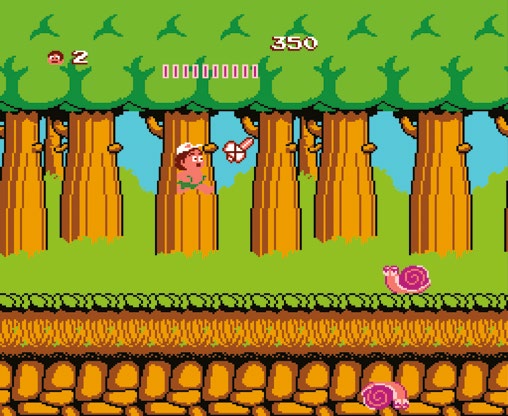
Later on, a PS2 remake of the first game appeared in 2003, and the four NES games appeared in a Game Boy Advance compilation in 2006. The series was last seen on consoles in 2009, when Adventure Island: The Beginning was released as a WiiWare game. Konami currently owns the rights to the Adventure Island series thanks to its acquisition of Hudson Soft in 2012, and it included New Adventure Island as part of the PC Engine Mini’s line-up in 2012.