ULTIMATE GUIDE
BUGGY BOY
WITH AN OVERSIZED CAB AND 3D SPRITE TECH THAT PREDATED SEGA’S SUPER SCALER GAMES, BUGGY BOY WAS AN EXTRAORDINARY SIGHT IN ARCADES – IF YOU COULD FIND ONE THAT IS. JOIN US AS WE TRACK DOWN TATSUMI’S THREE-SCREEN MONSTER
WORDS BY MARTYN CARROLL
Poor Tatsumi. In TX-1 (1983) and Buggy Boy (1985), the Japanese developer created two of the most advanced arcade racing games of the era, yet outside of its homeland, few will be familiar with the name. TX-1 was manufactured in the West by Atari, under licence from Namco, while Buggy Boy was distributed by Taito in Europe and Data East in North America (where it was renamed Speed Buggy). All these big arcade names put Tatsumi firmly in the shade – and to compound matters, when Buggy Boy is mentioned these days, many gamers are likely to think of Elite Systems, the UK developer which successfully converted the game to home computers in the late Eighties.
Buggy Boy debuted in arcades in July 1985 and it was hard to miss. Like TX-1, released 18 months prior, the original sitdown cab featured a steering wheel, stick shift, floor pedals and three monitors that were horizontally aligned to mimic the vehicle’s windscreen. The cab also offered ‘quadraphonic sound’ (translation: four speakers – two up front, two at the rear) that added to the impression of being behind the wheel, racing along to the sounds of revs, bumps and squeals. Buggy Boy was a hulking 700lb monster with a 1.5x2m footprint and it was this scale that caught the attention of CVG magazine. “Buggy Boy is a Goliath amongst arcade machines,” reported an unnamed correspondent in the February 1986 issue. “It’s larger than TX-1 with three screens giving a massive panoramic view of your thrilling ride.
TREE
“YOU OFTEN HAD TO EASE OFF THE ACCELERATOR AND PICK THE BEST PATH THROUGH ALL THE HAZARDS”
ULTIMATE GUIDE: BUGGY BOY
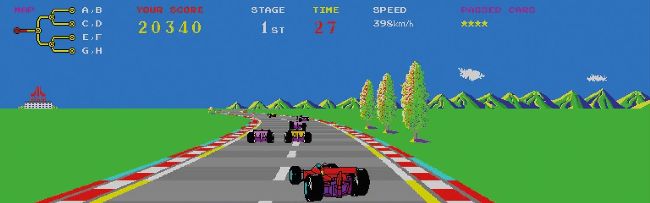
» [Arcade] Tatsumi’s TX-1 was marketed by Namco and Atari as the successor to the Pole Position games.
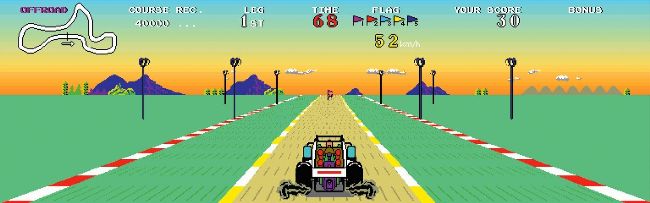
» [Arcade] The three monitors afford Buggy Boy players a ‘super widescreen’ display.
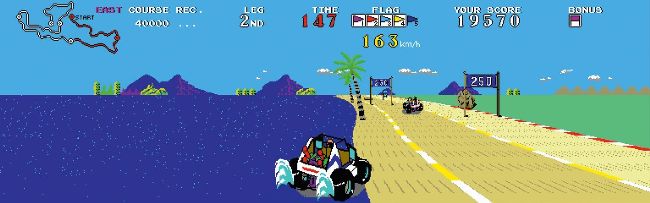
» [Arcade] Before Out Run, Buggy Boy players were already tearing it up along coastal roads.
SLIP SIGN
ROCK
BRIDGE 1 SIGN
CONVERSION CAPERS
HOW THE HOME VERSIONS LINED UP ON THE STARTING GRID
COMMODORE 64
This is quite a different game compared to the arcade version. The graphics are smaller and the racing is pacier, but the changes work and it’s an absolute blast to play. Despite the differences, it’s the only conversion to feature rival racers. It deserves its Zzap!64 Gold Medal.
AMSTRAD CPC
Visually this is similar to the C64 version, but it’s not as fast or as responsive, and the 3D effect is a bit wonky. Most of the coin-op’s features make it across, including footballs, embankments and the ability to whiz around on two wheels. Overall it’s not too bad.
ZX SPECTRUM
Featuring one of the biggest main sprites of any Speccy game, this deserves full marks for ambition. But it’s a mess. Other elements are similarly large but simply rendered, and they clog up the screen and slow things down. Unlike other versions, the road does undulate.
ATARIST
This is a solid conversion. The coinop’s graphics have been reproduced at a more manageable size, allowing the game to maintain a decent framerate, and the five courses are all true to the original. It’s just a shame the competitors aren’t there to add extra challenge.
AMIGA
As evidenced by the screenshots, this is visually identical to the ST version, of which it’s a direct port. However, in motion it’s not quite as smooth, and the sound effects have been changed to be more realistic, but as a result they’re not as faithful as on the ST.