WUNDER –KIND
GERMANY’S SHOOTING SINGLES STAR
WORDS RACHEL QUARRELL
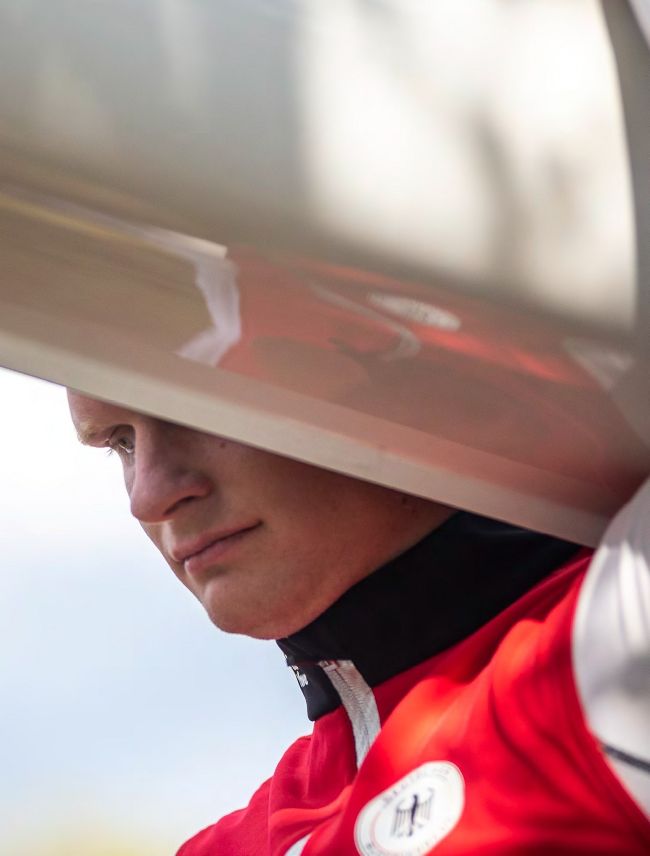
PHOTOGRAPHY BENEDICT TUFNELL
Stop for a minute and think carefully: how much has your rowing improved in the last 36 months?
Have you set a few new personal bests? Won a regatta or three? Become stronger, fitter, technically better? I bet you haven’t matched the meteoric rise of Olli Zeidler, the 23-year-old German sculler. Imagine going from raw rowing novice to world singles champion inside 36 months. Three years from capsizing every outing to beating the best scullers on earth. You’re about to read his mindblowing story, an almost unbelievable tale. But it’s true, and in a few months’ time Zeidler will sit on the start line in Tokyo as one of the top favourites for the 2020 Olympic singles title, less than four years after starting the sport. This is how it happened.
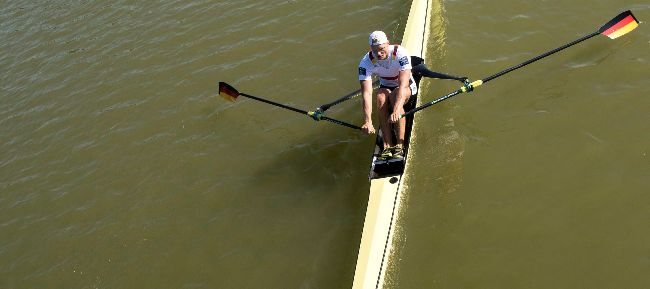
Zeidler racing at the 2018 World Rowing Championships in Bulgaria.
It’s August 2016, and a tall blond 20-year-old lad called Olli Zeidler is sitting in the grandstands at Rotterdam watching his younger sister racing in the German junior women’s eight — they are already European junior champions and will take world silver behind the Czechs. The boy is a swimmer, a seriously good freestyle racer, and has never been interested in rowing before, but having Marie-Sophie racing for real at the junior champs has awoken a spark in him. He feels the connection, the competitiveness, the excitement of the racing. His aunt Judith comes along from another tier of the grandstand and tells him, “You would be good at that, you should give it a try”.
The timing is perfect (clever aunt): only a few months earlier Zeidler has learned that despite being a multiple German swimming champion at one of the best clubs in the country, he, along with several of his SG Stadtwerkeclubmates has narrowly missed out on selection for the Rio Olympics. Being an Olympian has been his goal since he was a toddler, since he first understood what the Games means to those who compete at them. His hopes dashed, he then discovers that most of his clubmates are about to retire from the sport. His swimming family is disintegrating rapidly, his teenage routine of study and training vanishing without a trace. He is ripe for finding an alternative.
This is where the luck comes in: Zeidler’s family is no ordinary one, but German rowing nobility. Zeidler and his sister’s grandfather on their mother’s side is Hans-Johann Farber, a double Olympic medallist and multiple world champion, part of the great “Bear Four” which won at their home Olympics in 1972, and an icon in Munich rowing. On the other side of the family Zeidler’s father Heino was a junior world champion, and his sagacious double-Olympic-champion aunt Judith Zeidler met her husband while both were in the reunified German team. Zeidler’s family has an erg in the basement and he learned the correct body movements from the family experts aged seven so he could occasionally use it, but after showing early promise in swimming and several other sports, he had never been interested in rowing. As his grandfather told a German newspaper earlier this year, “all attempts to put a boat under him failed miserably.” The one time theytried to show him how to row aged 13, he took two strokes then capsized and swam to shore, claiming “now I am in my element”.