WOLF MAN
UNCHAINED MALADY
LEIGH WHANNELL TALKS ABOUT PUTTING A NEW SPIN ON THE WOLF MAN FOR HIS LATEST UPDATE OF A UNIVERSAL CLASSIC
WORDS: IAN BERRIMAN
AFTER THE FAILURE OF their 2017 reboot of The Mummy caused Universal Pictures to reconsider plans for an interconnected cinematic universe based on their horrors of the ’30s and ’40s, it briefly looked like no one would be touching that pantheon of properties with a bargepole for a considerable length of time.
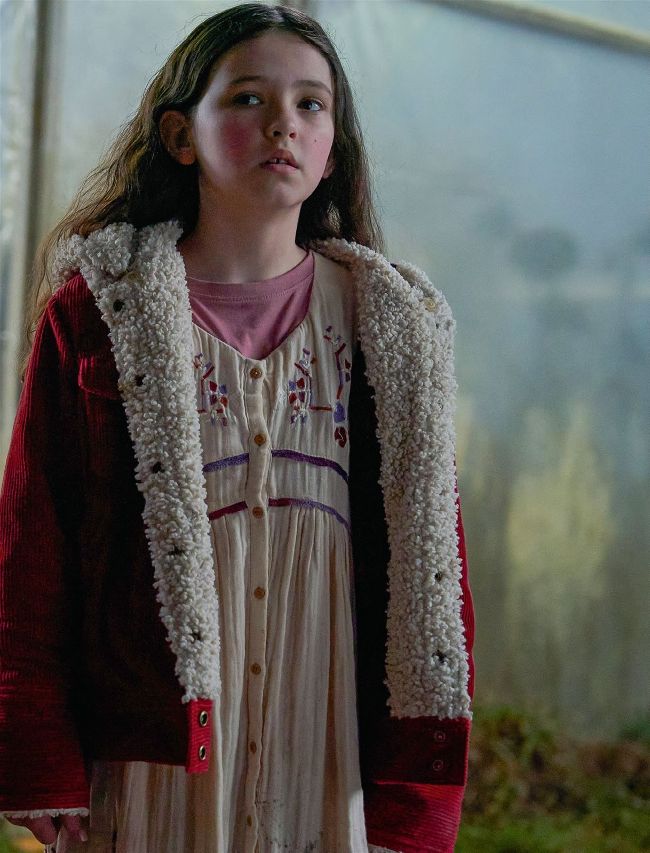
Uh, Ginger? You might want to turn around…
However, three short years later Saw co-creator Leigh Whannell brought us a new version of The Invisible Man, which proved that standalone takes on such classic titles can resonate with a contemporary audience. Now he’s aiming to pull off the same trick with a riff on another Universal horror: 1941’s classic The Wolf Man.
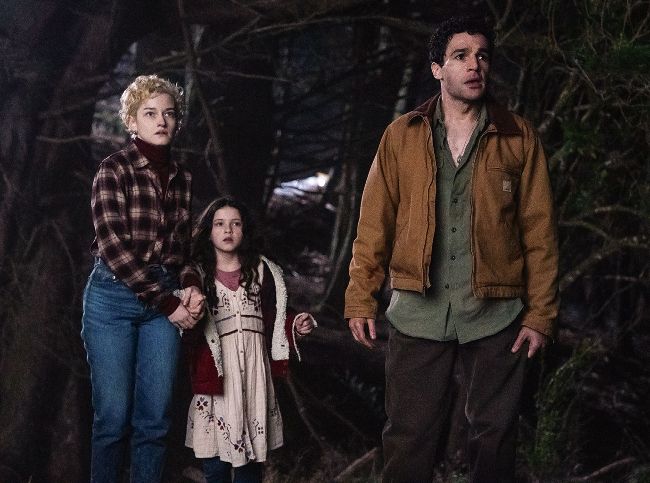
Julia Garner, Matilda Firth and Christopher Abbott.
PICTURES: NICOLA DOVE/UNIVERSAL PICTURES. STOCK IMAGES: VECTORTATU, SOLARSEVEN/GETTY
REALITY BITES
Like that previous effort, Whannell’s
Wolf Man
(yes,
sans
definite article) is set in the present day, and takes a markedly different approach to the material than its famous forebear.
“Absolutely, I would say there’s a commonality between the two films,”
Whannell tells SFX when we pose the question. “I’d sum it up by saying that my approach is to make it as grounded as I can.
“I’m a big fan of gothic horror movies. I love what Tim Burton did with Sleepy Hollow, and I love what Guillermo del Toro does. There’s such beauty to those gothic elements, like fog and cemeteries on a hill backlit by the Moon. From a production design element, I love all that stuff… but I think I love it more as a viewer.
“I’m the guy to watch that stuff, but I’m not the right guy to make it,” the director explains. “When it comes time for me to make a monster, my mind immediately wants to place that monster in the real world and take a very grounded approach: we’re not dealing with a fairy tale here, we’re not dealing with a folk tale, we’re dealing with something that could really happen.”
So instead of a heightened look, Wolf Man has a “pretty muted palette”, Whannell says, similar to The Invisible Man. “For both movies, Stefan [Duscio, cinematographer] and I were heavily influenced by Roger Deakins’s work with Denis Villeneuve, like Sicario and Prisoners. If you look at those movies, they’re beautifully photographed, without calling attention to themselves.