THE EVOLUTION OF WIPEOUT
AFTER MAKING GAMING HIP IN THE MID-NINETIES, THE FUTURISTIC PSYGNOSIS RACER WIPEOUT WENT ON TO INSPIREA LONG LINE OF POPULAR FOLLOW-UPS. KEY CREATIVES, INCLUDING NICKY PLACE, ROB FRANCIS AND KARL JONES EXPLAIN HOW THE LONG-RUNNING SERIES KEPT ITS COOL
WORDS BY RORY MILNE & DARRAN JONES

» [SNES] Although WipEout has its own style, its mechanics are largely based on Super Mario Kart.

» [PlayStation] Before WipEout, Pygnosis had made a string of other sci-fi games such as the shoot-’em-up Novastorm.
Even among a strong line-up of European PlayStation launch titles, WipEout stood out from the crowd. The Psygnosis game’s techno soundtrack, futuristic polygon visuals and breakneck speed were such a novel combination that it seemed like an immaculate conception. This was far from the case, however, as its designer Nick Burcombe had borrowed the game’s mechanics from a SNES racer, and its concept artist Jim Bowers’ gravity-defying ships had made their debut on the silver screen, as former Psygnosis creative Nicky Place points out.
“Nick Burcombe used to play Mario Kart while listening to really loud dance music, and he thought how ace it would be to develop a game that put those two things together,” Nicky recollects. “Around that time, Jim Bowers was doing a sequence for the film Hackers, where the characters played a game with anti-grav racing ships, and that brought him and Nick together. Jim had also been instrumental in the look of the shoot-’em-ups Microcosm and Novastorm, but the shooting in WipEout was because of Mario Kart.”
“NICK BURCOMBE USED TO PLAY MARIO KART WHILE
LISTENING TO LOUD DANCE MUSIC, AND HE THOUGHT HOW ACE IT WOULD BE TO DEVELOP A GAME THAT PUT THOSE TOGETHER”
NICKY PLACE

» [PlayStation] The future depicted in WipEout incorporates everything from idyllic countryside settings to dark dystopian vistas.

» [PlayStation] A CGI-rendered WipEout prototype appeared in the movie Hackers prior to the release of the PlayStation game.
In fact, WipEout had near-identical power-up mechanics to the popular SNES title. It even depicted its power-ups as icons painted onto its courses, which led to greater involvement in the project by its renowned cover artists. “That was a key element in Mario Kart – driving over speed boosts or whatever,” Nicky acknowledges. “It was that thing of trying to force players to be on a particular part of the track. The icons were all developed by The Designers Republic, which was originally just going to be doing the packaging, but we wanted to make its designs a really key part of the game’s aesthetics. So first and foremost it was about mechanics, and secondly we needed to think about what things were going to look like.”
But while the collectible single-use weapons imprinted on WipEout’s tracks were down to Nintendo’s racer, the Psygnosis title’s ships were a product of the firm’s earlier work. “Jim was developing lots of really cool concepts,” Nicky enthuses. “He was driving a lot of the visual output and conceptual art at Psygnosis, as well as some of the tech he was using. He was the concept artist for the anti-grav ships, which he had built this amazing ‘scratch’ model for. I think the ships lent themselves so well to the gameplay. The idea was that you could actually fly a lapped track, which meant we didn’t have to create the dynamics of a car stuck to a course.”

» Artist Nicky Place helped shape the look and style of the first three PlayStation WipEout titles.

» Rob Francis had design roles on WipEout 2097, WipEout 64 and WipEout Fusion.

» Wip3out was one of the earliest projects that coder David Jefferies contributed to.

» After playtesting WipEout Fusion, Karl Jones was a designer on Pure, Pulse, HD, HD Fury and 2048.

» Nick Roberts is head of studio at Amuzo Games and has overseen work on WipEout Rush and Merge.

» [PlayStation] Unlike the firearms in its predecessors Microcosm and Novastorm, the weapons in WipEout are single-use.
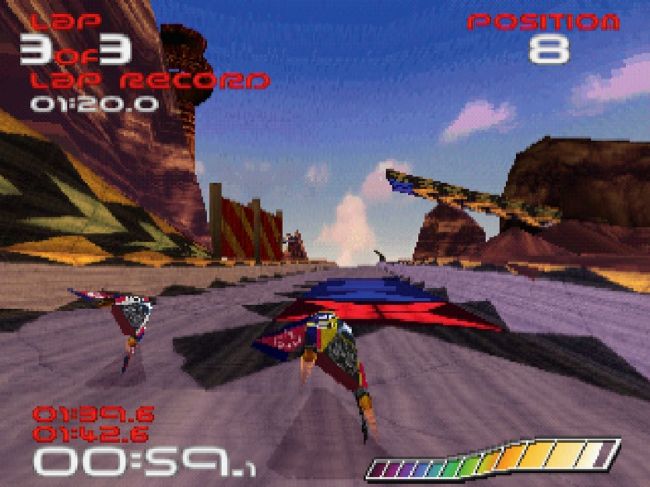
» [PlayStation] The anti-grav ships in WipEout allow you to pull off banked turns around the tightest of bends.

» [PlayStation] Unlike in the original, your ship blows up in WipEout 2097 if you take enough damage.
Further freedoms stemmed from WipEout’s futuristic setting, although Nicky was keen that it should have a realistic look that wasn’t too dissimilar to the 20th century. “The opportunities were that it was fun just to create things that had never been thought of before,” Nicky reflects. “So billboards in the future, and things like giant walkways. But it was very much rooted in normality, even though it was futuristic, so there was stuff that you could have just been driving around. We were also playing with the idea that yes you might have these great metropolises, but there would also still be some natural world left. So there were rolling hills and mountains.”
This leaning toward rural locations was driven by expediency as much as design, so much so that all but one of WipEout’s tracks was set in a natural environment.
“There were questions about how we could make big things quickly, and I think Nick suggested that a track might be heading inside a mountain,” Nicky ponders. “Whereas if we had made a big city there would have been a lot of detail we’d have had to put in there to make that believable. We could do elements of that when you got a very close view, but where you got a wide view we needed something big that wasn’t going to take us forever to model.”