Prophet Without Honor
Francis Galton and the Birth of Behavioral Genetics
BY ROBERT G. GOLDSTEIN, MD
THE INVENTION OF THE MICROCHIP HAS transformed molecular biology, yielding great progress in genomic medicine—especially in fields such as oncology and infectious disease. Unraveling the genetic underpinning of mental illness, however, has proved more daunting. This is hardly surprising, as many psychiatric disorders are highly heterogeneous and therefore difficult to link to specific genes. Further, most behavioral traits are likely polygenic—that is, controlled by many interacting genes. But despite slow progress in the area of behavioral genetics, psychiatry—after many decades lost in the wilderness—has benefited enormously from advances in neuroscience and has established itself as an empirically based medical discipline.
Unfortunately, psychoanalysis dominated American academic psychiatry during the middle decades of the twentieth century. Although it has since lost much of its influence, psychoanalytic thinking did much to obscure the prominent role of genetics in mental illness. Furthermore, despite significant advances in our understanding of the biological bases of behavior, psychoanalytically-tinged thinking has stubbornly hung on—having so thoroughly infected Western culture and folk-psychology. (Superstition, it has been said, may assume many disguises.)1 Large segments of the population, including many therapists, still assume a person’s behavioral problems and proclivities are predominantly shaped by one’s close relationships and “formative” experiences. In therapists’ offices throughout the world a watered-down version of Freud’s approach often still plays some role in the therapeutic process, as the patient (with the therapist’s guidance) concocts a “how-the-leopardgot-its spots” story of his or her current difficulties. We now know, however, that the mind is not structured along narrative principles but rather according to the laws of natural selection—from a blueprint written in digital code, composed of the base pairs that constitute our genetic endowments.
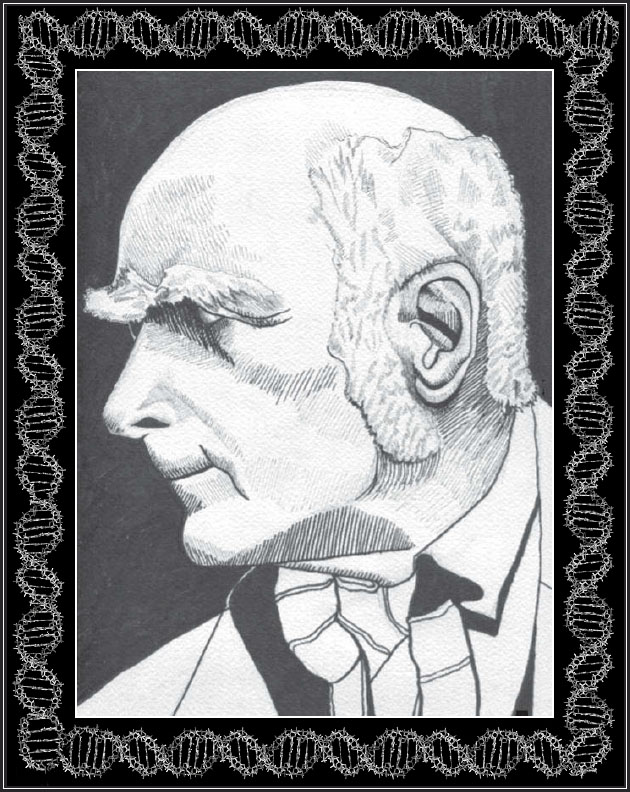
Francis Galton, Darwin’s cousin and the founder of the field of behavioral genetics.
Illustration by Anna L. Goldstein
While Freud was on the continent developing that prodigally creative but highly fanciful blend of nature philosophy, philology, and crypto-science he would call psychoanalysis, across the channel in the English countryside, the true scientific revolution led by Charles Darwin had already taken shape. Darwin’s theory of natural selection is generally thought to focus chiefly on the evolution of physical characteristics and the differentiation of species; however, Darwin showed a keen interest in behavior throughout his career—from the chapter on instinct in The Origin of Species to the two major works that are in good measure devoted to the study of behavior (The Descent of Man and The Expression of the Emotions in Man and Animals). Less well known is the important role that Darwin’s cousin, Sir Francis Galton, played in the Darwinian revolution. Galton explicitly tried to extend Darwin’s project by undertaking the first empirical studies of the inheritance of mental characteristics in humans; in doing so, he became the founder of the discipline known today as behavioral genetics.
I have often wondered when the idea first took hold of Galton: that the lineaments of our destinies lay buried in our forbearers’ graves; that one is born, in a sense, fully formed according to the laws of a yet undiscovered science—the earliest particulars of which would soon be illuminated by a Moravian beekeeper named Mendel. Perhaps it was during that dreary November in 1840 while he was a student at Cambridge. He was a callow first-year but he knew one thing for certain: he was quite unwell. The rigors of academic life (mathematics in particular) had caused him to take to bed—the first in a series of mental collapses. I imagine it was then that Galton first began to wrestle with the enigma of temperament and its transmission through the generations. Maybe it was the shape of his thin, tight-set mouth that reminded him of a close relation—one who had also suffered bouts of nervous exhaustion. Perhaps, immobilized in a bath growing lukewarm he thought: someone who came before me must have experienced this exact cast of mind—this “mill… working inside my head.”2 He would recover and go on to complete his degree but the riddle of inheritance would occupy him for a lifetime. The youth, who was driven to bed by the calculus, would go on to become founder of the discipline of biostatistics, a close collaborator of Darwin and a prodigiously inventive scientist in his own right.