An Easy Guide to Baloney Detection!
Hello!
In this special issue of Junior Skeptic we’ll learn many valuable tricks for sorting truth from nonsense. We need them!
We’re bombarded by claims every day of our lives. Friends tell us stuff. Labels and advertisements make claims about products. Books and websites make claims about the world. TV and YouTube channels show us amazing sights and tell us astonishing stories. But some of the things we hear sound too good to be true. How do we tell the difference between fact and baloney?
Let’s find out!
Sagan’s “Fine Art of Baloney Detection”
There was once a famous astronomer, book author, and TV star named Carl Sagan. He spent much of his life trying to teach the public about science— not just the cool things scientists have learned, but also the methods scientists use to find things out.
Sagan loved science, saying, “When you’re in love, you want to tell the world.” He thought every person deserved to share in the wonder of great scientific discoveries.
But Sagan was also frustrated to see people “bamboozled” by false claims. He didn’t like seeing people get cheated by scammers or taught things that weren’t true. He was convinced that people would get fooled less often if we all learned more of the thinking habits scientists use to solve problems.
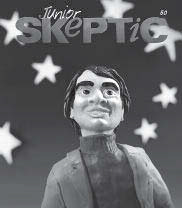
To learn more about Carl Sagan’s life and work in skepticism, see Junior Skeptic #50
He shared some of those methods for scientific thinking 30 years ago in an article called “The Fine Art of Baloney Detection,” then expanded his thoughts in his book The Demon-Haunted World. Sagan wrote,
In the course of their training, scientists are equipped with a baloney detection kit. The kit is brought out… whenever new ideas are offered for consideration. … What’s in the kit? Tools for skeptical thinking.
Today we’re going to put together our own baloney detection kits, starting with Sagan’s top ten tips for thinking like a scientist. We’ll learn what questions to ask when we hear weird things. We’ll learn how to avoid getting fooled by sloppy or slippery arguments—and also learn how to avoid fooling ourselves!
Sagan’s Ten Tools for Detecting Baloney (adapted for younger readers)
1 “Facts” Need Double-Checking
Sometimes when we look closely at a supposed “fact,” it vanishes in a puff of smoke. That’s because people make mistakes and assumptions—and sometimes make stuff up. Other people may repeat what they hear without checking. That’s not a good idea. “Wherever possible,” Sagan wrote, “there must be independent confirmation of the ‘facts.’ “
In some jobs it’s super important to get the facts right. For example, several hospital workers may check and re-check a patient’s name before they’re wheeled in for surgery. It wouldn’t be good to operate on the wrong person! Nurses, reporters, spies, and scientists all learn the habit of double-checking. Does that unusual radio signal come from deep space, or perhaps only from a nearby satellite? Scientists double-check!
2 Encourage debate
“Making an argument” doesn’t mean squabbling, but “presenting a case”— explaining why we think a certain thing and trying to convince others that we’re right. But it’s hard for most people to evaluate arguments about science or other complicated subjects. We just don’t know enough to have informed opinions. We need people who do.
For this reason, Sagan said we should encourage serious “debate on the evidence by knowledgeable” people from “all points of view.”
3 Beware of arguments from authority
When someone tells us something must be true because a wise or important person said it’s true, that’s an “argument from authority.” Such arguments “carry little weight,” Sagan explained, because
“authorities” have made mistakes in the past. They will do so again in the future. Perhaps a better way to say it is that in science there are no authorities; at most, there are experts.
Experts are people who’ve studied a topic for a long time. They’re more likely to have reliable knowledge about that topic, but not every topic. And even the most knowledgeable experts still make mistakes.
4 Spin more than one hypothesis
“If there’s something to be explained,” Sagan advised, “think of all the different ways in which it could be explained.” People often latch onto the first explanation that feels right without stopping to consider other possibilities. For example, a person who hears a strange noise in the night might suppose it is a ghost. But even if ghosts were real things, lots of other things cause noises. Could it be a burglar, or a cat, or the wind? Raccoons raiding the trash can? A television next door? If we consider many possible explanations—many “hypotheses”— we’re less likely to overlook the correct one. The next step, Sagan said, is to “think of tests by which you might systematically disprove each of the alternatives.” What’s left after testing has a “much better chance of being the right answer than if you had simply run with the first idea that caught your fancy.”
5 Don’t get too attached to your own hypothesis
Science solves problems using a simple but a mighty one-two punch: propose many possible explanations (hypotheses), but don’t believe them until after they are tested. It’s essential to remember that every proposed explanation is just an interesting notion until evidence tells us whether it’s right or wrong. “Try not to get overly attached to a hypothesis just because it’s yours,” Sagan warned. “Ask yourself why you like the idea. Compare it fairly with the alternatives. See if you can find reasons for rejecting it. If you don’t, others will.”