Why Freud Matters
Sigmund Freud, Anna Freud, and the Skeptical Humanist Tradition
ARTICLE
BY RAYMOND BARGLOW
“A great part of my life’s work has been spent to destroy my own illusions and those of humankind.” Sigmund Freud
“What a distressing contrast there is between the radiant intelligence of the child and the feeble mentality of the average adult.” —Anna Freud
Over the past half century, some of Sigmund Freud’s ideas have been debunked, and he personally has been exposed as a doctor who misunderstood and harmed a good number of his patients.1 I do not take exception to this evaluation. Especially during the years when he was building his career as a doctor, the founder of psychoanalysis deceived the public, if not himself, about the evidence for his views and his ability to cure. There is, however, another side to Freud’s character and to his achievements that the critics overlook. Indeed I believe that Freud belongs up there in the pantheon of great skeptical humanists alongside Socrates, Voltaire, and Hume. Like them, Freud believed that reason could help people undo the hypocrisies and deceptions in their lives, permitting a recovery of sanity and a measure of happiness.2
Freud’s critics also ignore contributions made over the past century by the psychoanalytic movement that he inaugurated. To make this second point, I’ll review the accomplishments of Sigmund Freud’s daughter Anna, whose role was pivotal in developing psychoanalysis in an openminded, evidence-based way. Her work is a telling counter example to the broad claim that psychoanalysis is an irrational theory and ineffective practice.3 Anna Freud and her colleagues not only observed assiduously, but also subjected the very concept concept of “observation” to scrutiny. When adults are observing and interacting with children, Anna Freud recognized, their perceptions may be clouded by their prior expectations: observers see what they wish to see and overlook or push aside everything else.
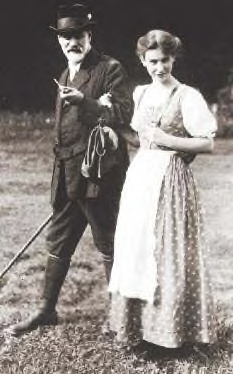
Anna and Sigmund Freud. Wikimedia Commons:
https://goo.gl/Jgk2vr
Mistaking Our Own Motives
Although Sigmund Freud’s own professional conduct was marred by the prejudices of his time, some of his concepts do cast light on the sources and nature of human irrationality. Freud believed that the mind is influenced by unacknowledged motives and unspoken memories. And that belief informed not only his “talking cure” therapy but also his social activism on behalf of issues that ranged from free mental health care to the humane treatment of shell-shocked soldiers who had survived the First World War.
Since the early 17th century when René Descartes penned his Meditations, rationalist philosophy had held that the human mind is unified and transparent to itself. Freud affirmed instead—and this is the premise that still informs psychoanalysis today—that humans are inclined, by nature and by nurture, to misunderstand their reasons for believing and acting. That we are fallible in this manner, mentally conflicted and influenced in ways that we only partly understand, is a condition that Freud found illustrated ubiquitously in dreams, slips of the tongue, religious beliefs, sexual preferences, and the foibles of our relationships with others. And he made this “diagnosis” of the human condition the basis for doing psychotherapy in a new way.
Freud perceived himself as following in the footsteps of those who had in the past challenged the pretense that human beings stand exalted as masters of their own fate and the pinnacle of creation:
Human pride now has to suffer, Freud wrote, a third, “most bitter blow” from empirical inquiry, which discloses “to the ‘ego’ of each one of us that he is not even master in his own house.” This view of the mind’s internal division launched what might be called a “research program” that since the turn of the 20th century has encompassed a great deal of qualitative and quantitative study of human psychology. And much of that study has been skeptical in character, calling into question not only conventional understandings of individual pathology but also wider cultural values and practices.
Psychoanalysis as a Research Program
It’s true that not many studies conducted within a psychoanalytic framework satisfy the gold standard in medical science: the randomized controlled trial based on quantification and statistical analysis. Certainly the activity of observing a child in a clinic is quite different from that of observing a planet through a telescope or a bacterium on a petri dish. However, these forms of inquiry also have much in common. The qualitative research, carried out in Anna Freud’s “laboratories”—nurseries, clinics, residential and day care centers—was guided by the same criteria of systematic observation, conceptual parsimony, and explanatory power that guide rational empirical inquiry of any kind.