God, Heaven, and Evil
A Renewed Defense of Atheism
BY KEN LEVY
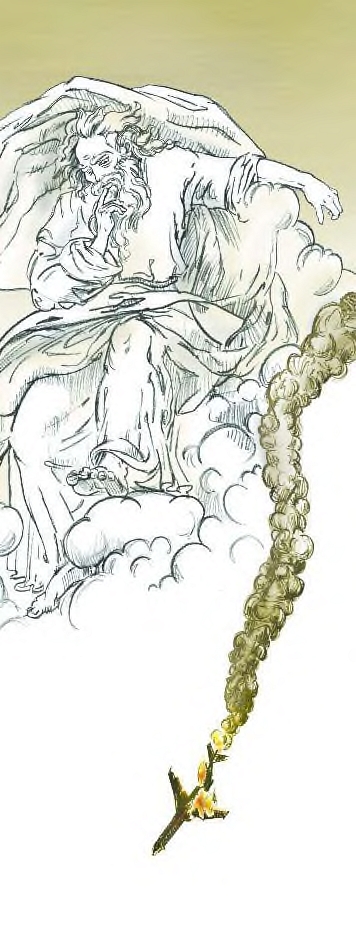
Drawn after Ercole Setti’s “God the Father Seated Among the Clouds (c.1530–1618).
After EgyptAir Flight 804 crashed on May 19, 2016, I asked the same question that many others undoubtedly asked as well: How could God let this happen? Of course, this plane crash is just one relatively small tragedy in the whole scheme of things. When we add in all of the other tragedies—all the violence, pain, suffering, and premature death that occur on this planet—the same question becomes correspondingly more difficult to answer.
This is the problem of evil, an argument that is typically used in support of atheism. If God were omnibenevolent, He would want to minimize such evils as violence, pain, suffering, and premature death; if God were omniscient, He would know everything that is happening in the universe; and if God were omnipotent, He would be able to act on His omnibenevolence and omniscience to prevent most or all evil from occurring. Yet all of this evil still occurs. Therefore God—an omniscient, omnipotent, and omnibenevolent being—probably does not exist. If a higher intelligence exists at all, it probably lacks at least one of these three qualities.
Theists, or believers, generally respond to this argument by proposing two reasons to believe that God’s existence is perfectly compatible with all of the evil that we observe and experience:
1. Despite His omnipotence, God simply could not have created a world that lacked evil. If there is to be good, there must also be evil. The existence of evil makes good possible.
2. Evil contributes to a much greater or higher good. For example, suffering builds moral character or brings victims much closer to God or to each other.
Believers always have at least these fallback answers at their disposal to allay any theological doubts. But the very fact that these two hypotheses can be applied no matter the kind or degree of evil in question should make us suspicious. Quite simply, they prove too much. They commit theists to the incredible position that God’s existence should not be doubted even if the degree of evil in the world far outweighs the good. Atheists are right to respond to this theistic “spin”: if God exists no matter how much evil there is, then what good is He in the first place? Better, it would seem, to have much less evil and no God than much more evil and God.
Believers typically supplement (2) above with the “free will defense”: God preferred to create a world in which humans have free will and therefore the capacity to perform evil acts rather than a world in which they lack free will. He preferred this world, a world in which humans are free to do wrong, because it is far more valuable, both in itself and to humans themselves, than a world in which they are forced always to be good. Humans who consciously make the choice to follow God’s commands—notably the moral laws embodied in the believer’s holy text, such as the Ten Commandments— experience and exhibit a much more profound knowledge of, and love for, God than humans who follow them out of either primitive fear or blind compulsion, or don’t follow them at all.