American Atlantis
A review of America Before: The Key to Ear th’s Lost Civilization by Graham Hancock
REVIEWED BY JASON COLAVITO
St. Martin’s Press, New York, 2019. 608 pp. $29.99 ISBN 13: 978-1250153739
IN 1552, THE HISTORIAN FRANCISCO López de Gómara became one of the first to suggest that the American continents were in fact Atlantis. America was, he said, greater than Africa and Asia combined, and the peoples of Mexico even called water “atl,” the very name of Atlantis, in memory of the sunken capital of ancient times. Nearly five centuries later, the new book America Before opens with its author, Graham Hancock, telling readers that after decades of ignoring the “obvious clue” of Atlantis because of the stigma attached to such research, he had come to believe that the lost continent “does sound a lot like America.”
America Before is the story of Hancock’s search for proof that Atlantis—or a civilization so similar as to be identical in all but name—flourished in the Americas prior to the end of the last Ice Age. His new book, handsomely produced by St. Martin’s in the United States and Coronet in the U.K., is well written and copiously illustrated.
In his early books on ancient mysteries, such as The Sign and the Seal (1992) and Fingerprints of the Gods (1995), Hancock wove a compelling narrative from sparse facts and heady speculation. These books were written as adventures in which Hancock cast himself in the role of a tweedier Indiana Jones, traveling the world in search of evidence of the impossible. Regardless of the conclusions he drew, the personal narrative of discovery created a compelling through-line that made these books engaging even for those who disagreed with the author’s ideas.
But with each successive book, Hancock seems to increasingly expect his readers to have read his earlier work. Although he remains a formidable writer capable of compelling narrative set-pieces, Hancock’s recent books have lacked something of the spirit of adventure of his earlier work. Since he is no longer an innocent questing for truth but a self-styled advocate of “alternative archaeology,” his books have taken on the tone of jeremiads, their sense of wonder and discovery replaced by righteous indignation and the casual assumption that most readers will already be familiar with his earlier volumes, which he references frequently with the clear expectation that readers have read and largely agreed with them.
This leads Magicians of the Gods (2015) to seem somewhat disjointed to those unfamiliar with Fingerprints. Now America Before plunges the reader headlong into a web of assumptions and conclusions that don’t always have clear lines of evidence leading to them. In just the first few pages, Hancock dismisses the consensus view of the peopling of the Americas without ever quite explaining it, and he attacks “the materialist-reductionist mind-set of Western science” with the assumption that his readers are familiar with the philosophy of science, or at least angry enough at scientists to nod in agreement. His writing is much angrier even than in Magicians, with a greater number of charged asides attacking science and celebrating the spiritual over the material. His attacks on archaeology are much louder than in earlier books and in places distract from or even overwhelm his putative argument.
I say this with regret because I have genuinely enjoyed reading Hancock’s earlier books, even if I disagreed with their conclusions. My differences with Hancock are with his ideas, not with the man. In fact, and for full disclosure, Hancock read the manuscript for my own forthcoming book on a similar topic to America Before (the myth of the Mound Builders) and kindly recommended it to his editor, though my book ultimately ended up with another publisher.
America Before is divided into eight somewhat loosely connected parts, which we will consider in turn.
1. Manitou: The Mystery of the Serpent Mound
The book first focuses on Ohio’s famed Serpent Mound, an earthwork whose origins are still debated. While that debate largely focuses on whether it was the work of the Adena culture (1000- 200 BCE) or the Fort Ancient culture (1000-1750 CE), Hancock zeroes in on its seeming astronomical alignment to the summer solstice sunset to speculate that it may be 13,000 years old. The reasons are complex, but the short version is that in 1987 some scholars argued that the earthwork was aligned at an azimuth of 302°. However, the solstice sunset took place at an azimuth of 300° and five minutes. The sun last set at that angle around 11,000 BCE. Ergo, the assumption of perfect accuracy creates an illogical result. But even if the argument were sound, Hancock instead chooses to frame it around his own outrage that archaeologists won’t accept the date, blasting thirty-year-old journal articles for what he sees as unwarranted sarcasm. He neglects to note that excavations at the site have not turned up any evidence for 13,000- year-old mound builders. He does concede, however, that later research revised the solstice alignment from 302° to 300°, rendering the whole point moot.
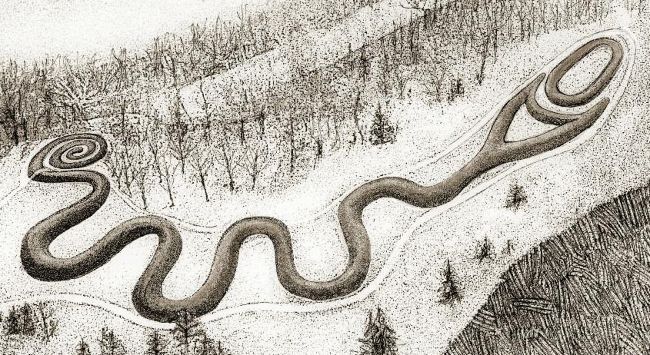
The Great Serpent Mound is located in Adams County, Ohio atop a peninsula shaped plateau between Ohio Brush Creek and a smaller tributary. The undulating shape of the effigy figure is about 3 feet high and 1,348 feet (411 m) long. The site is a park maintained by the Ohio History Connection. It is a United States Department of Interior National Historic Landmark.
Hancock describes the various efforts to understand Serpent Mound as attempts to create “doctrine,” rather than what they were—arguments among specialists that represented the best conclusions based on evidence then known. As the evidence improved, the conclusions changed. This is, for Hancock, “an Orwellian scene” whereby older hypotheses are “disappeared” as new ones, better supported by evidence, take their place. He calls the hypothesis that the Fort Ancient built the mound—a hypothesis later superseded by new and better evidence for an Adena construction followed by a Fort Ancient renovation—“a fairy-tale castle of speculation” (27) and claims that archaeologists like Brad Lepper merely wave “a magic wand” to fit sites into a very short chronology. Hancock characterizes scientific conclusions from available evidence as definitive dogmas, even though the nature of science is provisional and new evidence can and does demand new conclusions.
To this end, Hancock speculates that because snakes shed their skin, the mound’s serpentine shape could suggest that it may date from the Ice Age with periods of rebuilding every few centuries. No evidence supports this claim, but Hancock says none is needed, for it is possible that the Adena simply carted away the whole of the original mound (!) and rebuilt it from scratch, leaving no trace of the first mound. “Why not?” he asks.
Well, for one thing, people leave evidence of their presence, and no evidence suggests a mound dating back 13,000 years. The wholesale removal of an earlier monument, besides being impractical, would have left some trace behind to show it had occurred.
Hancock adds that after the mound’s supposed Ice Age origin, it was first rebuilt in 5000 BC. He bases this on the work of Ross Hamilton, author of Mystery of the Serpent Mound (2001), who claims that the Serpent Mound is a perfect image of the constellation Draco as it appeared in that year. Any undulating shape will bear a resemblance to Draco, and it is not beyond possibility that the constellation was intended. However, there is no evidence that the date of 5000 BCE was targeted, or that that Native peoples of Ohio recognized the same set of stars that we call Draco, especially since the constellations didn’t take their modern form until the Greeks modified Babylonian astronomy around 500 BCE, many thousands of years after the supposed 5000 BCE construction date.
While it is true that many cultures depict the circumpolar stars as a serpent, it is by no means universal, despite Hancock’s efforts to suggest otherwise.
The early Arabs, for example, saw it as two hyenas attacking a camel. Under the influence of Greek classics, Draco appeared in its serpentine form in later Arabic treatises, from which Hancock falsely implies an independent origin.
Hancock doesn’t flinch when Hamilton tells him, without evidence, that the Serpent Mound once featured a giant glowing crystal atop the head of the snake. The warrant for this is a Cherokee legend about the snake Uktena and the giant crystal Ulûñsû´t?i, which sat on its head and could give a warrior the ability to perform magic.
The story has no known connection to the Serpent Mound, geographically or temporally, and for good measure, the magic crystal story given in the book Hamilton cited when speaking to Hancock— James Mooney’s Myths of the Cherokee (1900)—doesn’t match the description he gave Hancock, who apparently did not check.