The Problem with the Walking Dead
And How They Flummoxed Science for Centuries
BY JAMES CLOSE
Van Helsing: “I want you to believe.” Dr. Seward: “To believe what?” Van Helsing: “To believe in things you cannot.”
—Bram Stoker, Dracula, 1897
The undead have been troubling humanity since the dawn of time. The world’s oldest reference to them is a 2,700-year old Mesopotamian clay tablet, which translates: “And the dead will rise up to eat the living, and the dead will outnumber the living!” Fastforward nearly three millennia and these words feel unnervingly modern, summarizing plotline for one of the world’s most popular TV series, AMC’s The Walking Dead.1
Surveys of global folklore confirm the idea of a “global undead.”2 But these revenants aren’t always as we imagine. Take, for example, the blood sucking vampires of Slavic tradition. They weren’t debonair aristocrats with castles and cloaks, like we see in the movies. Instead, they had more of a ghoulish character—dead peasants, rotten and fetid. Greek folklore warns us about the vrykolakas—ruddy corpses, engorged with fresh blood. The Vikings were plagued by the vile and bloated Draugr. In Germanic cultures, there is the nachzehrer, chewing through their shrouds, before sucking the blood of other corpses. There is the Chiang-Shih “hopping vampires” of China and the Arabic ghu¯l (ghoul). In the Philippines, the kalag or aswang can be heard in graveyards, eating newly buried bodies. Even the Indigenous Australians—separated from other populations 62,000 years ago3—have the blood sucking Yara-ma-yha-who.
These weren’t just idle folk stories. Instead, many people were truly paranoid that the dead might arise, taking precautions to keep corpses secured in their graves. The archaeological record bears testament to this grim history. In Bulgaria, for example, there have been reports of 700-year-old skeletons with ploughshares—the hefty blade of a plough—thrust through them.4 In Poland, bodies have been discovered with iron sickles over their throats—a self-decapitating booby trap against the walking dead.5 In Ireland, two 8th-century “zombie burials” were discovered with rocks rammed in their mouths, stopping them from ever biting anyone. 6 Similarly, the “Vampire of Venice” was disinterred with a large brick wedged in the teeth.7 Other times, people were so paranoid they pursued a range of preventive measures. In the English village of Wharram Percy, medieval peasants mutilated, decapitated, and then burnt the bodies of 10 villagers.8 According to Andrew Reynolds, Professor of Medieval Archaeology at University College London, there is “no good reason to doubt…that the primary aim was to prevent the corpse returning to haunt the living.”9
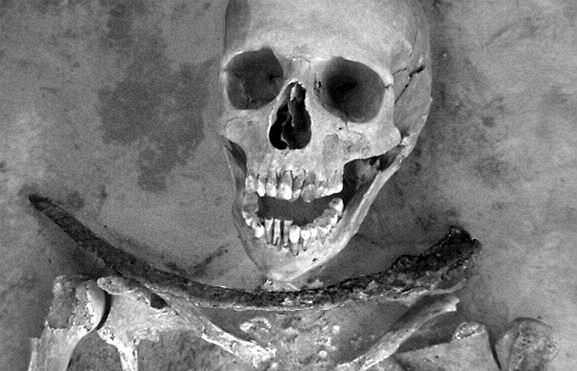
A sickle around the neck keeps this vampire in the grave. (Gregoricka et al. / PloS ONE).
Why all this fear? Why were people so paranoid about dead bodies rising up from their tombs? And why did these undead want to drink the blood and eat the flesh of the living?
Voltaire: The Ultimate Skeptic
During the Enlightenment, one might have expected the undead to have stopped bothering humanity. Not so. If anything, the problem got even worse. Early in the 18th century, the Hapsburg Empire was plagued by a series of vampire attacks. Numerous rumours circulated about nighttime assaults, followed by death and disease. Corpses were exhumed, discovered in a so-called “vampiric condition” and the alleged vampires were dispatched—usually by staking or beheading. Voltaire, always the skeptic, said the craze was “in Poland, Hungary, Silesia, Moravia, Austria, and Lorraine.”10 News of the attack spread across Europe. The controversy was dissected in early scientific periodicals, and it shaped into something of an early media frenzy.11 By 1732, the situation had reached peak vampire, with 12 books and four dissertations published in a single year. Voltaire noted, “vampires were the sole matter of conversation between 1730 and 1735.”12
The key theological verdict was given by the Benedictine monk and Church-appointed vampire investigator, Dom Augustin Calmet (1672-1757).13 His conclusions took an often skeptical tone, generally regarding vampires as a harmless superstition.