Conspiracy Theories
Why We Can't Unsee Patterns—Real or Imagined— Once We See Them
BY ROBERT D. KIRVEL
Introduction
EFFECTIVE CONSPIRACY THEORIES TYPICALLY CAPTURE and hold attention through audacious, often sinister, allegations rooted in emotion rather than an analytical or documented chain of cause and effect. Research on factors associated with conspiracy beliefs, including proposed political and psychological motives, has accelerated in the past decade, and the principal findings are revealing. However, largely ignored in the literature—although addressed in Skeptic’s recent cover story on conspiracies (Vol. 25, No. 1, 20201)—are some underlying considerations that might provide a foundation for human predispositions toward conspiracism, as reflected in the universality of conspiracy theories across cultures and throughout recorded history.
Three additional foundations to conspiratorial belief that I would like to explore here are: (1) the mathematical Ramsey theory, which shows how order (the perception of organization) must invariably appear from apparent disorder; (2) the neurophysiology of signal and pattern recognition underlying the ways vertebrates are “tuned” to detect information that is biologically or evolutionarily adaptive for survival; and (3) a human predisposition to derive and superimpose emotionally meaningful interpretations on sensory input and then to adjust behavior accordingly.
Given the broadly documented, emotional quality of conspiracy beliefs, together with additional psychological mechanisms suggested by other investigators, such as biased assimilation and motivated reasoning, conspiracism appears to be a predictable outcome in individuals who may lack or reject more analytic and cognitive tools to arrive at rational explanations for events.
Secret Plots
Conspiracy theories are notions or purported explanations, often with negative connotations, about some event that feature a secret, insidious, or fiendish plot as a central feature.2 The goal of the alleged cabal is often to deceive and manipulate people or to usurp political or economic power. Machiavelli advised in The Prince against advancing conspiracy theories because real conspiracies often fail to achieve desired ends. Modern research points to more troublesome effects, including the sowing of social discord, violence, and public mistrust while undermining constructive discourse on important issues. Even unlikely conspiracy theories can have adverse effects on people’s lives, health, and safety.3
Actual conspiracies, such as bribery or collusion among team players to lose a championship game, insider trading or schemes to cheat regulatory standards, and plots to rob a bank, involve real events with a documented chain of cause and effect. In contrast, conspiracy theories offer allegations that are often social in origin and outcome, rooted in emotion, diabolical in tone, intuitive rather than analytical, and that may or may not be true.
Despite their adverse consequences, conspiracy beliefs are not limited to fringe groups, and their prevalence cannot be blamed on the internet or social media. Instead, they are pervasive across cultures and throughout recorded history, and they can crop up almost anywhere. Among the more enduring in Western culture are notions about John F. Kennedy’s assassination at the hands of a massive cabal involving the CIA, Russians, Cubans, and the Mafia; NASA moon landings being staged by the government; UFOs and aliens landing on Earth; secret societies controlling nearly everything; and 9/11 as an inside job. A 2016 survey by researchers at Chapman University4 found the following percentages of Americans surveyed who agree or strongly agree that “the government is concealing what they know about…”
CONSPIRACIES & QANON
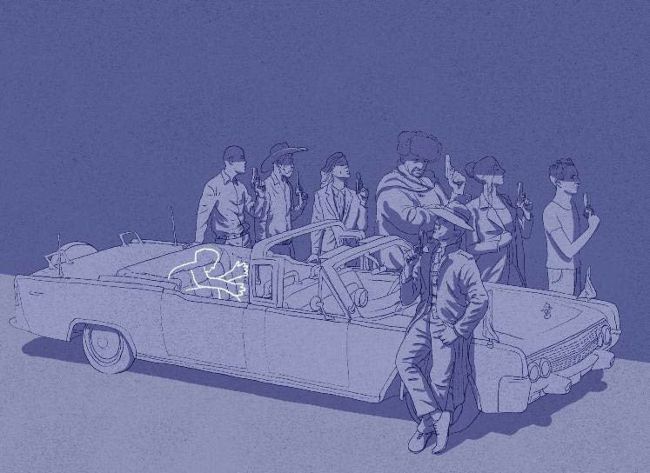
Illustration by Izhar Cohen
It’s no exaggeration to suggest almost every major historical event has generated a conspiracy theory. Indeed, enthusiastic conspiracists have occupied high places in society and politics, including the White House.
Although some conspiracy ideas can be credible— or correct in questioning ethics, politics, or society in general, or useful in holding authorities accountable—intentionally mistaken or absurd theories (e.g., QAnon and the satanic pedophile ring that President Trump is allegedly combatting) can be harmful to individuals or culture as a whole, often by confusing facts and fiction or fueling hatred. Why are crazy or manipulative conspiracy theories so prevalent? Is it true that certain psychological characteristics cause some people with a so-called “conspiracy mindset” to believe them more than others? Scientific studies addressing these questions have mushroomed in the last decade. Other insights on possible origins of conspiracy theories lie in some relatively under-appreciated ideas related to mathematics, biology, and how beliefs are shaped by human emotion and anxiety.