Cognitive Dissonance
Junior Skeptic 79
by Daniel Loxton
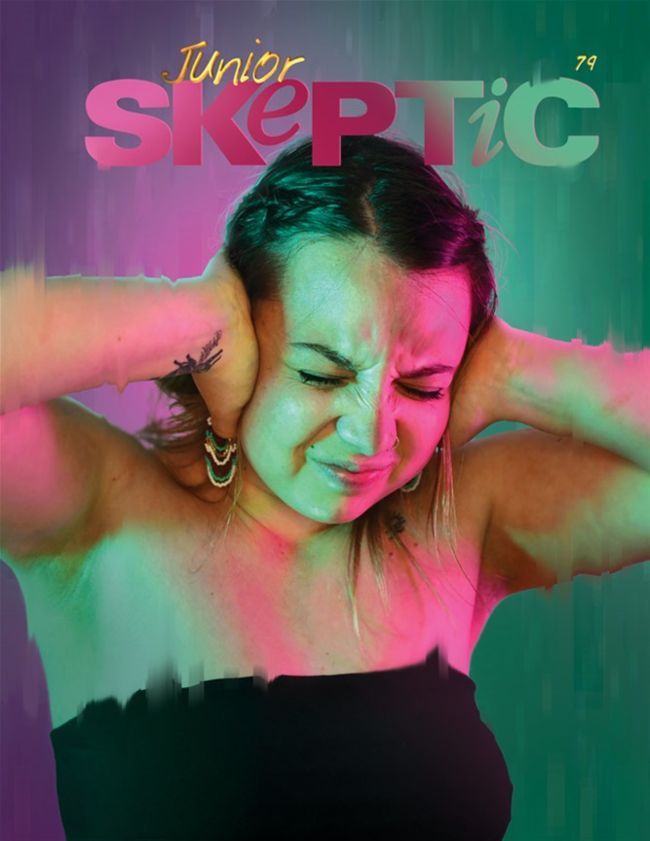
This Issue’s Cover by Daniel Loxton features modelling by Sylvie Gordaneer.
HELLO!
We’ve investigateded some very weird mysteries in the pages of Junior Skeptic. Today we’ll delve into the deepest, strangest mystery of them all: what’s happening inside our own brains!
There are smart people today who believe that the Earth is flat, that they’ve been kidnapped by space aliens, or even that the deadly coronavirus pandemic is a hoax. How is it that so many people believe things that aren’t true, despite strong evidence that they’re wrong? Well, how is it that any of us decide what is true, or which sources to trust? How do our brains sometimes fool us into justifying our silliest beliefs and most hurtful behaviors? Let's find out!
OUR HUMAN SUPERPOWERS
Most of this story will be about the ways our brains work badly, or at least work differently than we expect. But first, let me tell you: your brain is also amazing! Your brain is more powerful than any computer ever built. There is nothing else like it in the animal kingdom. Lots of creatures are smart, but none can match your special human superpowers: imagination, invention, reason, and language.
Humans have used our astonishing brains to create art and science, to cure disease, and even to journey beyond our planet. We’ve changed our own world in ways our prehistoric ancestors could never have imagined. We’ve built cities, planted farms, and created fabulous technologies.
Our world of smartphones, airplanes, and rocket ships is very different from the African grasslands where our ancestors first learned to walk upright — and began to evolve those great big brains.
MYSTERIOUS MINDS
Imagine life in Ice Age Europe 15,000 years ago. The humans who lived at that time had fully evolved modern brains, every bit as clever as ours. They lived in small groups and survived by hunting mammoths and other animals. They used their big brains to cooperate in the hunt, and for useful technologies such as spears, fire, and animal skin clothing. They had plenty of smarts left over for storytelling, cave paintings, and conversations.
They had modern brains, but they were not modern people. Their culture was different. Their languages and beliefs were different. In particular, they did not know any of the things that science has discovered in modern times — including the things science has learned about how our minds really work.
Those Stone Age people would have experienced emotions such as love and anger, just as we do. They would have known that they had thoughts inside their own heads. They also knew they could tell stories and share ideas with the other members of their group.
But they would not always have known why they thought, felt, and believed the things they did. (The truth is, neither do we, most of the time!) Some reactions were obvious, of course, even in the Stone Age. A person might feel angry or scared because another person hit them or threatened them. Some members of a group would be known for certain personality traits such as kindness or courage, which would help other group members to understand and predict their behaviors. But what if a wise leader acted foolishly, or a brave hunter acted cowardly?
Philosophy and the Mind
Sometimes group members would express beliefs or emotional reactions that were difficult to understand. Prehistoric people probably relied on magical explanations for strange thoughts, feelings, and behaviors. If a person acted strangely, they must be influenced by gods, ghosts, demons, or spirits.
We know this belief was common thousands of years later when ancient people learned to plant crops, build cities, and write things down. For example, the Ancient Greek philosopher Plato claimed there were “two types of madness, one arising from human disease, and the other” caused by the gods. Such “heaven-sent madness” could even be a good thing, leading to great poetry and artistic inspiration.
Ancient philosophers, historians, artists, and politicians were very interested in how people think and what they believe. They noticed something you’ve certainly noticed yourself: people believe a lot of things that aren’t true.
Fooling Ourselves
Furthermore, people also believe things about their own beliefs, and those can also be wrong. For example, if you think 1+2=5, you’re wrong about two things: an arithmetic problem, and your own ability to add numbers correctly.
For centuries, philosophers tried to understand how people really think. However, there’s only so much they could learn by thinking about thinking. They needed new ways to learn. Eventually philosophers found what they were looking for: early versions of scientific thinking, such as observing nature and testing ideas through experiments.
English philosopher Francis Bacon promoted this new scientific approach four hundred years ago. He urged people to seek evidence. He knew it was all too easy for us to fool ourselves otherwise. The truth is, people don’t simply accept correct ideas and reject false ones. Instead, Bacon explained, “what a man had rather were true he more readily believes.” Our emotions, wishes, assumptions, and the opinions of others tend to “infect the understanding” without us even realizing.
Bacon made special note of a huge problem: once we commit to an idea, it’s very hard to change our minds—even when the evidence says we should.
The human understanding when it has once adopted an opinion (either as being the received opinion or as being agreeable to itself) draws all things else to support and agree with it. And though there be a greater number and weight of instances to be found on the other side, yet these it either neglects and despises, or else by some distinction sets aside and rejects; in order that by this great and pernicious predetermination the authority of its former conclusions may remain inviolate.
Bacon was absolutely right about that. We do resist changing our minds. In fact, we look for excuses not to. We tend to seek out facts, opinions, and people who agree with the things we already believe. We also tend to ignore or reject evidence that we might be wrong.
Today we call this bad habit “confirmation bias.” It causes all sorts of mischief, as you might well imagine. But why do people resist and ignore good evidence? And do some people change their minds when others can’t? It took another three centuries to develop a testable theory to help explain what was really going on in people’s heads when we form, defend, or change our beliefs.
THE UNCONSCIOUS
Thinking We Don’t Notice
The long quest to understand our own minds eventually came to be called “psychology” (from Greek words meaning “soul” and “study”). It stopped being a job for just philosophers and started being a job for specialists who studied people’s reactions in interviews, therapy sessions, and experiments.
One thing was clear right away: we have a lot more stuff going on in our brains than we’re aware of most of the time. Think of walking along chatting with a friend. Our attention will usually be on our conversation, not moving our legs. Our brains automatically take over the complicated business of coordinating our muscles without bothering the “conscious,” self-aware part of ourselves. In fact, it’s sort of difficult to walk smoothly if we do think consciously about walking.
Automatic processes in our brains are actually super useful. We’d hardly have time to think about anything else if we had to constantly manage our own breathing or the beating of our heart! However, there is a down side to automatic, “unconscious” thinking processes we aren’t aware of: our brains constantly make decisions about what to believe and what to feel without us knowing it’s even happening.