BAPTISM BY FIRE
How Christian Violence Abetted the Advent of Nationalism
BY CHRIS EDWARDS
In the year 390, the Roman Emperor Theodosius strode up the steps of a Cathedral in Milan, Italy. His entry into the church was interrupted by the Bishop of Milan, St. Ambrose. Theodosius carried with him the power of a Roman Emperor, but also the guilt of a Christian. In response to a violent uprising in the Grecian city of Thessalonica, the causes of which involved a sexual scandal and chariot racing, Theodosius had commanded his army to put down the rebellion. The emperor later rescinded his order, but it was too late to save the crowd from being slaughtered, and the emperor’s behavior, decided St. Ambrose, had been un-Christian. The bishop required that the emperor ask forgiveness and implement a policy that would prevent any similar actions in the future.
The confrontation between Ambrose and Theodosius set a precedent for the later Roman church and state: a Christian emperor’s behavior should be guided by Christian principles. If the Church authorities determined this not to be the case, then the Church could excommunicate the ruler from the Christian mass. In the early 4th century, Constantine tried to synthesize the Roman military state with Christianity, but, as is evidenced by the showdown between Ambrose and Theodosius just a few decades later, amalgam could not hold. The Church would not justify violence until the year 800, with the creation of the Holy Roman Empire, and would then have to do so only through torturous theological justifications. Eventually, the union between Christianity and state-sponsored violence would decompose and, from that, a nationalism that not only embraced but indeed encouraged the use of state-owned violence was formed. Nationalism originated with Constantine’s error.
When Constantine (r. 306–337) won the Battle of Milvian Bridge in 312, and with it control of Rome, he immediately began to institute Christianity as (more or less) the official religion of the Roman Empire. Constantine seems not to have been a believer in the tenets of Christianity per se, but the religion attracted him with the concept of “one god, one emperor.” He likely hoped that Christianity would unite the now diverse Roman imperium in a way that the traditional pantheon of Roman gods no longer could.1
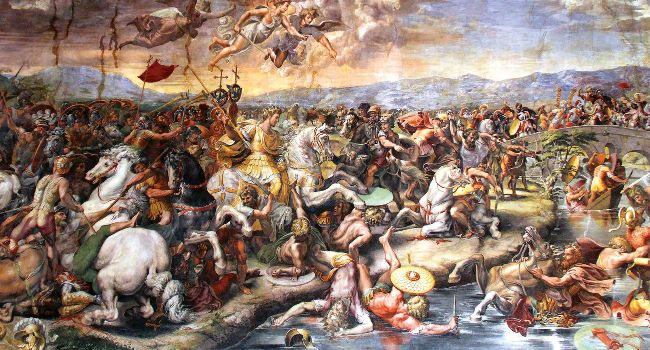
The Battle of the Milvian Bridge depicted by Giulio Romano circa 1520–1524, Vatican City, Apostolic Palace
When he elevated Christianity to Rome’s faith, Constantine seems to have been concerned with the religion’s lack of organization. Although the first three centuries of the faith are nebulous, by the 4th century, Christianity possessed a core message of sorts and Christians held a loose-leaf anthology of texts that included about two dozen gospels.
Did Constantine ever read the gospels? We have no way of knowing, but it is hard to imagine that a man who entered Rome with the head of his rival and brother-inlaw on a pike would have been comforted by phrases such as “Blessed are the peacemakers” or “The meek shall inherit the Earth.” There are many interpretations of the Christian gospels, but it is hard to justify invoking them as a justification for how to gain and exercise political power. Before Constantine, the Chinese had adopted Confucianism, and the Aryan conquerors in India instituted a Hindu caste system; both ideologies consistent with the exercise of hierarchical state power. After Constantine, the Arabs and Aztecs would develop religious systems that embraced the use of violence as a way of expanding and upholding the state. Only in Rome, however, did the state authorities choose to justify power with a state religion based upon a religious literature whose protagonist eschews violence and is martyred by the state, rather than installed as its ruler.