Biological Reasons Young-Earth Creationists’ Worldwide Flood Never Happened
Like the geological evidence, biological evidence demonstrates that a worldwide flood never happened 4,350 years ago, as young-Earth creationists believe.
LORENCE G. COLLINS
Christians who call themselves creationists believe that a creator formed the universe, Earth, and its life, but beliefs about creation and evolution exist along a considerable spectrum.1 Among the landscape of modern evangelical Christianity, many contemporary young-Earth creationists have a narrow view of what constitutes “biblical” creationism.
Using well-established biological concepts and observations of living animals as well as in fossils of both plants and animals in the geologic column of sedimentary rocks, I will address concerns with this narrow view. I demonstrate that this view is misguided, that a worldwide Noah’s flood never happened about 4,350 years ago, and that Earth is much older than 6,000 years. This approach complements my earlier Skeptical Inquirer article, “Twenty-One Reasons Noah’s Worldwide Flood Never Happened” (March/April 2018), which focused on geological evidence.
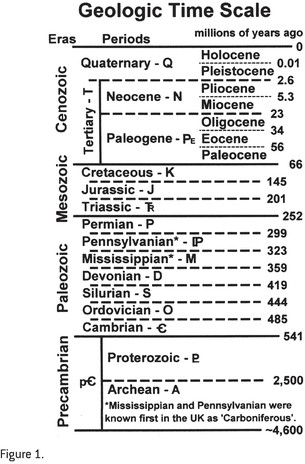
Most young-Earth creationists believe that the sediments deposited by this flood were deposited over Earth’s globe and constitute a large portion of the geologic record beginning in the Cambrian Period in the Paleozoic Era to at least the end of the Cretaceous Period in the Mesozoic Era. They believe that all sedimentary rocks younger than this time from the Paleocene to the present (Holocene at the top of the time scale) were deposited after the flood (Hill et al. 2016). In the time scale shown in Figure 1, 6,000 years would hardly be the thickness of a sharp pencil line at the very top of the image. Therefore, the YECs condense the extent of animal and plant generations to an extremely tiny fraction of the length of this image. As I demonstrate, such a belief requires abandoning large portions of scientific consensus and common sense, but a recent Gallup poll2 of the adult population in the United States indicates that nearly half of the people in this country (46 percent) believe what young-Earth creationists claim is the literal biblical time frame. (A more recent Gallup poll3 indicates that 38 percent of the adult population believes that humans were created by God in their present form but that a very young age for the origin of Earth is roughly 10,000 years.) However, in this article it is assumed that the very long ages indicated in Figure 1 are valid.
Much has been written about geological failings of socalled flood geology (Hill et al. 2016). Here I will focus instead on some observations of organic life and how their characteristics, ecology, and distribution raise far from trivial problems for the YEC understanding of a global flood.
Animals on Noah’s Ark
Regarding the origins and maintenance of biological diversity, young-Earth creationists also believe that the animals that are seen today were brought to Noah’s ark in pairs (or in septets for clean animals, per Genesis 7:2–3) and the pairs eventually evolved to form different species. That is, not all of today’s species (more than five million and perhaps as many as fifty million) were placed on the ark but only representatives of kinds or baramins.4 (A baramin is a badly coined word combining the Hebrew words bara [created] and min [kind]; minbaru is closer to the Hebrew.) Baramins (when referring to animals) are approximately equivalent to the taxonomic category of families of animals. For example, a pair of cats in the cat family was put on the ark from which lions, tigers, cheetahs, leopards, pumas, caracals, jaguarondis, servals, ocelots,5 and other species of cats evolved to make the thirty to forty known cat species in the world today, including domesticated cats. In the same way, a pair of canines, a pair of horses, and pairs of other kinds of animals were also brought onto the ark, and each pair produced the different species of each kind, or baramin, that are observed today. The effect of this is that the number of animals that Noah had to preserve on the ark is minimized, presumably allowing enough space to care for and feed them.
Conventional geology and paleontology recognizes that there are as many as fifty million Linnean species living today,6 including thirty million modern insect species for which 73,000 have been described.7 Furthermore, it also must be recognized that much greater numbers of animal species once lived on ancient Earth. According to YECs, these were supposedly buried in sedimentary rocks deposited by Noah’s Flood. So what is seen today is only a tiny part of the vast majority of life that once lived on Earth. Within the context of an ancient Earth and our understanding of the geologic column, the number of buried and extinct species in the fossil record could perhaps have been more than five billion different species or organisms.