Reviews
RECORDINGS
CAROLINE BITTENCOURT
AUERBACH 24 Preludes for violin and piano Christine Bernsted (violin) Ramez Mhaanna (piano)
NAXOS 8.574464
A Danish duo on searing form in one of contemporary music’s great mavericks
Soviet-born, now US-resident composer Lera Auerbach took Chopin’s 24 Preludes op.28 as a model for the overall structure and tonalities of her own 1999 cycle for violin and piano, one in each key and its relative minor, obediently following the cycle of fifths all the way round until it starts again. You’d hardly know it, though, from the often grotesque, sometimes violent music she magically shoehorns into these blazing miniatures, whose relationship with functional tonality seems perpetually up for discussion.
There are distinct nods to Shostakovich, Gubaidulina and even the uncompromising dissonances of Ustvolskaya in among Auerbach’s heart-on-sleeve writing, and the Danish duo of violinist Christine Bernsted and pianist Ramez Mhaanna rise to its challenges magnificently. Bernsted, in particular, sounds like an entirely different player from piece to piece – thin and reedy in the lamenting no.1, frenetically arpeggiating in the flamboyant no.14, ice-cold in the fearful tremolos of no.16, for example – as she responds vividly to Auerbach’s wide-ranging musical demands. Both players, though, throw themselves into the composer’s high-emotion sound world with fierce commitment, to the extent that a full traversal of all 24 pieces can prove a draining experience – or, perhaps more accurately, a profoundly cathartic one. Recorded sound is close and clear.
DAVID KETTLE
PRISM V BACH The Art of Fugue BWV1080: Contrapunctus XIV; Vor deinen Thron tret ich hiermit BWV668 BEETHOVEN String Quartet in F major op.135 WEBERN String Quartet Danish Quartet
ECM NEW SERIES 4858469
A fascinating century-hopping series reaches a fitting finale
The Danish’s ‘Prism’ series ‘passes a linear beam of light’ from Bach’s seminal contrapuntal writing to Beethoven’s late quartets, which then function as the prismatic pathway to a related, more recent work. Bach’s solemn organ chorale prelude BWV668 and Contrapunctus XIV from The Art of Fugue provide the bookends for this final instalment, the players responding naturally and subtly to each other and bringing clarity and fluidity to their contrapuntal interaction, despite a predominantly smooth, sustained approach. The blending of timbre and secure intonation is matched by playing of conversational vitality in the opening Allegro and fiery scherzo of Beethoven’s op.135. The slow movement’s meditative variations are conveyed with radiance and intensity – though the initial sotto voce indication is largely ignored – and the finale is negotiated with seasoned skill and authority, the impassioned intensity and anguish of its introductory material contrasting sharply with the affirmative joy and vigour of its Allegro.
The fundamental motif of Webern’s tripartite, single-movement String Quartet (1905) links well with op.135’s finale, signalling its serial potential before releasing a sound world warmed by late- Romantic tonality and textures, exquisitely shaded and balanced. Throughout, ECM’s engineers do full justice to these refined, coherent and erudite performances, which combine an exhilarating sweep with minute attention to details of phrasing and timbre.
ROBIN STOWELL
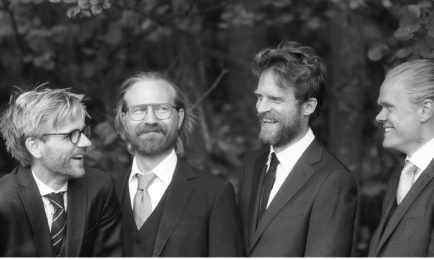
The Danish Quartet stuns in its series finale
LYRITA RECORDED EDITION
E. CASALS Cello Concerto in F major ‘In romantic serious style’
LALO Cello Concerto in D minor Jan Vogler (cello) Moritzburg Festival Orchestra/Josep Caballé Domenchi
SONY MUSIC G010004973738G
A landmark premiere recording of a concerto by the ‘other’ Casals
Jan Vogler produces good heart-onsleeve playing in the lush and dramatic opening movement of Lalo’s Cello Concerto, with much appassionato where directed, and supple beauty in the generous melodies. There are touches, too, of the heroic figure striding forth in the bravura rhetorical passages; this is good storytelling stuff, well matched by the orchestra, with its punchy brass. There is delight in the second movement, too, with soulful, reflective Andantino sections alternating with faster folk-dance passages that mingle elfin lightness and high energy, with Vogler scrupulously observing the many accents as the flutes hocket around him. He romps through the highspirited finale, again with an air of rustic celebration, aided by a biting edge to his bowing.