PAGANI UTOPIA
CAMERA LIGHTS REFRACTION
The new Pagani Utopia is a staunchly analogue V12 hypercar. Only fitting then, that we shoot it with a camera that feels the same way
WORDS PAUL HORRELL
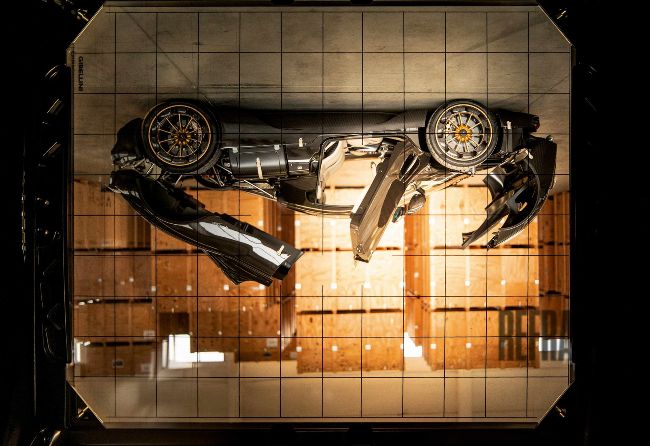
PHOTOGRAPHY TOM SALT
14 PAGANI UTOPIA
Six photos. That’s Tom Salt’s output today. Six near-silent precision clicks of the shutter in this outlandish camera’s lens. Between each shot is a complex set of actions to lightproof the gigantic eight-by-10-inch negative, and swap its film holder for a fresh one. Every photo takes more than an hour of inch-fussy manoeuvring of car and camera, meticulous composition, focus and light metering. Every shadow and reflection has to be managed, any superfluous piece of litter and distraction has to be physically cleansed from the scene. No digital retouching is allowed.
There are electric SUVs that accelerate as fast as a Pagani Utopia. No fuss. But they don’t have the charisma of a 6.0-litre V12 or the involvement of a manual transmission. Analogue isn’t dead. Not yet, not ever. And just as streaming never quite replaced vinyl and the pdf never quite replaced calligraphy, digital photography hasn’t quite replaced film.
The reason should be obvious on these pages. Put in the hard yards and the results from a large-format film camera can be spectacular. Even with the muffling effect of magazine printing, they show mesmerising detail and a gorgeously luminous tonal quality. You could jump into these prints like a pool.
But that’s just the start. The optics of large-format cameras let the photographer control the depth of focus: Ansel Adams and Group f/64 closed the lens right down like a pinhole camera to get everything sharp, whereas flinging open the aperture will lift the subject sharply out of cloud-soft surroundings. The vertical and lateral movements of the bellows-mounted lens allow perspective control to prevent keystoning, the tapering effect looking up at buildings. Of course our phone cams have digital keystone correction and a bogus ‘portrait mode’ that (mostly) recognises a face and blurs the background. But they’re so not the same. Besides, the tilt function of the lens means the photographer can twist the pane of focus, keeping sharpness through an object that diagonally recedes into the distance. It all bestows immense artistic freedom.
Alessandro Gibellini trained as a civil engineer, but one day his dad gave him a film camera, and he was hooked. He began to experiment with larger film formats, and soon built a view camera, promoting his version of this 170-year-old apparatus via social media – oh the irony. His engineer’s inclinations led him away from the traditional hardwood frames into titanium and aluminium alloys, and even carbon fibre. It makes them more rigid, obviously a vital characteristic with precision optics. He also wanted to make every component, every bracket and arm and control knob, a thing of beauty in itself. His little factory is in a hillside village just south of Modena. I must have passed it, oblivious, dozens of times when road-testing Ferraris, Lamborghinis... and Paganis.