EVOLUTION OF TARGA
It has become a Porsche icon, but we know the Targa was originally conceived as a slightly desperate compromise. Total 911 charts the evolution of an accidental masterpiece
Written by Kieron Fennelly Photography by Ali Cusick
There was always an open-top Porsche: Ferry’s first model was an open barchetta and if production realities soon dictated a closed design, it was only a couple of years before a convertible 356 appeared. This was a vital model, especially in the US, for which Porsche’s gung-ho distributor Max Hoffman persuaded Zuffenhausen to build the Speedster, as featured in issue 128 of Total 911. By the late 1950s, consideration of the 356’s successor was in full swing at Porsche. Between the competing designs of Erwin Komenda (Porsche’s long-standing body engineer who saw himself as carrying the beacon for the late Professor Porsche), Ferry’s son Butzi who represented the first generation of automobile stylists, and Ferry’s own preferences, little thought was given to an open car. Moreover, high development costs of the 901 Coupé meant there was little in the way of budget left to invest in a convertible model.
The other concern at that time was the controversy in America, stirred up by Ralph Nader, about whether car manufacturers were putting users’ lives at risk with fundamentally unsafe cars. In particular, the Chevrolet Corvair (a flat six rear engine design) had been singled out, as had the VW Microbus. In the general uncertainty, it was also unclear whether the US authorities were going to ban open cars. It was dissuasive enough: Porsche would develop an alternative to the Cabriolet which would be the birth of the Targa.
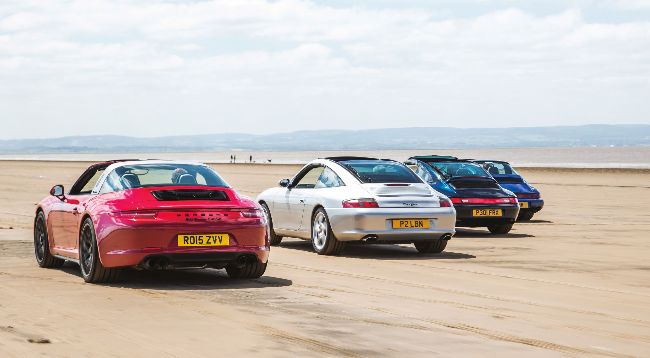
Porsche’s experiments with open prototypes had already demonstrated that some sort of ‘roll hoop’ did in fact manage to restore rigidity. Therefore, the ‘alternative cabrio’ would have this roll hoop and it then became a question of what it would look like and how it would be incorporated. Gerhard Schröder, who had built 356 cabrios at Karmann, said that the most important detail at this stage was “to make this roll bar look right.” Having first agreed on the aesthetics, they could then strengthen it as much as necessary. Eugen Kolb later told Porsche historian Tobias Aichele they were concerned that this roll bar should not rust and as it morphed into an altogether wider hoop, the idea of making it in stainless steel came from design chief Butzi Porsche. It was he who influenced the positioning of the hoop and also authorised the final design, even though we know that Porsche registered the patent citing designer Gerhard Schröder and engineer Werner Trenkler as its inventors.