Early 911s: 911E
THE Underdog
Porsche’s 911E sat in the middle of the early 911 range, but is widely overlooked in the classic market today. Is the consensus among enthusiasts justified?
Written by Kyle Fortune
oT

Photography by Dan Pullen
The moon landings, the first commercial flight of the Boeing 747, the RAF’s adoption of the Harrier Jump Jet, Concorde being test flown, and the introduction of the Porsche 917… 1969 isn’t short of significant technical firsts The last year of the swinging Sixties is a noteworthy year for the 911 too, as in August Porsche introduced the ‘C Series’, which brought a stretch of 2.2 inches (57mm if you’re metric) to the wheelbase, in a bid to counter the 911’s on-limit behaviour. It wasn’t just the chassis to which 2.2 was relevant to, either, as the 911’s flat six grew in capacity from 2.0 litres to 2.2 litres for the 1970 model year (in late ’69). That move would help in flattening and fattening out the 911’s torque curve and, somewhat conveniently, allowed the 911 to move up a class in GT racing.
It’s difficult to comprehend that the 911E I’m looking at is now 52 years old. First imported into the UK by AFN, its VIN identifies it as the 42nd 911E to roll down the production line at Zuffenhausen, and more than likely the first RHD ’69 911E to be built. Finished in Metallic red, code 8181, its condition is best described as time warp. It looks every bit as fresh as it would have done when its first owner collected it, way back when MontyPython’sFlying Circuswas airing for the first time on BBC television.
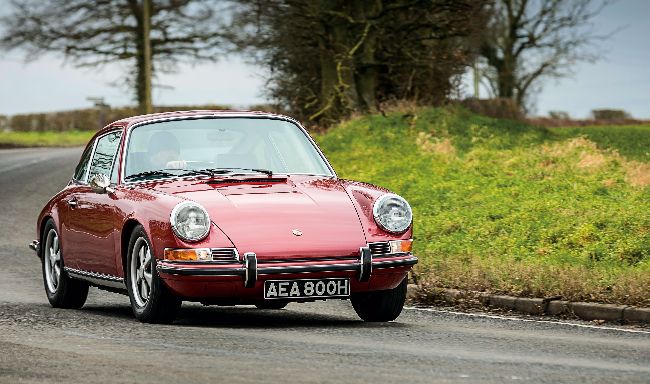
Its small dimensions and modest power means the 911E provides a fun drive at sensible speeds on the public road
Three owners would follow that original owner, with it being bought by a Mr Protheroe in December 1987 – he undertook a well-documented restoration and the ‘Red Baron’, as this car became known, was a regular finalist in Porsche Club GB Concours competitions. Any ’69 911 is a significant car, then, but the T and this E are more often than not overlooked over the range-topping S model. That’s unjustified; Porsche’s strategy back then, much as it remains today albeit with slightly differing nomenclature, saw the T as the entry model with 125bhp, this E having 155bhp and the S having 180bhp, each meritorious within their contemporaneous and respective price segments – giving customers a breadth of capabilities that suit their own particular needs.