50 THE BEATLES
Greatest Guitar Songs
No band has inspired more people to play guitar than The Beatles – the greatest, biggest and most influential band of all time. And so – to coincide with the long-awaited premiere of the three-part documentary series GetBack – TG presents The 50 Greatest Beatles Guitar Songs, as voted by you in a recent poll on GuitarWorld.com.
There were so many to choose from. IFeelFine, with its groundbreaking use of feedback. AHardDay’sNight, with that mythic opening chord. HelterSkelter, when the Fab Four turned it up to 11. Blackbird, one of the most perfect acoustic songs ever recorded. And Something, the classic ballad that marked George Harrison as a songwriter to rival John Lennon and Paul McCartney, and in which George delivered what was arguably the greatest solo he ever played.
The top 50 countdown features in-depth analysis of every song from TG writers Grant Moon, Ellie Rogers and our former Editor Tim Tucker, a writer, musician and respected authority on The Beatles as host of the podcast MyFavouriteBeatlesSong, which celebrates the music of the Fab Four with distinguished guests.
On page 54, Tim also reveals 10 Great Beatles Guitar Moments You’ve Never Heard Before – lost treasures unearthed on the newly-released super-deluxe edition of the band’s final album LetItBe.
And while the pioneering quartet took us all on a Magical Mystery Tour, we take you on a magical gear tour in our profile of the now-iconic guitars and amps used by the band.
Finally, we'll show you exactly how the band wrote some of those incredible songs as we look at some of the chords, changes and harmonic techniques they employed. Turn the page, and let’s get started!
Tim Tucker is a writer, musician and host of the podcast 'My Favourite Beatles Song', which celebrates the music of the Beatles with distinguished guests: www.myfavourite beatlessong.com
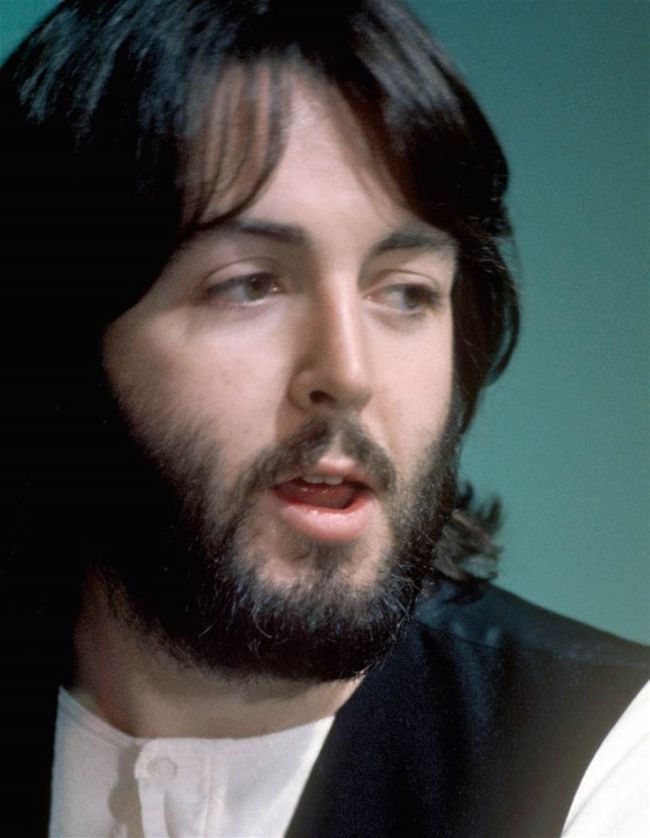
Photos Ethan Russell
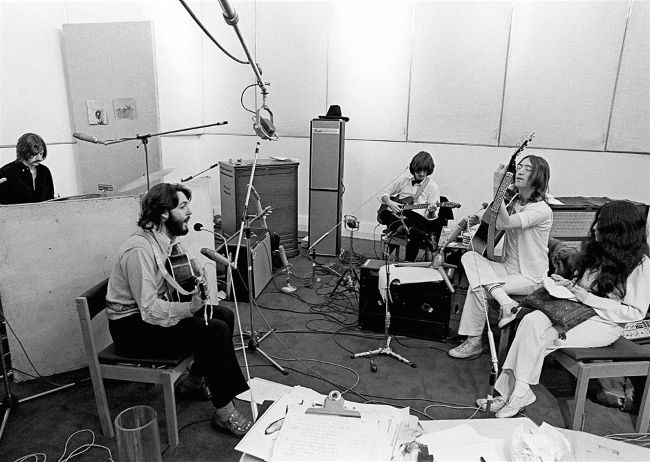
FIVE OF US From left: Ringo Starr, Paul McCartney, George Harrison, John Lennon and Yoko Ono
50 HELP!
Swift picking arpeggio action
After an explosive chorus-intro, we get a speedily-picked arpeggio run, played by George Harrison, that pulls us into the lead song from the Beatles’ second film. He uses a combination of fretted and open strings on a Gretsch Tennessean to provide the distinctive guitar hook in one of the band’s most deceptively upbeat songs. Lennon later explained the lyrics as a genuine cry for help, brought on by the pressures of Beatlemania, but the driving arrangement and upbeat delivery makes the finished recording a joyful pop/rock experience. Harrison’s lead is backed by Lennon’s 12-string rhythm part, played on a recently acquired Framus Hootenanny 5/024.
49 BIRTHDAY
Monster old-school rock and roll riffage
An old-school rocker inspired by Little Richard that Paul McCartney wrote in one recording session for the White Album, before the other Beatles had even arrived. With Paul on piano duties, George Harrison takes the bass role, leaving John Lennon to provide a rare lead guitar performance on a Beatles record. Most notable for its epicblues-rock riff and unison bass and lead guitar run, this is the sound of an experienced band creating joy in the studio.
48 I AM THE WALRUS
A soundscape worthy of Picasso
An astonishing re ording that ex-Smiths guitarist Johnny Marr called ‘like Hieronymous Bosch set to music.’ The song’s combination of queasy strings, grungy electric piano and twisted lyrics showcases the band at the height of their psychedelic period. But underpinning the sound effects and semi-nonsense lyrics is a startlingly adventurous song structure. Fundamentally in the key of A, it draws chords from the parallel minor key, being made up of nothing but major chords with roots on all seven white keys on the piano.Harrison plays his psychedelically painted Fender Strat, while McCartney’s Rickenbacker 4001S bass provides the low end.
47
YOU’VE GOT TO HIDE YOUR LOVE AWAY
The Fabs get folky
Bob Dylan made a massive impression on the Beatles, and his influence can be felt in this, the first all-acoustic song the band recorded, with Lennon on his 12-string Framus and Harrison playing his Gibson J-160E. The modal-flavoured 12/8 tune uses aG ‘pedal’ note on the 3rd fret of the top string, throughout the sequence of first position open chords. This folky drone yields interesting chord voicings, such as the Dsus4 and Fadd9, that give the song its distinctive character (and most likely influenced Noel Gallagher on Oasis classics Whatever and Wonderwall). The first Beatle recording to use an outside musician, flautist Johnnie Scott.
46
I WANT TO HOLD YOUR HAND
The song that launched the Beatles in the United States
IWant To Hold Your Hand’s impact was huge, prompting future rock superstars such as Bruce Springsteen, Tom Petty and Todd Rundgren to buy guitars and form bands. The opening C to D salvo pre-empts the power pop format to come and introduces the ingenious harmonies of the verse. The song’s chord sequence, which Bob Dylan called ‘outrageous’ for the time, gallops from G major to D to Em, peaking with an exhilarating high on B7 under the falsetto ‘haaaand’, inspiring hysterical screaming from the girls in the audience. Throw in the tender shift in key, via a Dm7 chord under the line, ‘And when I touch you...’, and you’ve got the blueprint for Beatlemania.
45
I’VE GOT A FEELING
Paul and John merge guitar riffs one last time
The Beatles Get Back project (which turned into the LetIt Be album), was conceived as an exercise in recapturing the band in live performance. In I’ve Got A Feeling, the opening rolling guitar pattern, a combination of two entirely different songs by Lennon and McCartney over the same sequence, hangs on a bluesy groove swinging from A to D over an A bass pedal note. John and George’s guitars provide the captivating rhythmic interplay, with overdriven blues runs and grungy rhythm work filling out the picture. Billy Preston supports on electric organ, making this one of the funkiest fab tracks on one of their last live recordings.
44
HAPPINESS IS A WARM GUN
A cryptic journey through the history of rock
The most complex song the Beatles ever conceived took forty-five takes to get right. In under three minutes it runs a gamut of rock and roll guitar styles, musical genres and time signatures: there are sections in 4/4, 3/8, 6/16 and 4/8. The song opens with a gentle folky fingerpicking meditation over extended minor chords, (‘She’s not a girl who misses much...’), shifts into a 3/8 modal passage (‘I need a fix...’) and an ambitious multi-metre polyrhythmic groove (‘Mother Superior jump the gun...’), before wrapping up in a throwback C-major Doo Wop passage (‘Happiness is a warm gun...’).