HUMANITY
Sharing the planet’s chronicle through the eyes of its souls
BY CHRIS COLLARD
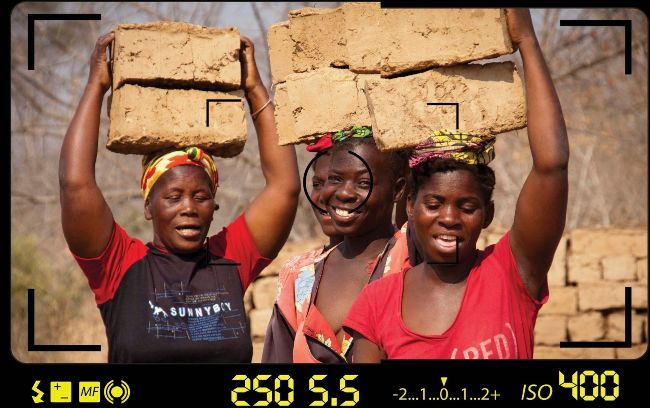
The ladies of a small village near Lake Kariba, Zambia, were absorbed in song as they carried heavy mud bricks to the building site of their new place of worship. (Image data: Canon 40d, 18-200 lens, 134mm focal length, ISO 400, f/7.1)
On a bookshelf in my office rests a National Geographic collection dating back to the 1950s. Every spine is yellow, with the exception of one, February 1981, which was orange to highlight the then-current energy crisis.
While its carroty pigment renders it easy to pinpoint among a sea of yellow, if we fast forward to June 1985 and reveal its cover, we glimpse an image that changed the world … or at least mine: It’s Steve McCurry’s famous portrait of a nameless 12-year-old refugee who became known as the “Afghan Girl.” Her penetrating eyes, tattered scarf and dirtsmudged skin conveyed a life of struggle and pulled on the heartstrings of a generation.
Friend Pablo Rey (who’s been traveling the globe for two decades in a Mitsubishi van with his wife, Anna) observed, “There are lots of pretty mountains, lakes and beaches, but it’s the people we remember.”
As travelers and visual storytellers, how do we convey the soul of a life unknown in a single frame? How do they live and provide for their families, how do they play, and how do they love?
Before we continue, I need to state that you don’t need to travel through Africa or Afghanistan to delve into the photographic art of humanity. It’s an omnipresent force of nature that’s around us every day and can be found in a rural Nevada café or on a Utah cattle ranch.