MODERNIZING A CLASSIC
Upgrading an Older 4WD While Maintaining Vintage Style
STORY AND PHOTOS BY JONATHAN HANSON
I distinctly remember complaining that I’d paid too much when I bought my 1973 Land Cruiser FJ40 from a friend in 1978. True, it only had 23,000 miles on it and was in “as-new” condition. But still, couldn’t a buddy have accepted less than $3,500?
I know what you’re thinking—and you’re right: In vehicular terms, that purchase was an investment right up there with IPO Apple stock. More than 300,000 miles later, that FJ40 has yet to leave me stranded a single time, except as the result of a dead battery. It’s been used for exploration, guiding sea kayaking trips in Mexico and four-wheel-drive training (not to mention a first date with my wife). And it’s now insured for more than 10 times what I paid for it.
Legends Live Long Lives
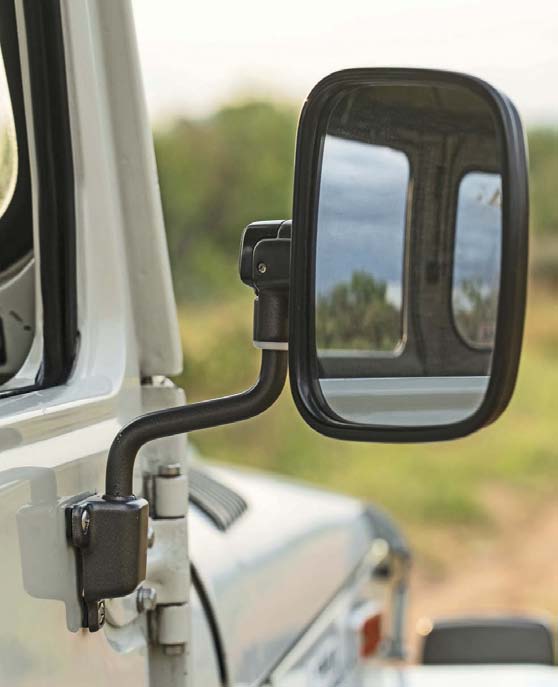
Euro-spec factory mirrors are a huge improvement on stock, U.S.-spec mirrors.
There are other owners of early Land Cruisers, first-generation Broncos, Series Land Rovers, Jeep CJs and Scouts who were lucky to score them when they were just old 4x4s, along with an increasing number of passionate fans who were happy to shell out a lot more in recent years to fulfill their dreams of owning a legend.
But, while our vehicles’ values have soared into the 21 st century, their engineering remains firmly stuck in the mid-20 . My Land Cruiser came with four-wheel drum brakes, simple lap belts and no head restraints, a three-speed transmission with a non-synchro first gear, a points-style distributor and sealed-beam headlamps perfected in 1940. Fully adjustable air conditioning was available … via the window crank. Traction aids? None. Driving 65 mph on the freeway produced instant tinnitus. Other 4x4s of the same era share many (or all) of these traits.
Luckily for me and many other owners, the corollary to rising classic values is an increase in the number of companies offering parts and accessories to upgrade our classic vehicles.