RHIANNON GIDDENS
Imazing Grace
Theunstoppable RHIANNON GIDDENS has spent a career recovering the African-American histories buried in folk music. Now, locked down in Limerick, she tells Laura Barton how her latest album – including a bunch of “old sad songs” – remind her of home and of generations past. “I am the sum of everything that I do,” she explains
RHIANNON GIDDENS
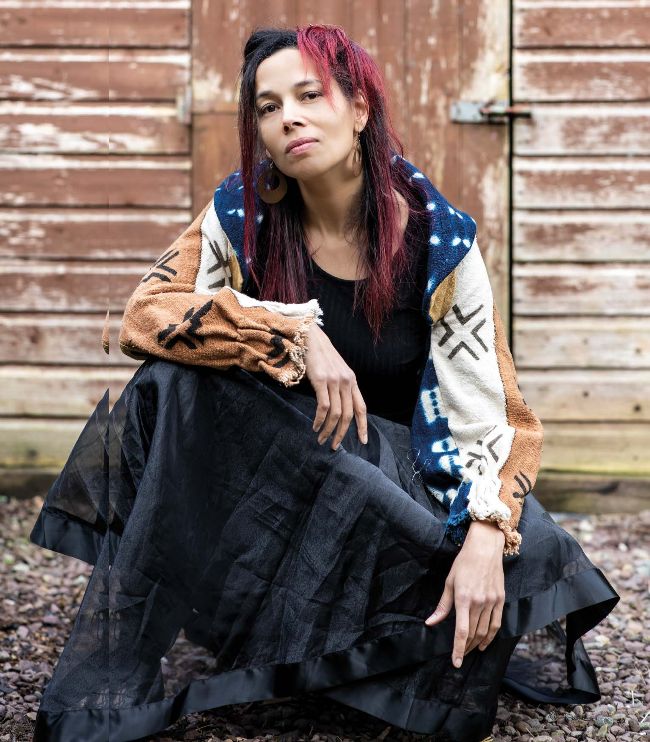
Rhiannon Giddens in 2021: “A rare voice that can cross boundaries”
Photo by KAREN COX
RHIANNON Giddens sits in her kitchen, hair pulled back, wearing a maroon sweatshirt, waiting for the washing machine to finish its final, furious cycle. For the past year, the Grammy-winning singer, fiddle and banjo player has been shored up at her home in Limerick, discovering, for the first time in 16 years, how to live a life other than that of a touring musician. It has not been an entirely elegant process. “Everything has been a learning curve,” she says: the relentless slog of cleaning and housekeeping, the notion of keeping more than two weeks’ worth of food in the house, teaching herself how to cook the dishes she remembered from growing up in North Carolina. “I probably went overboard baking biscuits,” she says. “Just to try and fill that creativity.”
This is the longest Giddens has ever been away from her American homeland. Although she relocated to Ireland when her children, now eight and 12, began Gaelic-language school – and her new partner and musical collaborator, Francesco Turrisi, is also based in the country – she has travelled back and forth between the States and Ireland every few weeks. Last year, of all years, was a particularly hard time to be away from America. As the Black Lives Matter movement spilled out across the country and the November election was followed in January by the storming of the Capitol, Giddens looked on with a feeling of helplessness. “All I could think about was what was going on in my home and howI couldn’t be there,” she says. “Not that I think I could have done anything, but even just to add to the conversation, to be a positive energy there, to support the people doing the work…It was really tough to feel I was stuck here.”
She wrote a song, “Build A House”, with the cellist Yo-Yo Ma, to mark Juneteenth – the annual holiday commemorating the end of slavery in the United States. “What can I say about what’s been happening, what’s happened, and what continues to happen?” she wrote on Twitter. “There are too many words and none, all at once. So I let the music speak.”
“I did what I could,” she says now. “But I was just a mess. My children asked, ‘Mommy, why are you crying?’ AndI thought: ‘How can I explain this to you…?’”
Belonging is a complex subject for Giddens; one that has run all through her life and career, from her days of studying opera at Oberlin to her explorations of Gaelic lilting, old-time banjo, classical composition, covers, collaborations and on to her new album, They’re Calling Me Home, made during lockdown with Turrisi.
The sense of dislocation that Giddens draws on in her creative work began early in her life. The daughter of a black mother and a white father who divorced when she was a baby, Giddens was raised with her older sister in rural McLeansville by her maternal grandparents until she was eight, later moving into the city to live with her father. It was an early collision of influences – of race and geography and generations, and of the music her grandparents loved, from blues, old time and jazz to the ’60s folk revival-led record collection of her father.
“Being a multiracial child in North Carolina, there’s a lot of crossroads that go through there,” she says. “We’re not the mountains, we’re not the plantations, we’re this mixture of all of these things.” Greensboro, her home city, is where the civil rights sit-ins began in 1960, when four African-American students refused to leave a Woolworth’s lunch counter after being denied service. “Greensboro is very diverse,” says Giddens. “I think I miss that a lot being here. I miss seeing people who look like me. That’s what I saw, growing up, going back and forth between the two worlds – black and white – and seeing how similar they both were. It’s a particular kind of vibe which I think really set me up for everything that I’ve done afterwards.”