ALBUM BY ALBUM
Iron & Wine
The man behind the stage name, South Carolina songwriter Sam Beam, reviews his back catalogue
me, diving into asong is away to explore something where you don’t know how you feel,” explains Sam Beam. “Or how to communicate different kinds of images or paint different pictures inside of asong. How you can tell astory. That’s what I’m most interested in.”
“FOR As alter ego Iron &Wine (named after aprotein supplement he chanced upon in aGeorgian gas station), Beam has made acareer of such painterly explorations, his richly allegorical and allusive songs feeding into an intuitive sense of melody and rhythm. The native South Carolinian made his start with 2002’s hushed, folkish The Creek Drank The Cradle, going on to release six more solo albums, numerous EPs and atrio of collaborative efforts with Jesca Hoop, Calexico and Band Of Horses’ Ben Bridwell. His latest is Light Verse, agorgeous set of songs recorded in LA with various players and, on four tracks, a 24-piece orchestra. Its arrival coincides with anew documentary, Who Can See Forever, which serves as both concert film and awider study of its often-elusive subject.“FOR As alter ego Iron &Wine (named after aprotein supplement he chanced upon in aGeorgian gas station), Beam has made acareer of such painterly explorations, his richly allegorical and allusive songs feeding into an intuitive sense of melody and rhythm. The native South Carolinian made his start with 2002’s hushed, folkish The Creek Drank The Cradle,
Two decades on from his debut, and despite various stylistic turns, Beam feels that his approach to songwriting is essentially the same. “I like songs that talk about what we want, whether it’s aromance or some existential answer,” he says, locating athrough line. “But they also need to place us in the world. The songs show our desires in aframe. I just like making the portrait.”
ROB HUGHES
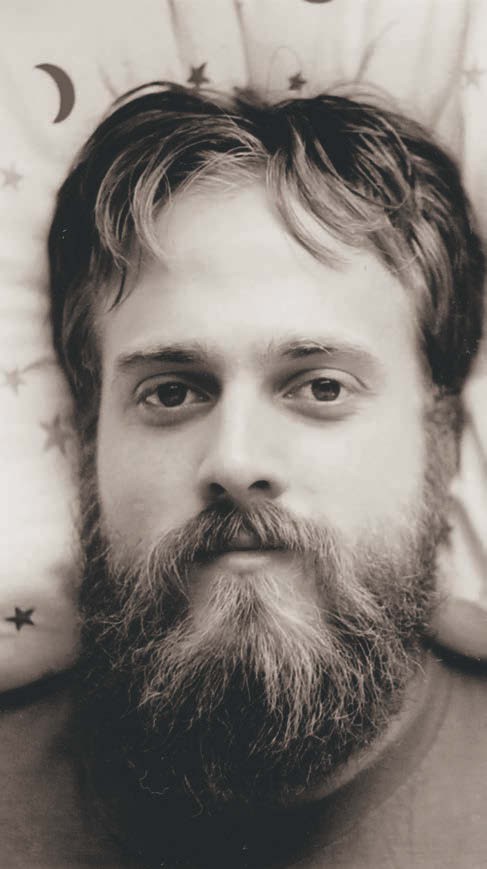
All-round creative: Sam Beam in 2001
KIMBLACK
THE CREEK DRANK THE CRADLE
SUB POP, 2002
Beam’s rustic debut is a bewitching batch of home demos, softly burnished with acoustic guitar, slide and banjo. Good friend Ben Bridwell (pre-Band Of Horses) helped broker the Sub Pop deal I’d done alot of other creative pursuits – filmmaking, art-making and so on –and none of them were really giving me the positive feedback that music was. I approached songwriting in asimilar way to those other endeavours, being open to experimentation, but also refining the thing, sticking with it until it’s how you want it to be. The songs had this intimate quality, they were recorded at my house, with amicrophone in my bedroom. Serendipitously, the type of material that Iwas singing about didn’t really demand to be screamed. So it all kind of worked together –the style of recording, where it was happening and how it was happening. And just the natural quality of my voice. I hadn’t really been in asituation to test how I could project. I’d never been inaband, never played aconcert, I was just doing it for fun. The idea of getting arecord deal was all a dream. Iwas like, ‘Wouldn’t it be great to be doing music as aliving?’ without having any idea what the practical reality of that would involve. It was just acase of putting one foot in front of the other. I’d bought the latest Passman book about the music business, but that was as far as I’d gotten. So I’ll always be eternally in Ben Bridwell’s debt.