PHAROAH SANDERS
Higher Powers
A prodigy of Sun Ra and John Coltrane, PHAROAH SANDERS merged jazz and spiritualism to forge a transcendent new sound. With Pharoah’s ground-breaking, self-titled 1977 album reissued this month, John Lewis explores its creator’s master plan. “There was always a touch of the Biblical prophet about Pharoah,” reveals one eyewitness. “The spirit seemed to radiate through every note he played.”
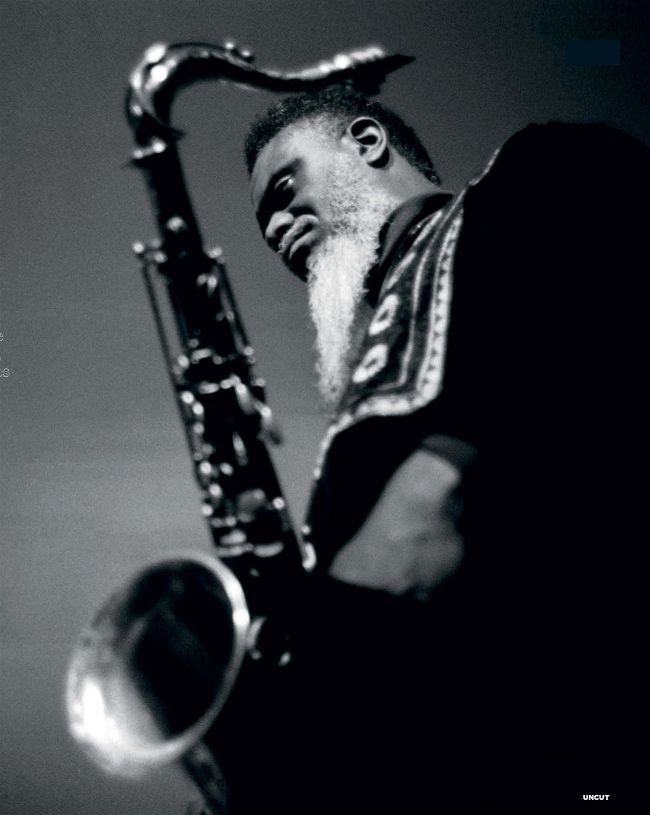
Pharaoh plays: Sandersonstage atNewMorning, Paris,1986
Photo by JOHN VAN HASSELT
IT’S a warm day in September 1976 and Pharoah Sanders is in a small studio near New York City, recording his first album in three long years. But the saxophonist who made his name as John Coltrane’s wingman in the 1960s is not playing the Afrocentric astral jazz that he’s been associated with for the last decade – ecstatic, multiphonic blasts over an orchestra of horns, bells and African percussion. Instead he asks his guitarist to play a two-chord riff on a heavily FX-laden electric guitar and starts to improvise, the two accompanied only by a double bass and a harmonium. It is a serene, meditative, ambient piece – outthere but utterly accessible – quite unlike anything Pharoah has played before.
“He was playing mantras,” says Pharoah’s guitarist Tisziji Muñoz. “He wasn’t playing jazz, he was playing ancient folk melodies. They seemed designed to put you in a deeper trance state. It was about accessing a level of mediumship, of super consciousness, or inner intelligence, a psychic side of you. He was channelling some very deep stuff.”
The album he made, called Pharoah, released in 1977 on a tiny New York indie label, went largely ignored at the time, and isn’t even listed in some discographies. Initially Sanders himself hated the album and the band never played together again – the organ player on the session, Clifton “Jiggs” Chase, quit jazz altogether and ended up co-writing and producing hip-hop singles for the Sugar Hill label.
But the mystique around this obscure album grew. Four decades on, shortly before his death, Sanders was talking of it as his lost classic, and preparing a tour to celebrate its reissue on Luaka Bop. “I think it’s an album that shows the beauty of simplicity,” says Bedria Sanders, Pharoah’s wife throughout the 1970s, who also plays harmonium on the album. “At the time, Pharoah wanted to record something more ambitious, with a bigger budget, and was disappointed with what he ended up with. But, on reflection, you can see that working with limited resources can create something even more compelling.”
For Bedria, the album’s sunny, hypnotic feel fits in with the spirituality that Pharoah Sanders was exploring. “The first time I saw Pharoah, I could see this aura around him,” she says. “I know this sounds ridiculous, but it’s true. There was this bright purple and blue aura that physically enveloped him, like a halo. There was always a touch of the Biblical prophet about Pharoah. That spirit seemed to radiate through every note he played.”