Bon anniversaire CDG
Paris/Charles de Gaulle is the undisputed gateway to one of the biggest tourist destinations in the world, and this year, it celebrates its 50th anniversary. Airliner World takes a look at the history of the facility and how far it has come since it opened in 1974
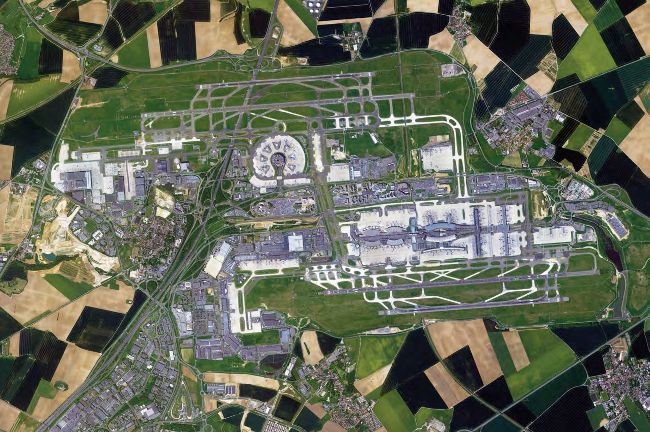
ABOVE:
The sprawling
site of Paris CDG, which covers more
than 12.7sq miles
(33km2) across three
departments and
six communes
SI IMAGING SERVICES/ IMAZINS/GETTY IMAGES
In 1957, the French government decided that its capital required a new airport to relieve the pressure on the city’s other facility, Orly and fully replace Le Bourget. A suitable site, located 16 miles (25km) north of Paris, was eventually chosen with land in three départements: Seineet Marne, Seine-Saint-Denis and Val-d’Oise. One of the communities in the area is Roissy-en-France, and even today, Charles de Gaulle (CDG) is occasionally referred to as Paris Roissy or Roissy Airport.
Planning for the new airport, to be known as Aéroport de Paris Nord (Paris North), began in earnest. Designers, led by chief engineer Jacques Block, were keen to ensure that the new facility would be one of Europe’s largest, most efficient, and most sophisticated.
The final masterplan, produced in 1966, was the biggest in the world at the time. The airport would be built over 12.7sq miles (33km²), a third of the size of the city it would serve. Five runways would accommodate aircraft under development at the time, including the supersonic project from Europe, the US and the USSR, as well as the world’s first widebody, the Boeing 747.
Construction began in December 1966, and after eight years and a cost of $275m at the time, the airport, now called Charles de Gaulle after the French President who led the FreeFrench Forces during World War Two before establishing the French Fifth Republic, officially opened on March 8, 1974. It immediately became home to the country’s flag carrier, Air France, and UTA (Union de Transports Aériens– at the time, France’s second longhaul airline). Alongside the original terminal, a large cargo complex was built, and several hangars were erected to accommodate maintenance for the incumbent carriers. Indeed, the Air France hangar was one of the biggest in Europe and could accommodate two Boeing 747s and four McDonnell Douglas DC- 10s at any given time. In its first year of operation, CDG handled over 2.5 million passengers.