ASKSPACE
PLANET
How do you study the core of a planet?
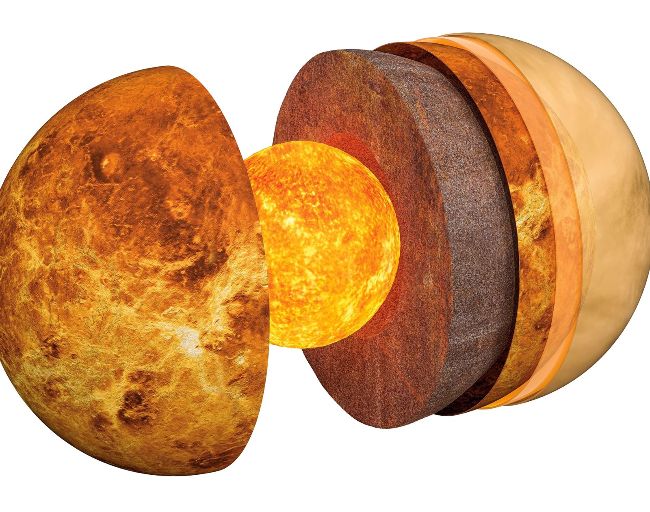
Different methods and missions have informed us about planetary cores
Planetary cores, dominated by iron in terrestrial planets, can’t be directly sampled, but geophysics-based methods provide tools to probe the cores of planets and moons. On Earth, seismic waves were used to measure the core’s radius. The nowdefunct InSight mission used seismic shear waves reflected from the surface of the core to estimate Mars’ core radius. These methods require a lander which is equipped with a sensitive seismometer and suitable seismic sources – in this case marsquakes. Similar techniques have been used to measure the small lunar core, where both moonquakes and surface impacts were detected. A future seismic mission to the Saturnian moon Titan is planned by NASA.
In the absence of a seismometer, careful estimates of the rotational and gravitational properties of a planet, like those made for Mercury by MESSENGER or for Mars by orbiters and the InSight lander, can be used to infer properties of the core. Recent observations of vibrations in Saturn’s rings have been used with gravitational measurements to learn about the properties of its huge ice-rock core. Finally, examination of planetary magnetic fields provides important information about the temperature and heat flow inside cores of some planets within our Solar System. Dr Jessica Irving, senior lecturer at the School of Earth Sciences, University of Bristol
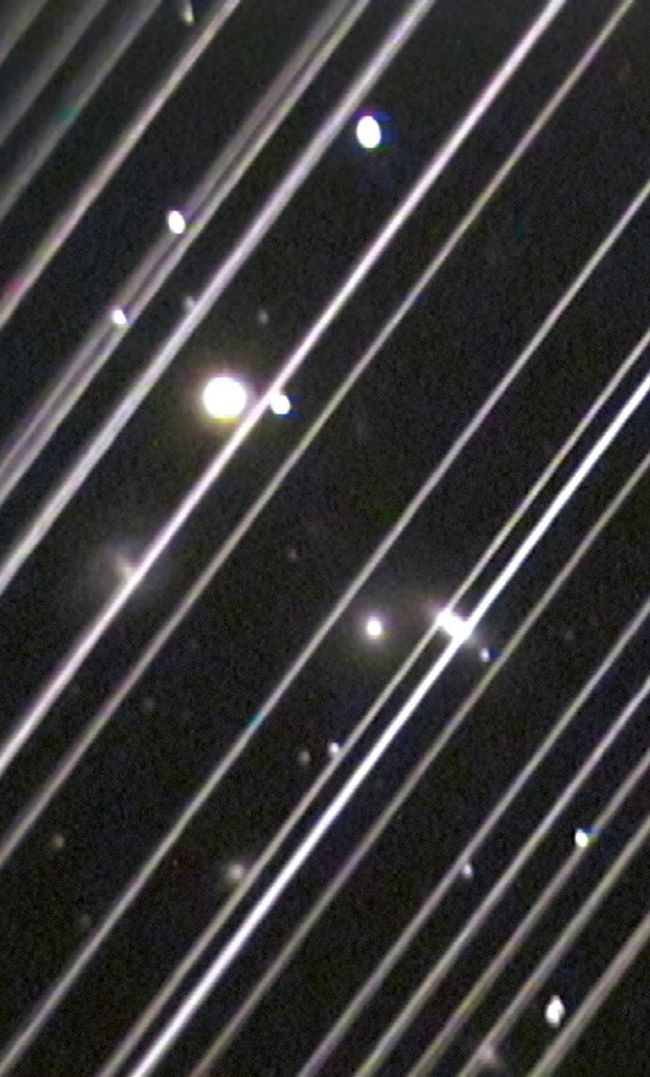
Starlink satellites are affecting the views around the world
ASTRONOMY
If low-Earth-orbit satellites are problematic, could they just be placed higher?
Actually, that would be worse. It’s a little complicated because you could think that maybe a lower orbit satellite would be brighter because it’s closer, which is true, but the trick is that it moves faster in a lower orbit because it has to not fall out of the sky. That means that when you are taking a picture it will move out of the way faster and the pixels won’t linger long enough to make as bright of a streak in the image, which is better.