HUBBLE SEES WILD WEATHER RAGING ON A DISTANT HOT JUPITER
Extreme heating and tidal locking result in fierce cyclones and powerful storms in the atmosphere of WASP-121 b
Reported by Keith Cooper
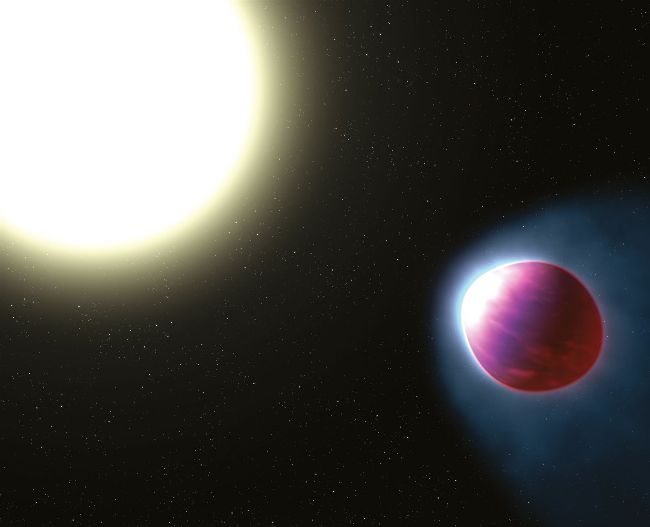
WASP-121 b is a large, gaseous exoplanet in a tight orbit around its star
The Hubble Space Telescope has seen cyclones raging in the dynamic atmosphere of a hot Jupiter located 880 light years away thanks to observations and computer modelling that could one day be applied to characterise weather on smaller rocky exoplanets. The planet, dubbed WASP-121 b, has a mass about 1.16 times greater than our Solar System’s Jupiter and orbits its star at a distance of just 3.88 million kilometres (2.41 million miles). That’s just 2.6 per cent the distance between Earth and the Sun. Furthermore, WASP-121 b speeds around its star once in only 1.27 days – in other words, its year is just 1.27 Earth days long.
Being so close to its star, WASP-121 b is also tidally locked, meaning it rotates on its axis in time with its orbit such that it always shows the same hemisphere to its star. Its permanent dayside reaches temperatures around 2,329 degrees Celsius (4,224 degrees Fahrenheit), causing WASP-121 b’s atmosphere to become bloated, expanding the radius of the planet to a size 75 per cent larger than our beloved Jupiter. In this insufferably hot maelstrom, it’s suspected that evaporated iron, barium and oxides of titanium and vanadium lace the world’s atmosphere and form showers of molten metal on weather fronts between the day and night sides.