Future-proof LIVING
A derelict bungalow just a few doors down from Flicky and David Ridel’s existing house offered the perfect opportunity to create an adaptable self-build home for life
WORDS SARAH WELSH PHOTOS JOE LENTON
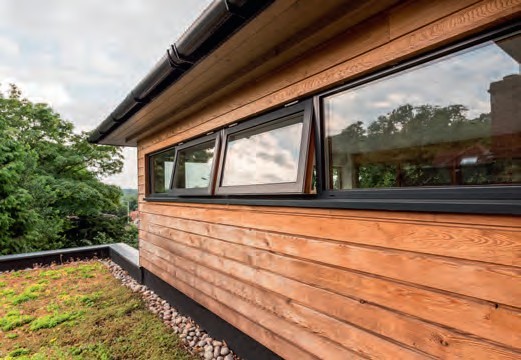
A green roof has been installed on the garage
David and Flicky Ridel had often discussed the idea of taking on a self-build project. And when they both retired, it seemed like the ideal time to downsize from their large period property and create something more manageable. “Flicky has always wanted me to design a very modern house for us to live in,” says David, an architect by trade. “Our previous place had become too big for us and we wanted a home for life – one that would be energy efficient, easy to maintain, warm and adaptable as we grow older.”
It wasn’t until the couple noticed a dilapidated bungalow standing empty on their street that the wheels were finally set in motion. They bought the property with the intention of knocking it down and rebuilding a contemporary home in its place – potentially a risky move, given the house was sited in a conservation area.
Planning perfection
David spent the summer of 2013 honing the design to balance the couple’s needs with the planners’ requirements before putting in an application. Thankfully, the gamble paid off, and within 12 weeks they had planning permission to build a new two-storey house. It helped to have the support of the Norwich Civic Society, which was impressed by how the project would enhance the conservation area – so much so that it bestowed the house with its 2015 Design Award.
The architecture was led by David’s concept of creating a simple, double-height space at the centre of the property to act as a focal point from which all the other rooms lead. “I love the atrium because it floods the house with natural light,” says Flicky. “Initially I was concerned that it would it be too invasive, but the internal blinds and the trees provide subtle screening.”