Should you build a Passivhaus?
This design and build standard is a popular way of ensuring an energy efficient result, but is it the right solution for your selfbuild? Emily Smith investigates
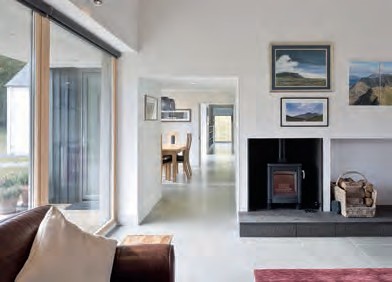
Top & inset: After seeing some properties designed to Passivhaus standard, John and Jeanette Fenwick were inspired by this way of producing a bespoke house that would be extremely thermally efficient and cheap to run. The home’s performance is so impressive that it was crowned a winning project at the UK Passivhaus Awards 2016
At the beginning of the 1990s Professors Bo Adamson of Sweden and Wolfgang Feist of Germany came up with a building standard that aimed to optimise energy performance, which they named Passivhaus. The first dwellings using their calculations were constructed in 1991 and today there are over 50,000 Passivhaus structures across Europe. But the concept is still fairly new to the UK, where only 800 buildings have been certified – so what exactly is Passivhaus and why should you consider using it?
What is Passivhaus?
It’s a specific way of designing and constructing a building that aims to reduce space heating/cooling demand, and consequently energy consumption, while still ensuring the rooms have excellent air quality and comfort levels. A Passivhaus’s design and build process needs to follow guidelines set out in the Passive House Planning Package (PHPP) which specifies limitations for different areas of the property, from heat demand to U-values.
Fundamentally, the Passivhaus concept is a fabric first approach. The building needs to be orientated south to benefit from solar gain and packed with high performance insulation, with good airtightness as well as minimal thermal bridges in the structure, too. At the same time, designers must ensure the property doesn’t overheat in the summer. One option is to make the house compact so that the ratio between external surface area and internal volume works to reduce heating demand. The inclusion of a mechanical ventilation and heat recovery (MVHR) system helps to maintain good air quality at all times. The diagram on page 64 shows how this setup works.