COVER FEATURE
Ditch Google for Proton
Google tools may be free and easy to use, but they also compromise your privacy. Robert Irvine explains why you should switch to Proton’s safer and better alternatives
Despite fierce competition from Amazon, Meta and TikTok, Google remains the most notorious tech company for invading its users’ privacy. It tracks you around the web, across your devices and even in the real world, collecting your data so its ‘partners’ can target you with personalised ads.
In previous cover features, we’ve recommended ditching Google Search for more private search engines such as DuckDuckGo, and Chrome for a a less intrusive browser like Brave (or DuckDuckGo again). But what about other Google tools such as Gmail, Google Drive and Google Password Manager? These store sensitive data including your emails, personal files and passwords, but Google infamously doesn’t protect that data using end-to-end encryption. Although there are alternative tools that do, they can be tricky to master and you’ll need to switch between multiple services.
WHAT YOU CAN DO
• Transfer Gmail messages to a secure alternative
• Block tracking pixels and links in emails you receive
• Check the security of all your account passwords
• Protect your files and photos with end-to-end encryption
• Share documents securely using time-limited links
• Connect to free VPN servers with no data limit
Proton (www.snipca.com/55318) provides a solution to this privacy problem. It offers equivalents to many Google tools, which don’t collect, share or analyse your data, and which store it securely so only you can access it.
Proton’s services and software are as simple to use as Google’s, and are integrated in a similarly convenient way. Here, we explain why you can trust Proton with your private data and show you how to use all its brilliant free tools on your PC, phone and tablet.
What is Proton?
Proton (www.snipca.com/55318) is a Swiss technology company, based in Geneva, that specialises in privacy-focused software and services. It was founded in 2014 by a team of scientists who met at CERN (the European Organisation for Nuclear Research) and “decided to build a better internet where privacy is the default” (www.snipca.com/55312).
The company launched its first tool, Proton Mail, through a crowdfunding campaign with the goal of creating the world’s most secure email service. Proton is now funded by grants and paid subscriptions, and last year set up a non-profit organisation called the Proton Foundation, which is now its controlling shareholder (www.snipca.com/55313).
How is Proton more private than Google?
As a Swiss company, Proton is protected by the country’s privacy laws, which are among the strictest in the world. Switzerland’s neutrality means it’s not subject to intelligence-sharing agreements, such as those of the Five Eyes, Nine Eyes and Fourteen Eyes alliances (see www.snipca. com/55314 for an explanation), and Swiss companies are prohibited from passing data to foreign law-enforcement agencies.
Proton further prevents surveillance by providing end-to-end encryption for all its tools (see screenshot below), so your privacy is “mathematically guaranteed”. Unlike in the US, UK and EU, the Swiss government has not introduced or considered any legislation to limit users’ right to encryption.
The company says it doesn’t possess the keys required to decrypt users’ data: “As a result, even if Proton were forced to turn over all our computer systems, your data would continue to be encrypted” (www.snipca.com/55315). What’s more, unlike Google, all Proton tools are free of ads and don’t collect or share your data for advertising or any other purpose.
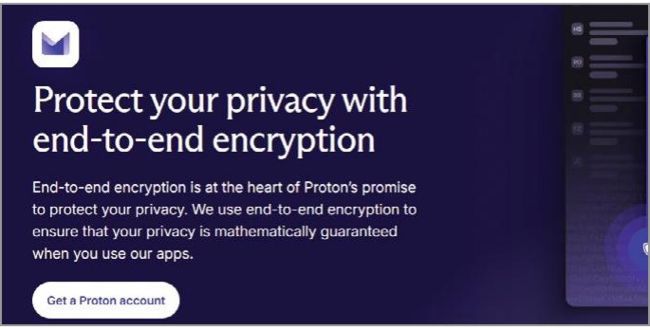
All Proton tools guarantee your privacy using end-to-end encryption
Where does Proton store users’ data?
Proton initially stored its users’ data in a former military bunker, built into a Swiss mountain under 1,000 metres of granite. When Proton Mail and the company’s other tools became popular, it moved to a larger data centre in Zurich and additional centres in Germany and Norway.
These data centres outside Switzerland allow Proton to provide a faster and more reliable service. All user data is still protected by Swiss privacy laws, and Proton says its zero-access encryption ensures your data remains private no matter where its servers are located.