AQUARIUM HUSBANDRY Botanicals
Style yourself on botanicals
For a hobby obsessed with cleanliness, the idea of filling a tank with rotting matter is anathema. But that’s just what one aquatics pioneer is suggesting.
SCOTT FELLMAN
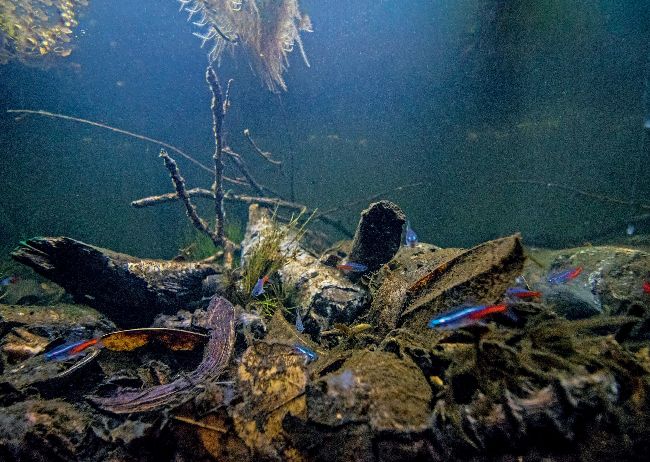
Nathan Hill’s old botanical-style aquarium in action.
THERE HAS been a definite buzz in the aquarium world recently, about what has come to be known as the ‘botanical-style aquarium’, and the chances are that you may have seen pictures of these fascinating systems, rich in life and compelling in appearance.
But what is a botanical-style aquarium? At its most simple level, it’s a system that utilizes materials from terrestrial plants to facilitate natural processes in the aquarium.
Leaves and seed pods contain many compounds, ranging from lignin to cellulose to tannins and humic substances — all of which have an impact on the aquatic environment, both structurally and chemically.
A botanical-style tank isn’t a style of aquascaping, at least not in the sense that one would classify an Iwagumi or a diorama.
Sure, botanicals create a different look in your aquarium, but their biggest selling point is that they facilitate a different set of functions in the aquarium. It’s more of a methodology than an aesthetic.
Using botanicals compels us to embrace certain natural elements that might make us uncomfortable, such as the formation of biofilms, fungi, the process of decomposition, and the accumulation of detritus.
This requires a certain mental shift.
Taking the plunge
We have two choices. We can resist Nature’s advances, and attempt to circumvent or thwart Her processes of decomposition, growth, and evolution. We can scrape away unsightly biofilms, we can remove detritus and algae. We can trim our plants to look neat and orderly.
Or, we can allow Her seemingly random, relentless march. We can make a conscious decision to embrace the biofilms, fungal growth, decomposing leaves, and tinted water. We start this by accepting the look, and continue from there.